
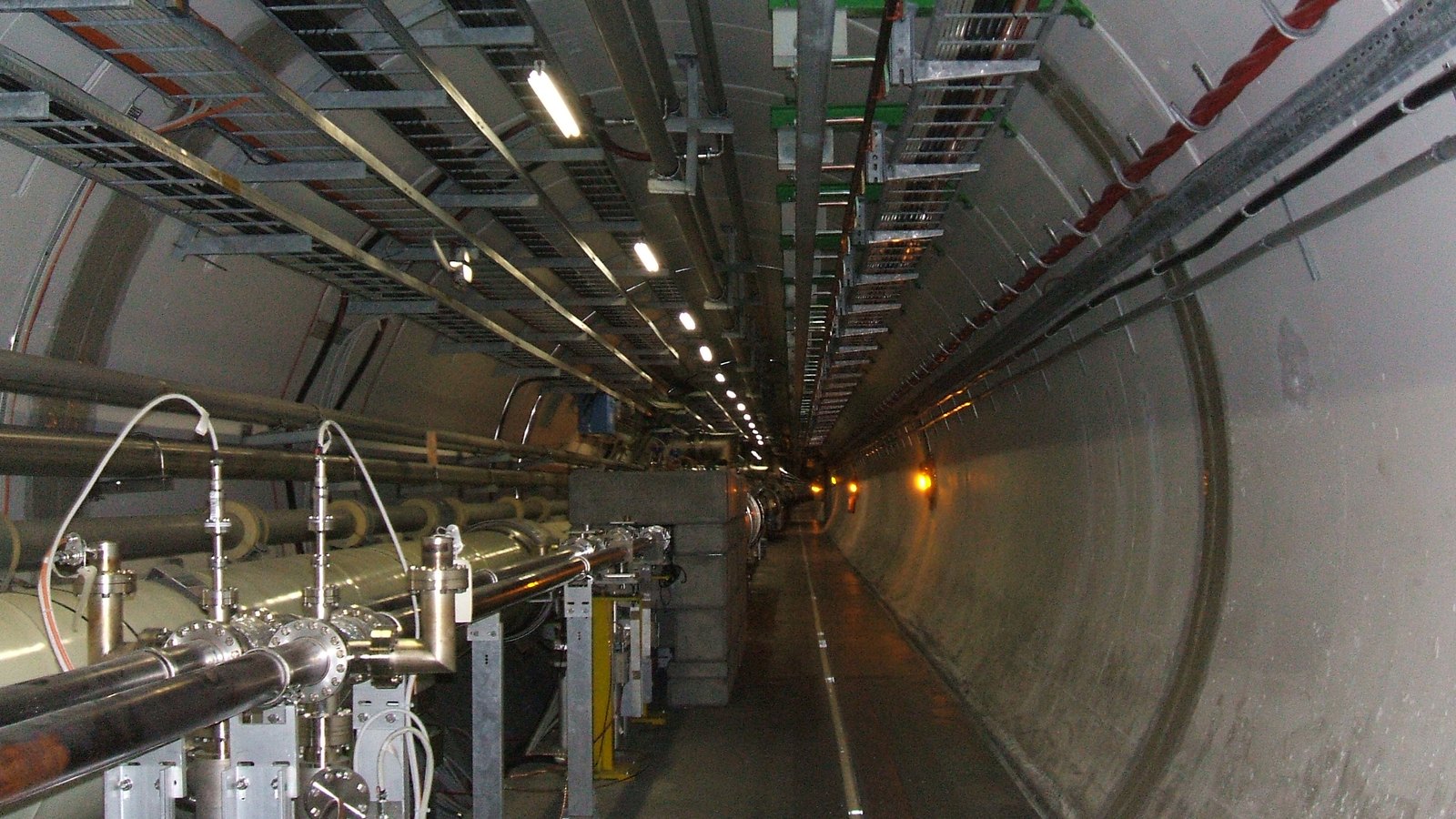
On November 19, 2026, particle physicists at CERN’s Large Hadron Collider confirmed that the LHCb collaboration documented the first single-experiment 3.2-sigma evidence for the ultra-rare decay of neutral B0 mesons into pairs of muons. The milestone validates upgraded Run 3 detector instrumentation, placing stringent constraints on physics beyond the Standard Model that directly inform experimental agendas, compute allocations, and international research infrastructure across university physics departments.
First Single-Experiment Evidence for a One-in-Ten-Billion Meson Transition
The LHCb collaboration at CERN presented landmark measurements establishing the first single-experiment evidence for the decay of a neutral beauty meson into a pair of oppositely charged muons (B0 → μ+ μ-). Neutral B0 mesons—formed from a bottom quark and a down antiquark—are produced in high abundance during proton collisions inside the Large Hadron Collider. However, their transition into two muons is heavily suppressed in the Standard Model, predicted to occur roughly once in every 10 billion decays. Analyzing proton-proton collisions recorded during 2024–2025 at 13.6 TeV, the collaboration observed a signal excess yielding 3.0 standard deviations (3.0σ) of statistical significance from Run 3 alone. Combining this sample with Run 1 (2011–2012) and Run 2 (2015–2018) legacy records raised the overall significance to 3.2σ.
In particle physics conventions, 3.0σ satisfies the recognized threshold for experimental evidence, representing a 0.3% probability of arising from random background fluctuation. While short of the 5.0σ required for formal discovery, the measurement marks the culmination of a four-decade search. The collaboration detailed its background suppression methodologies and systematic uncertainty budgets in an arXiv preprint submitted by the LHCb collaboration.
Leadership within the 19-person analysis team emphasized the technical challenge of isolating the signal. “Physicists have been chasing this decay for more than forty years,” stated Marco Santimaria of INFN Laboratori Nazionali di Frascati, who co-led the analysis. “Extreme precision is required to pick the muons out of the overwhelming background.” Harry Cliff, LHCb Rare Decays Convener and analysis co-lead affiliated with the University of Cambridge, highlighted the strategic reach: “Seeing evidence of this rare decay is incredibly exciting, opening up new possibilities to probe beyond the direct reach of the LHC. The future LHCb upgrade will allow us to observe many more of these decays, providing even greater sensitivity to undiscovered particles.”
Upgraded Detector Instrumentation and Branching Fraction Measurements
The measurement was enabled by the LHCb Upgrade I detector, which recorded 18 inverse femtobarns (fb^-1) of integrated luminosity during Run 3. Architectural improvements include a redesigned Vertex Locator (VELO) silicon pixel detector operating millimeters from the beamline, a new Upstream Tracker, and Scintillating Fibre tracking planes. The upgraded experiment operates a triggerless data acquisition system streaming collision events into an all-software GPU processing farm at the full 40 MHz bunch crossing frequency.
Alongside B0 → μ+ μ-, the team reported the world’s most precise branching fraction for the sister decay, Bs0 → μ+ μ-, and measured the Bs0 effective lifetime at 1.60 ± 0.16 (stat) ± 0.01 (syst) picoseconds, matching the theoretical prediction of 1.62 picoseconds. Researchers evaluated signal significance using mathematical frameworks detailed in CASRAI’s reference on the z-statistic to p-value connection.
The table below summarizes the reported decay observables, theoretical predictions, and experimental precision:
| Decay Observable | Standard Model Prediction | LHCb Combined Measurement (Runs 1–3) | Significance | Status |
|---|---|---|---|---|
| B0 → μ+ μ- Branching Fraction | (1.03 ± 0.05) × 10^-10 | (1.14 +0.42/-0.39 stat +0.06/-0.05 syst) × 10^-10 | 3.2σ (3.0σ Run 3) | First single-experiment evidence |
| Bs0 → μ+ μ- Branching Fraction | (3.66 ± 0.14) × 10^-9 | (3.52 ± 0.28) × 10^-9 | > 7.8σ | World most precise measurement |
| Bs0 Effective Lifetime | 1.62 ± 0.02 ps | 1.60 ± 0.16 (stat) ± 0.01 (syst) ps | Consistent | Standard Model agreement |
| Ratio R_μμ (B0 / Bs0) | 0.028 ± 0.002 | Consistent within 68% CL | Compatible | Suppression ratio verified |
Four Decades of Flavor Physics Searches and Standard Model Constraints
Flavor-Changing Neutral Current (FCNC) transitions cannot occur at tree level in the Standard Model due to the Glashow-Iliopoulos-Maiani (GIM) mechanism. They proceed solely through higher-order electroweak “penguin” and “box” quantum loops involving virtual W and Z bosons and top quarks. In addition, helicity suppression sharply restricts pseudoscalar meson decays into two muons, rendering the process exceptionally sensitive to virtual contributions from undiscovered particles like extended Higgs bosons or leptoquarks. Experimental teams evaluated signal hypotheses using the principles described in CASRAI’s guide to hypothesis testing and confidence intervals.
Early searches began in the 1980s at CLEO and ARGUS, continuing at LEP and the Tevatron. In 2015, a joint LHCb-CMS Nature publication confirmed Bs0 → μ+ μ- at 6.2σ and found initial 3.0σ evidence for B0 → μ+ μ-. However, full Run 2 datasets in 2020 saw the B0 signal dip below 2.0σ, leaving its existence unconfirmed. The Italian National Institute for Nuclear Physics outlined the historical progression in an INFN Laboratori Nazionali di Frascati rare decay bulletin.
Collaboration and University Stakeholder Reactions
Partner universities and national research councils emphasized the engineering and analytical breakthroughs enabling the result. The University of Oxford Department of Physics commentary on the 42-year search noted that UK physicists supported by the Science and Technology Facilities Council (STFC) contributed key tracking hardware and event reconstruction pipelines.
University of Manchester researchers developed the advanced machine-learning classifiers used to separate rare muon signatures from dense beam backgrounds, as reported in a ScienceDaily report on the University of Manchester findings. In theoretical physics assessments, Sci.News coverage of LHCb rare particle decay evidence highlighted that agreement between the measured branching fraction and Standard Model predictions places severe bounds on supersymmetric models and heavy vector bosons.
Implications for University Physics Programs, High-Performance Computing, and Research Infrastructure
With direct searches at 13.6 TeV revealing no new resonance peaks, experimental high-energy physics funding is increasingly concentrating on precision quantum probes. University physics departments renewing grants with the U.S. National Science Foundation, Department of Energy, and European Research Council must tailor computational and hardware requests to these high-rate precision regimes.
Operationally, handling data from the triggerless Upgrade I detector requires Tier-1 and Tier-2 university computing centers on the Worldwide LHC Computing Grid (WLCG) to deploy dedicated GPU acceleration, high-throughput storage, and scalable networking. Research offices must enforce rigorous standards for results reproducibility by preserving software environments and ntuples. Furthermore, as explored in CASRAI’s evaluation of reproducibility versus replicability, confirming a single-experiment 3.2σ evidence threshold demands eventual cross-detector replication by CMS to achieve an indisputable 5.0σ discovery.
Next Milestones: Run 3 Data Completion, Joint CMS Combination, and High-Luminosity LHC Upgrades
The LHCb collaboration will continue recording proton collisions through the conclusion of Run 3, targeting an integrated luminosity exceeding 23 fb^-1 by the end of 2026. The expanded collision sample is projected to reduce statistical uncertainties by approximately 25%.
Simultaneously, LHCb and CMS physicists are establishing a joint combination working group to perform a combined statistical analysis of Run 3 collision data. Such a combination could surpass the definitive 5.0σ discovery threshold ahead of Long Shutdown 3 in 2028. Looking further ahead, the High-Luminosity LHC (HL-LHC) starting in 2030 and the planned LHCb Upgrade II will accumulate 300 fb^-1, turning rare beauty decays into ultra-precise stress tests of fundamental physics.
Sources
- CERN: LHCb finds evidence of one-in-ten-billion particle decay, checked 2026-11-21
- arXiv: Evidence for the decay B0 -> mu+ mu- and improved measurements of the decay B0_s -> mu+ mu-, checked 2026-11-21
- University of Oxford Department of Physics: Evidence of rarest particle decay after 42-year search, checked 2026-11-21
- INFN-LNF: LHCb identifies a decay that occurs once in ten billion, checked 2026-11-21
- ScienceDaily: CERN scientists finally find evidence of a particle decay so rare it took 40 years to detect, checked 2026-11-21
- Sci.News: CERN Physicists Find Evidence of Ultra-Rare Particle Decay, checked 2026-11-21


