
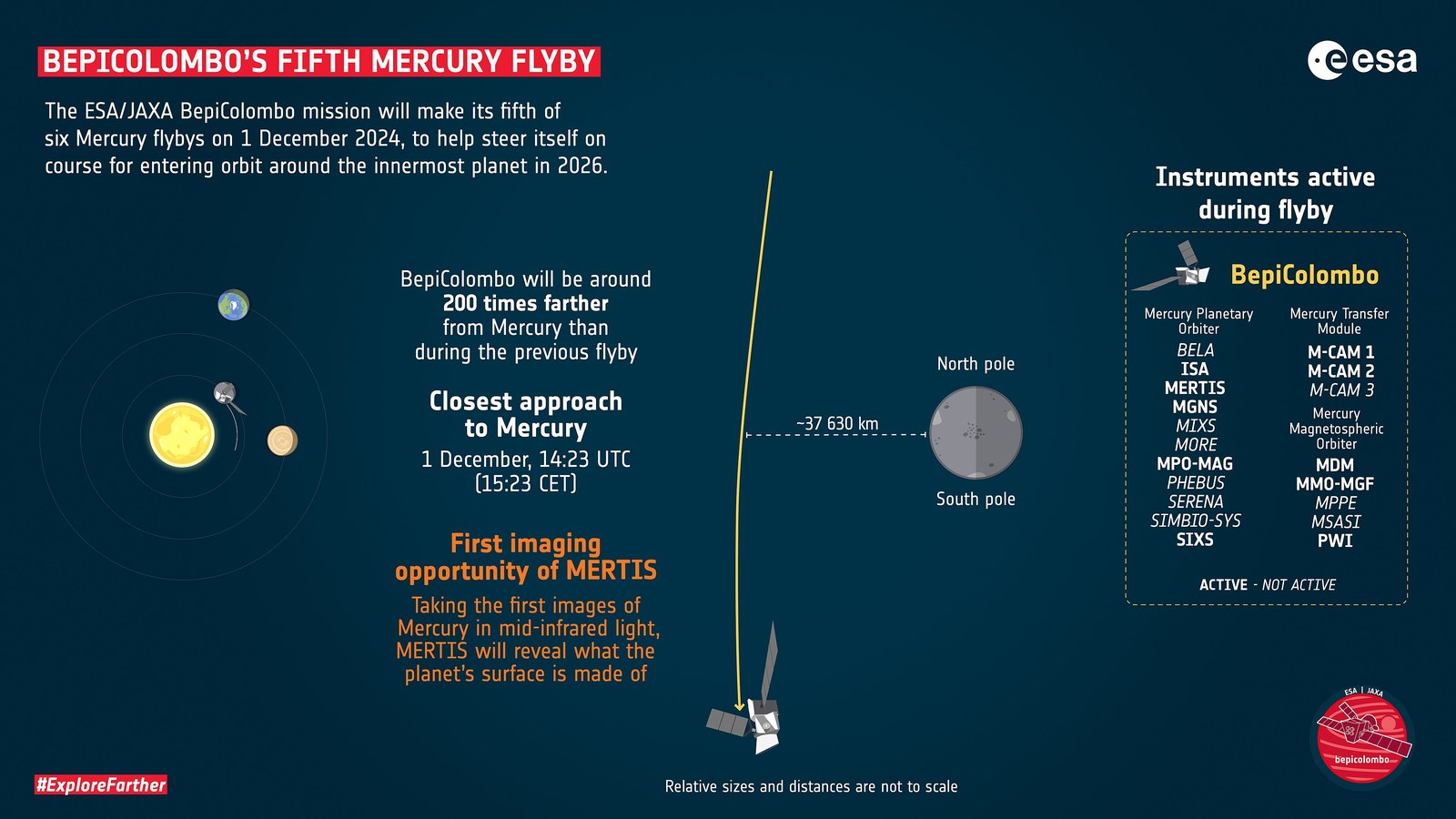
On November 20, 2026, astrophysicists and planetary scientists at the University of Leicester and the European Space Agency confirmed that the Mercury Imaging X-ray Spectrometer aboard the BepiColombo spacecraft captured its first in-flight cosmic X-ray observations of the Crab Nebula after an eight-year, 10-billion-kilometer interplanetary voyage. The calibration milestone validates novel microchannel X-ray optics ahead of orbital insertion at Mercury, establishing crucial operational baselines for university research teams, international payload consortia, and planetary data facilities preparing for upcoming geochemical surface mapping.
First cosmic light for BepiColombo X-ray spectrometer
The Mercury Imaging X-ray Spectrometer (MIXS) is the first imaging X-ray telescope deployed on a planetary science mission. Operating aboard the European Space Agency (ESA) and Japan Aerospace Exploration Agency (JAXA) BepiColombo composite spacecraft, MIXS spent eight years stowed behind the Mercury Transfer Module (MTM) following launch in October 2018 from Europe’s Spaceport in Kourou, French Guiana.
Following the planned jettison of the transfer module on September 3, 2026, MIXS gained an unobstructed view of deep space. The science team directed the instrument toward the Crab Nebula (Messier 1), a supernova remnant and pulsar located approximately 6,500 light-years away. Because the Crab Nebula emits an intense, highly stable, and catalogued flux of high-energy X-rays, astrophysicists rely on it as the primary standard candle for calibrating spaceborne X-ray detectors.
The calibration campaign ran across September 11 and 12, 2026, executing 55 spacecraft slews and collecting 39 hours of observational exposure. The sequence utilized 30-minute pointed integrations at varying offsets from the Crab pulsar, interrupted by slews to offload angular momentum from spacecraft reaction wheels. Analysis of the resulting 1-minute integration frames revealed that the telescope angular resolution matches or slightly exceeds laboratory calibration baselines recorded in Leicester in 2015 prior to flight integration.
Key mission specifications and observation metrics
The calibration data confirm that the optical assembly and focal plane arrays survived eight years of solar radiation and thermal cycles without performance degradation. The science team verified zero optical photon leakage into the detector housing, confirming the integrity of thin-film optical blocking filters designed to shield sensors from solar reflection.
The table below details the operational metrics of the Crab Nebula calibration campaign alongside the nominal Mercury science specifications.
| Parameter | Crab Nebula Calibration Baseline | Nominal Mercury Science Mission |
|---|---|---|
| Target Object | Crab Nebula (M1 supernova remnant / pulsar) | Hermæan surface regolith and exosphere |
| Target Distance | 6,500 light-years (astrophysical standard) | 400 km to 1,500 km orbital altitude (MPO) |
| Observation Window | September 11–12, 2026 (39 hours total) | Commencing April 2027 (nominal 1 Earth year) |
| Spacecraft Dynamics | 55 slews with reaction-wheel off-loading | Nadir-pointing 3-axis stabilized polar orbit |
| Spatial Resolution | Sub-arcminute angular verification | 1 km to 10 km spatial surface resolution (MIXS-T) |
| Energy Bandpass | 0.5 keV to 7.5 keV soft X-ray spectrum | 0.5 keV to 7.5 keV (fluorescent elemental lines) |
| Primary Elements Mapped | X-ray continuum and synchrotron emission | Mg, Al, Si, P, S, Ca, Ti, Cr, Mn, Fe |
| Lead Institution | University of Leicester (Space Park Leicester) | International European Consortium / UK Space Agency |
Cruise phase separation and novel lobster-eye optics
Roughly 80 percent of the technology on MIXS represents completely novel hardware. As detailed in ESA Cosmos mission documentation, the instrument suite consists of two complementary channels: MIXS-T, an imaging telescope employing microchannel plate grazing-incidence optics, and MIXS-C, a wide-field collimator providing broad flux integration without spatial imaging.
X-rays penetrate traditional reflective mirrors. MIXS-T circumvents this barrier using grazing-incidence “lobster-eye” optics, where square-pore microchannel plates reflect X-rays at glancing angles under one degree to focus photons onto cooled solid-state sensors. As reported by ScienceDaily, in-flight data confirmed that this intricate assembly maintained alignment across launch and eight years of interplanetary transit.
To quantify elemental abundances from fluorescent X-rays emitted by Mercury’s crust, MIXS operates in tandem with the Solar Intensity X-ray and particle Spectrometer (SIXS), an external monitor supplied by the University of Helsinki. SIXS measures real-time solar X-ray flares and charged particle fluxes, providing the solar illumination reference required to normalize MIXS spectral readings.
Mission team and consortium reaction
The successful first-light observations triggered celebrations across the University of Leicester and partner institutes in the United Kingdom, Finland, Spain, Germany, and France.
Professor Emma Bunce, principal investigator for MIXS and Director of the Institute for Space at the University of Leicester, emphasized the engineering resilience of the payload: “We have waited a long time to make measurements with MIXS and it is fantastic to see it operating brilliantly in space. This is testament to our engineering and technical team, and our international partners who we have worked with over many years to build this incredible instrument. Eighty percent of the technology on MIXS is new. During our calibration observations we have determined that MIXS is generally performing fantastically well in space. We have no effects in our images that are associated with stray light. The detector has suffered no radiation damage after eight years in space.”
Bunce also paid tribute to the late Professor George Fraser, who led MIXS development until his death in 2014: “We are thinking of George as we operate MIXS fully in space for the first time and know that he would be very, very proud of the team and delighted at our first light observations.”
Dr. Adrian Martindale, MIXS Instrument Scientist at Leicester, added: “BepiColombo, and MIXS in particular, are like part of my family. I have been involved since I was an undergraduate and touched almost every part of the instrument before it was launched. This first data is mind-blowing to me. The last time we could see through this telescope it was in the basement under the School of Physics and Astronomy in Leicester, but after a rocket launch, eight years in space and 10 billion kilometres travelled it looks just the same.”
What it means for researchers, universities, and research offices
The operational validation of MIXS provides actionable insights for university research offices, space science departments, and investigators managing long-baseline international instruments:
- Decadal lifecycle and grant administration: Deep-space missions demand sustained administrative support across multi-year cruise phases. Research offices must preserve technical documentation, manage funding renewals across grant cycles, and nurture early-career researchers into permanent scientific leadership roles.
- Calibration pipelines and technical metadata standards: Establishing the in-flight point spread function enables science ground teams to compile precise response matrices. Data managers must record pointing attitudes, slew angles, and detector temperatures as standardized technical metadata to ensure raw telemetry translates accurately into calibrated physical units.
- Data curation and noise reduction: Measuring planetary surface fluorescence requires automated data curation workflows to separate genuine geological signals from galactic cosmic rays and solar particle backgrounds.
- Consortium governance and open science: Large planetary instruments rely on multilateral agreements between universities, national agencies, and contractors. Aligning mission data policies with open science repositories ensures global research access once proprietary validation periods expire.
Next steps toward orbit insertion and science operations
The Crab Nebula campaign leads directly into BepiColombo’s arrival sequence at Mercury. According to the European Space Agency mission overview, the spacecraft stack begins gravitational capture and orbital insertion on November 21, 2026.
Between December 9 and 10, 2026, flight controllers at the European Space Operations Centre (ESOC) in Darmstadt, Germany, will separate the two scientific orbiters: ESA’s Mercury Planetary Orbiter (MPO) and JAXA’s Mercury Magnetospheric Orbiter (MMO / Mio). Dedicated thruster firings will then maneuver each craft into its operational orbit, with MPO descending to a 400-by-1,500 km polar orbit for surface mapping.
The Leicester team will conduct comprehensive orbital commissioning through early 2027 to fine-tune detector voltages and background filtering. Nominal science operations will begin in April 2027, launching a one-year primary survey to map surface elemental distributions across Mercury’s volcanic plains, impact craters, and polar hollows.
Sources
- Space Park Leicester: BepiColombo MIXS: First X-ray Images from Mercury Mission, checked 2026-11-21
- ESA Cosmos: COSMOS MIXS – BepiColombo – Cosmos, checked 2026-11-21
- ScienceDaily: After 8 years in space, a groundbreaking X-ray telescope finally opens its eyes, checked 2026-11-21
- European Space Agency: BepiColombo overview, checked 2026-11-21


