
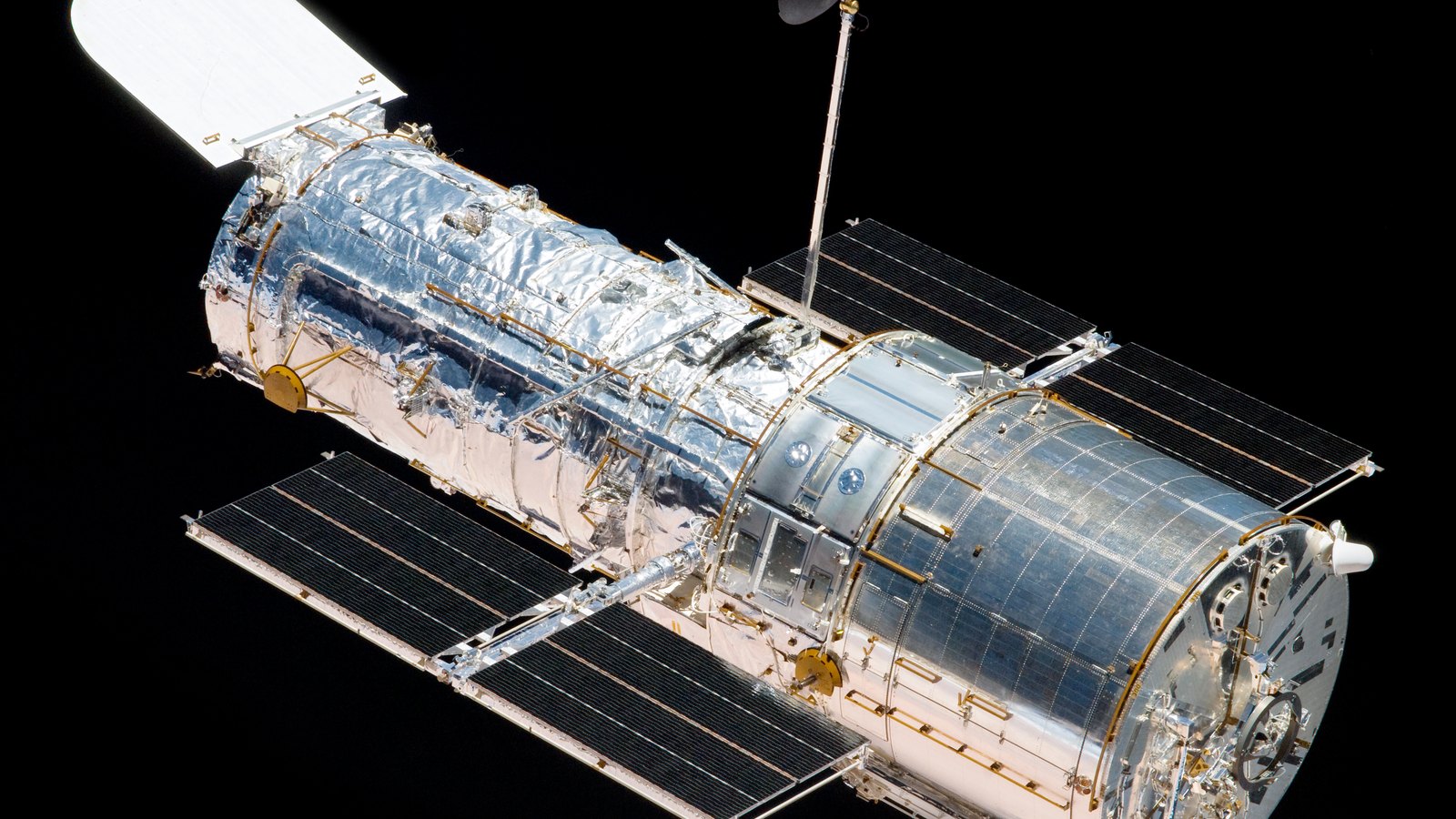
NASA has released an official Request for Information asking commercial aerospace vendors and academic research institutions to submit operational concepts to reboost, service, or safely deorbit the Hubble Space Telescope, providing university astrophysics departments and research offices with critical timeline projections as the premier optical observatory faces atmospheric orbital decay in the early 2030s (NASA Science).
Commercial Solicitation and Orbital Decay Parameters
Issued by NASA Goddard Space Flight Center under procurement notice 80GSFC27RFIHSTS, the market-research solicitation explores whether commercial in-space servicing capabilities can extend Hubble’s operating life. Operating in low Earth orbit since 1990 without onboard propulsion, the 11,110-kilogram observatory suffers continuous altitude degradation from thermospheric drag. Deployed at 610 kilometers and periodically boosted by space shuttle crews, Hubble has descended below 515 kilometers, with atmospheric drag accelerating during solar cycle maximums.
NASA flight dynamics assessments project a 10 percent probability of uncontrolled atmospheric entry by September 2032 and a 50 percent probability by December 2033. Because uncontrolled re-entry of Hubble’s 2.4-meter primary mirror and heavy structural elements creates terrestrial risk, NASA specified that any commercial intervention must occur by 2032. The RFI establishes a response deadline of 3:00 p.m. EST on November 30, 2026, inviting non-binding technical architectures across three distinct tracks.
Key Details of the Three Mission Architecture Tracks
The solicitation partitions potential commercial engagements into three operational pathways, allowing vendors to address individual capabilities or integrated solutions:
- Track 1: Orbital Reboost: Grappling Hubble and elevating its altitude to at least 600 kilometers, extending active scientific life by 15 to 20 years.
- Track 2: On-Orbit Servicing: Conducting robotic or crew-tended maintenance to inspect thermal insulation, replace failing gyroscopes, or augment attitude control precision.
- Track 3: Controlled Deorbit: Attaching a dedicated propulsion module to guide the decommissioned observatory into an unpopulated ocean impact corridor.
NASA Goddard outlined core benchmarks governing submissions across the three tracks:
| Mission Architecture Track | Primary Technical Objective | Target Orbital Parameters | Latest Mission Execution Window |
|---|---|---|---|
| Track 1: Reboost | Autonomous or robotic elevation | Raise altitude to at least 600 km | Mid-2032 (prior to drag threshold) |
| Track 2: Servicing | Gyroscopic or attitude maintenance | Maintain stable 3-axis pointing precision | Concurrent with reboost or by 2030 |
| Track 3: Controlled Disposal | Targeted atmospheric descent | Guided descent into remote maritime zone | Late 2033 to mid-2034 |
Commercial respondents must supply the launch vehicle, rendezvous spacecraft, proximity operations sensors, and mission control systems. NASA Goddard will furnish historical telemetry, engineering models, and docking interfaces, while the Space Telescope Science Institute coordinates scientific operations.
Background, Previous Feasibility Studies, and Technical Constraints
Between 1993 and 2009, NASA conducted five space shuttle servicing missions. During Servicing Mission 4 in 2009, astronauts installed the Soft Capture Mechanism (SCM) on Hubble’s aft bulkhead, providing a standardized low-impact docking ring designed specifically for future robotic capture after shuttle retirement.
In late 2022, NASA Goddard issued a preliminary RFI, leading to an unfunded feasibility study with SpaceX and the Polaris Program to examine reboosting Hubble using a modified Crew Dragon. NASA chose not to advance that concept in 2024, citing concerns over crew safety, thruster plume contamination on optical coatings, and proximity risks. However, recent advances in commercial satellite servicing prompted NASA to re-examine industry readiness.
Current space situational awareness data confirms that solar activity has expanded Earth’s thermosphere, heightening drag across low Earth orbit. Without thrusters, Hubble relies on reaction wheels and magnetic torquers for pointing, making external propulsion the only viable method for altitude restoration.
Stakeholder Perspectives and Leadership Commentary
Agency leadership emphasized that market research evaluates technical options without committing federal funds. “Hubble still has important science ahead of it, and we should be looking at every reasonable opportunity to keep it delivering for as long as possible,” said NASA Administrator Jared Isaacman. “If there are innovative and cost-effective ways to extend the life of an asset already on orbit, we owe it to the American taxpayer and the scientific community to explore them. Extending Hubble’s life would mean more discoveries, more science, and more opportunities to expand our understanding of the universe.”
Nicky Fox, Associate Administrator for NASA’s Science Mission Directorate, noted the strategic value of industry maturation: “Hubble is a national icon that has fundamentally changed how humanity views our universe for more than 35 years. Commercial industry has rapidly evolved in recent years to offer new capabilities for in-space satellite capture and servicing. Given the time we have until Hubble’s anticipated re-entry, we are eager to explore the breadth of possibilities to boost Hubble to a higher orbit while we develop the flagship mission to follow.”
Sector analyses observe that pairing disposal options with reboost concepts provides NASA with programmatic risk mitigation (The Talk of Titusville). Industry observers highlighted that the 2026 RFI prioritizes robotic tugs over crewed concepts to reduce mission risk (SpaceNexus). Trade coverage emphasized that responses will benchmark commercial pricing models for large-scale orbital life extension (NeoTeo).
Implications for University Researchers and Sponsored Projects Offices
For academic astronomy departments and university sponsored projects offices, Hubble’s orbital timeline directly influences observation scheduling, grant management, and multi-observatory campaigns. Science operations, directed by the Space Telescope Science Institute (STScI) through AURA, continue via the STScI proposing portal across annual Guest Observer (GO) cycles.
Key operational impacts include:
- Guest Observer Grant Lifecycle Planning: Principal investigators awarded HST observing time receive research grant funding through NASA astrophysics programs. As orbital decay accelerates, observation scheduling faces compressed visibility windows. Sponsored projects offices must monitor performance periods, preparing for project modifications or no-cost extensions if observation timelines shift under federal grant rebudgeting rules.
- Ultraviolet Capability Continuity: Hubble remains the only high-resolution observatory providing ultraviolet spectroscopy and imaging via the Cosmic Origins Spectrograph and Wide Field Camera 3. Because the James Webb Space Telescope operates in the infrared, a premature Hubble deorbit would leave astronomy without space-based ultraviolet capabilities until the Habitable Worlds Observatory launches in the late 2030s.
- Public-Private Collaboration Agreements: University space centers evaluating teaming arrangements with aerospace contractors must navigate intellectual property and data rights. Commercial partnership frameworks frequently employ Cooperative Research and Development Agreements (CRADA) or Space Act Agreements, requiring technology transfer offices to review proprietary protections and export control compliance.
- Archival Data Stewardship: Under NASA open science standards, all HST calibrations and observations are preserved in the Mikulski Archive for Space Telescopes (MAST), requiring ongoing data management support for university researchers.
Next Steps and Procurement Milestones
Commercial vendors and academic institutions must submit capability statements by November 30, 2026, at 3:00 p.m. EST. NASA Goddard will assess technical feasibility, safety protocols, and cost structures during the first quarter of 2027.
If viable concepts emerge, NASA may release a formal solicitation in 2027 or 2028. Any servicing spacecraft must complete qualification by 2031 to meet the 2032 operational window, securing Hubble’s scientific mission before atmospheric decay compromises flight control authority.
Sources
- NASA Science: NASA Explores Potential Commercial Servicing for Hubble Telescope, checked 2026-11-24
- SAM.gov: Hubble Space Telescope (HST) Servicing Request for Information (Notice ID 80GSFC27RFIHSTS), checked 2026-11-24
- Space Telescope Science Institute: Proposing and Hubble Science Operations, checked 2026-11-24
- The Talk of Titusville: NASA Seeks Solutions to Save Hubble Space Telescope, checked 2026-11-24
- SpaceNexus: Hubble’s Second Rescue Call: NASA’s October 29 RFI Tests Whether Commercial Servicing Has Matured, checked 2026-11-24
- NeoTeo: NASA’s Hubble Reboost RFI: Options and Deadline, checked 2026-11-24






