
On November 24, 2026, the Department of the Navy formally submitted a revised information collection for the Navy Family Accountability and Assessment System to the Office of Management and Budget under Federal Register Notice 2026-23903. The emergency reporting framework establishes mandatory disaster accounting for personnel, civilian staff, and Outside the Continental United States contractors, directly impacting defense researchers and university personnel assigned to overseas naval research facilities and field trials.
Federal Register Submission of OMB Control Number 0703-0091
The Department of the Navy published a 30-day notice on November 24, 2026, in the Federal Register Notice 2026-23903 under Docket ID USN-2026-HQ-0463, formally requesting OMB approval for a revision of OMB Control Number 0703-0091. Issued under the Paperwork Reduction Act of 1995, the submission covers the Navy Family Accountability and Assessment System (NFAAS). Alternate OSD Federal Register Liaison Officer Aaron T. Siegel authorized the notice, establishing a public comment deadline of December 24, 2026.
The collection is legally grounded in Department of Defense Instruction (DoDI) 3001.02, “Personnel Accountability in Conjunction with Natural or Manmade Disasters,” and Office of the Chief of Naval Operations Instruction (OPNAVINST) 3006.1, “Personnel Accountability in Conjunction with Catastrophic Events.” NFAAS achieves comprehensive accountability following severe storms, earthquakes, man-made incidents, or armed conflicts, covering active-duty military, reservists, Navy civilian staff, Nonappropriated Fund (NAF) personnel, Navy Exchange (NEX) employees, Outside the Continental United States (OCONUS) contractors, and their dependents.
Beyond baseline headcounts, NFAAS allows naval commands to assess disaster impacts on mission readiness and direct targeted recovery support to displaced families. The tool also provides continuity monitoring for sponsors and families during Sailor Individual Augmentation deployments across overseas operational commands.
Operational Scope, Response Burdens, and OCONUS Contractor Mandates
Under the Paperwork Reduction Act submission, the Navy provided annual burden calculations reflecting public respondents subject to the collection. Active-duty military personnel are excluded from PRA burden accounting; therefore, the published estimates reflect civilian personnel, OCONUS contractors, and household dependents.
| Reporting Metric | Submission Specification | Statutory and Regulatory Basis |
|---|---|---|
| Annual Public Respondents | 6,956 individuals | DoD civilian staff, OCONUS contractors, and household dependents |
| Response Frequency | 2 responses per respondent annually | Semi-annual verification window and post-disaster accountability muster |
| Total Annual Responses | 13,912 submissions | Standard semi-annual profile validations and event reporting |
| Average Response Time | 3 minutes per submission | Electronic authentication, contact update, and safety muster |
| Total Annual Burden Hours | 696 hours | Cumulative compliance commitment under OMB Control No. 0703-0091 |
| Affected Public Category | Individuals or households | Paperwork Reduction Act public classification |
| Contractor Inclusion Scope | OCONUS defense contractors only | CONUS-based defense contractors explicitly excluded |
Reporting takes place through the Navy Family Accountability and Assessment System portal, where affiliated individuals verify contact numbers, current physical locations, and dependent records. When a disaster strikes, personnel in the affected geographic area log in or contact command muster officers to confirm safety. Affected individuals can submit an integrated Needs Assessment Survey across 19 recovery categories, encompassing temporary housing, transport, medical access, and legal services.
Historical Origins and Inter-Service Emergency Accountability Frameworks
The Navy accountability framework was created following Hurricane Katrina in 2005. As recorded in the Office of Management and Budget clearance history maintained by the OMB Office of Information and Regulatory Affairs ICR Review, naval leadership previously lacked a centralized tool to locate displaced personnel across damaged Gulf Coast installations.
Katrina scattered thousands of military members, civilian employees, and technical contractors across multiple states, exposing vulnerabilities in paper-based telephone trees. NFAAS replaced those legacy methods with an integrated web platform and mobile application connecting individual reporting with regional installation support centers.
The Navy filing coincides with a companion Department of Defense notice published on the same day. In Federal Register Document 2026-23901, the Department of the Air Force submitted a 60-day proposed information collection notice (Docket ID USAF-2026-HQ-0133, OMB Control No. 0701-0173) for its Fire Emergency Services Information Management System (FES-IMS). The Air Force system tracks emergency personnel, including civil engineering contractors and foreign national staff at OCONUS installations, demonstrating a broader Pentagon drive for comprehensive visibility over non-military workforces operating abroad.
Installation Readiness Exercises and Emergency Preparedness
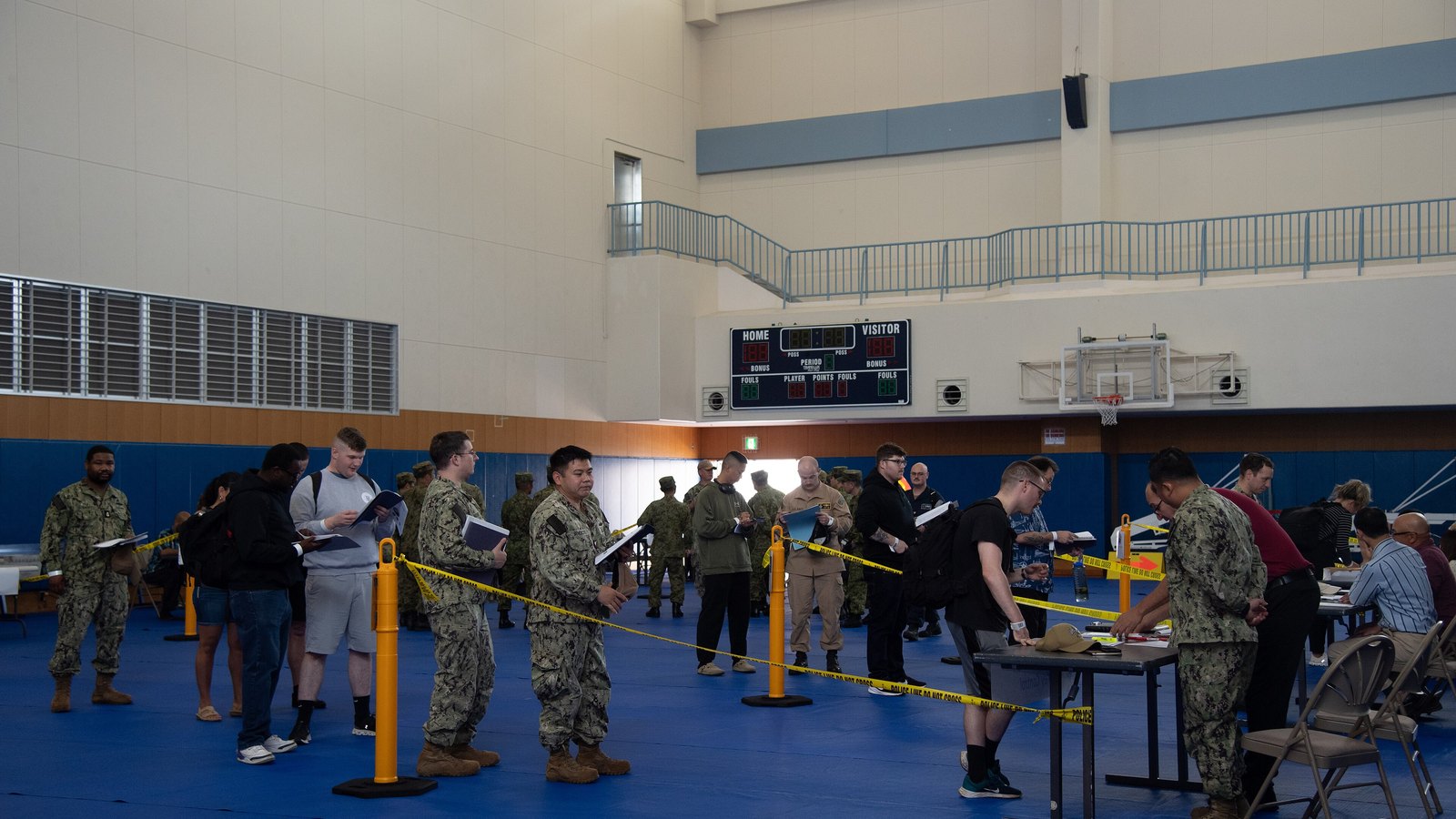
Naval commands continuously evaluate accountability systems through mandatory full-scale drills. Regions participate in annual exercises, such as Hurricane Exercise Citadel Gale in the Atlantic and Citadel Pacific across Indo-Pacific bases, verifying communications infrastructure before severe weather events occur.
Operational evaluations documented through the Pearl Harbor Naval Shipyard emergency preparedness initiatives on the Defense Visual Information Distribution Service illustrate how installations use recurring drills to maintain emergency readiness. Facility leadership emphasizes that maintaining current contact rosters for civilian and contractor workforces is essential for rapid search-and-rescue execution, hazardous material controls, and facility recovery.
During simulated disasters, command coordinators must account for military, civilian, and OCONUS contractor personnel within designated timeframes. Commands that detect communication failures or outdated contact records must implement corrective procedures, enforcing compliance with semi-annual update requirements.
Compliance Implications for Defense Researchers, Universities, and Overseas Contractors
OMB Control Number 0703-0091 establishes direct operational requirements for universities, defense laboratories, and commercial vendors executing research contracts abroad. Although domestic contractors based in the United States are exempt from NFAAS, personnel deployed OCONUS—including oceanographic researchers, technical staff at overseas naval medical research units, and contractors at joint testing stations—are subject to mandatory registration.
University sponsored research offices and defense prime contractors must establish procedures ensuring that faculty, postdocs, and technical specialists sent overseas maintain active NFAAS records. Academic administrators must align emergency muster obligations with their institutional research security frameworks to safeguard personnel during foreign deployments.
Institutional compliance leaders and each appointed research security officer must incorporate OCONUS muster protocols into international travel oversight. While recent federal initiatives like the USDA research security training requirement and the DOE research security training requirement address research integrity, foreign influence, and cybersecurity, NFAAS governs the physical protection and accountability of defense research personnel abroad.
University research administrators must confirm that personnel deployed to overseas naval stations fulfill reporting responsibilities under DoDI 3001.02 during crises. Maintaining updated profiles in NFAAS ensures rapid coordination of military transport, medical evacuation, and disaster relief during emergencies.
Public Comment Timeline and Federal Implementation Milestones
The Navy notice opens a 30-day public comment period through December 24, 2026. Interested institutions, defense contractors, research universities, and workforce representatives may submit recommendations to OMB’s Office of Information and Regulatory Affairs through the federal Paperwork Reduction Act portal.
Public feedback is invited on whether the collection is essential for Navy disaster response functions, the accuracy of the agency’s burden estimates, measures to improve data quality, and methods to reduce administrative overhead through automated systems. OMB will review comments and issue a Notice of Action determining whether to grant a three-year extension for OMB Control Number 0703-0091.
Navy installations and overseas research centers are preparing for the first semi-annual NFAAS verification cycle of 2027, when all covered personnel and OCONUS contractors must log in to validate their emergency information. Research institutions with overseas naval commitments should audit deployed personnel rosters to ensure compliance with naval emergency directives.
Sources
- Federal Register: Submission for OMB Review; Comment Request (Document 2026-23903, Docket ID USN-2026-HQ-0463), checked 2026-11-29
- Federal Register: Proposed Collection; Comment Request (Document 2026-23901, Docket ID USAF-2026-HQ-0133), checked 2026-11-29
- Office of Information and Regulatory Affairs: View Information Collection Request (ICR) Package (OMB Control No. 0703-0091), checked 2026-11-29
- Defense Visual Information Distribution Service: Pearl Harbor Naval Shipyard Promotes Community Resiliency through Emergency Preparedness, checked 2026-11-29
- Commander, Navy Installations Command: Navy Family Accountability and Assessment System (NFAAS), checked 2026-11-29






