
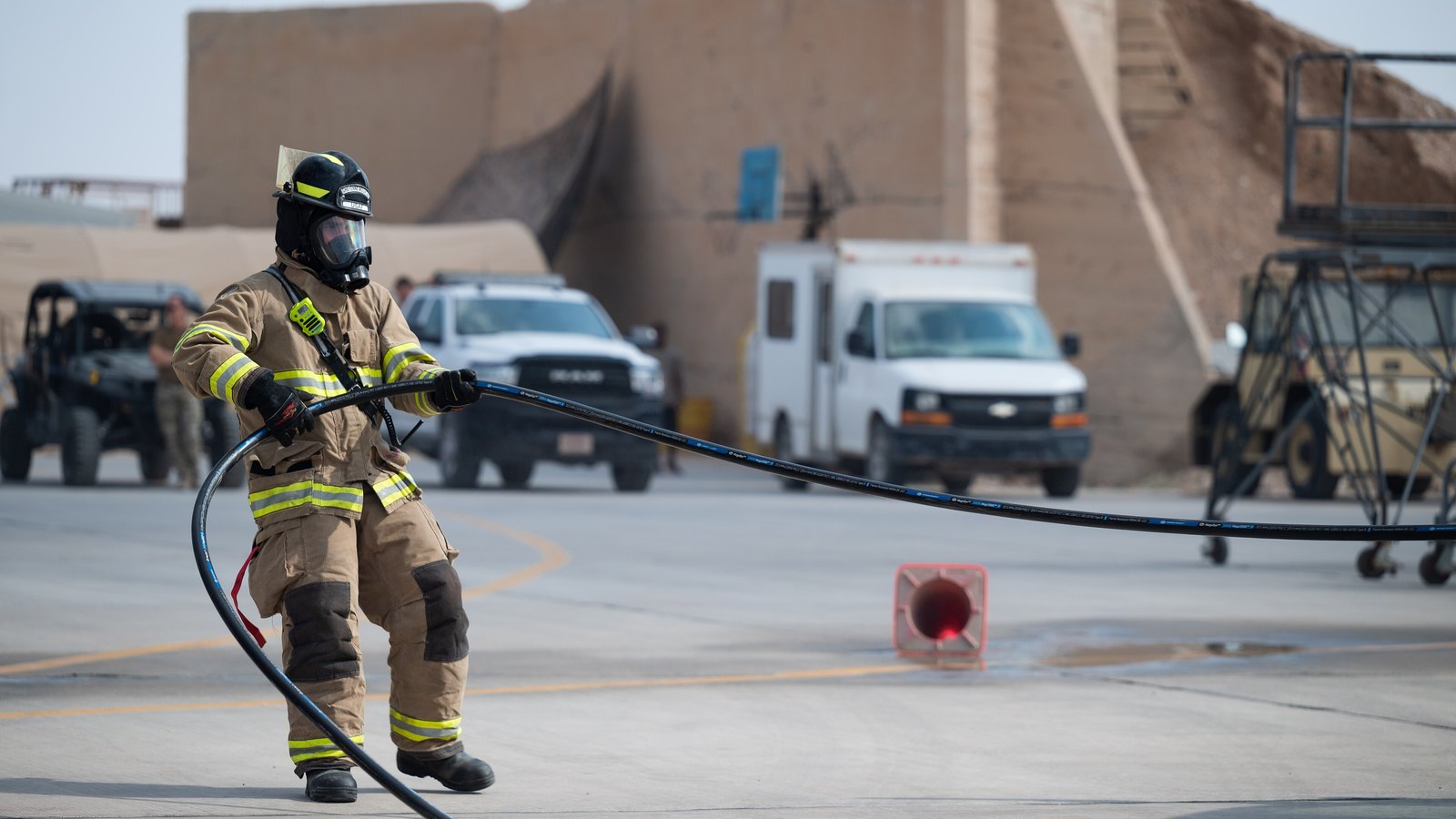
The Department of the Air Force published a 60-day notice on November 24, 2026, initiating public review for its Fire and Emergency Services Information Management System under OMB Control Number 0701-0173. Administered under Air Force Civil Engineer oversight, the system standardizes emergency dispatch, training records, and personnel accountability across military installations, directly affecting academic research centers and defense contractors operating specialized laboratories on military facilities.
Air Force Notice on FES-IMS Emergency Data Collection
The Department of the Air Force and the Office of the Secretary of Defense issued a 60-day information collection notice under the Paperwork Reduction Act of 1995 to renew authorization for the Fire Emergency Services Information Management System, designated by the Air Force Directorate of Civil Engineers (AF/A4C) under Docket ID USAF-2026-HQ-0133. The proposed extension covers the personnel data collection instrument assigned Office of Management and Budget (OMB) Control Number 0701-0173, maintaining the digital infrastructure that tracks fire department personnel, emergency dispatch rosters, and training credentials across military installations worldwide.
According to the notice signed by Alternate OSD Federal Register Liaison Officer Aaron T. Siegel, the information collection applies to approximately 2,000 respondents annually. Each respondent completes a single submission on occasion, requiring an estimated average burden of 15 minutes (0.25 hours), resulting in a cumulative annual reporting burden of 500 hours across the defense enterprise. The data collection is coordinated operationally through the Air Force Life Cycle Management Center (AFLCMC) located at Maxwell Air Force Base-Gunter Annex in Alabama.
The personnel profile collection is conducted through a structured 26-question interview at each respondent’s respective duty location. The intake interview is administered in person by a uniformed military member or Department of Defense civilian specifically assigned the FES-IMS “Core Data” collection role. This in-person validation ensures that identity verification, assigned duties, emergency response roles, and professional firefighting qualifications are authenticated before access credentials and system accounts are generated.
Key Parameters and Administrative Burden Metrics
The FES-IMS platform establishes an enterprise baseline for tracking personnel profiles, shift rosters, operational readiness, and incident response histories. System accounts are mandatory for personnel supporting installation fire departments, including Air Force Active Duty members, Air National Guard personnel, Air Force Reserve units, Department of the Air Force civilians, and commercial civil engineering contractors. At overseas installations classified as outside the contiguous United States (OCONUS), the covered population explicitly includes foreign national personnel employed at U.S. military facilities.
In addition to basic administrative account management, FES-IMS logs daily emergency dispatch logs, tracks mandated recurring certifications in structural and aircraft firefighting, monitors emergency medical technician (EMT) credentials, and generates formal after-action reports following emergency incidents. The system provides immediate situational visibility to installation commanders regarding available response capacity, specialized rescue equipment, and certified hazardous material response teams.
| System Parameter | Regulatory Standard | Operational Specification |
|---|---|---|
| Federal Docket Identifier | USAF-2026-HQ-0133 | Department of the Air Force 60-day notice |
| OMB Control Number | 0701-0173 | Public information collection extension |
| Program Directorate | Air Force AF/A4C | Logistics, Engineering and Force Protection |
| Managing Center | AFLCMC / Maxwell AFB | Air Force Life Cycle Management Center |
| Annual Respondent Pool | 2,000 individuals | Military, civilian, and contractor personnel |
| Response Frequency | On occasion (single intake) | 1 response per respondent annually |
| Average Response Time | 15 minutes (0.25 hours) | Face-to-face structured interview |
| Total Annual Burden | 500 burden hours | Federally approved compliance estimate |
| Collection Instrument | 26-question intake profile | Administered by certified Core Data collectors |
| Geographic Reach | CONUS and OCONUS | Domestic bases and overseas installations |
| Public Comment Window | 60 calendar days | Written submissions due January 25, 2027 |
Statutory Framework and Defense Emergency Architecture
The regulatory authority underpinning the FES-IMS architecture derives from federal statutory requirements governing federal fire safety and paperwork administration. Federal agencies are mandated under the Federal Fire Prevention and Control Act codified at 15 U.S.C. Chapter 49 to maintain effective fire suppression capabilities, professional responder qualifications, and standardized reporting mechanisms across all federally owned facilities. This mandate works alongside the Paperwork Reduction Act of 1995, which requires formal OMB review and public evaluation of federal information collection burdens every three years.
Policy leadership for the Air Force fire service is centered at the Air Force Civil Engineer Center Fire and Emergency Services Division, located within the AFCEC Readiness Directorate. The division establishes enterprise standards, oversees career-field training, directs apparatus procurement, and defines operational safety standards across the service branch. AFCEC synchronizes fire readiness guidelines with Department of Defense instructions and ensures compliance with criteria established by the National Fire Protection Association (NFPA) and the International Fire Service Accreditation Congress (IFSAC).
Historically, military installations managed emergency dispatch logs and training certifications through decentralized physical logs and localized legacy databases. The deployment of FES-IMS unified these functions into a single enterprise system, ensuring that firefighter qualifications, specialized aircraft rescue and firefighting (ARFF) ratings, and hazardous materials response certifications remain fully verifiable across joint bases and combatant commands.
Cross-Agency Coordination and Interoperability Standards
Emergency response operations on military installations operate in close coordination with civilian and interagency emergency management frameworks. The Air Force aligns incident reporting formats within FES-IMS to match data specifications set by the National Fire Incident Reporting System, which is administered by the U.S. Fire Administration under the Federal Emergency Management Agency (FEMA). Standardizing incident classification codes enables defense installations to share emergency data seamlessly with local municipal fire departments operating under mutual aid agreements.
For external contractors and university research centers performing work under defense contracts, institutional compliance and administrative coordination are typically supervised through the institution’s designated cognizant federal agency. This administrative oversight ensures that emergency management plans, personnel safety tracking, and defense facility access protocols satisfy Department of Defense instructions and federal reporting standards without duplicating compliance mechanisms.
Implications for University Defense Labs and Research Facilities
While FES-IMS serves military fire departments directly, the system holds direct operational implications for university-affiliated research centers (UARCs), federally funded research and development centers (FFRDCs), and academic engineering laboratories operating on or adjacent to Air Force bases. Academic institutions frequently conduct defense research involving advanced aerospace propulsion, hypersonic wind tunnels, energetic chemical compounds, high-power lasers, and unmanned systems testing at major Air Force test ranges and research campuses, including Wright-Patterson, Eglin, Edwards, and Kirtland Air Force Bases.
When university personnel, principal investigators, postdoctoral researchers, and technical staff manage physical experimental facilities located within base perimeters, base emergency services must maintain up-to-date hazard inventories and emergency contact rosters. Personnel collaborating with base civil engineering departments or emergency services must meet federal identification and background vetting requirements. The inclusion of foreign national contractors and civilian personnel in FES-IMS highlights the heightened scrutiny applied to installation access and institutional protocols governing research security across defense laboratories.
Furthermore, experimental testing involving hazardous substances, toxic propellants, or reactive chemical synthesis requires strict environmental health and safety coordination with installation fire marshals. Research universities operating dual-use laboratories must align on-site emergency procedures, chemical storage inventories, and hazardous byproduct disposal with military fire prevention standards. Conducting periodic safety evaluations comparable to an institutional lab waste audit ensures that laboratory hazardous materials classifications match the response capabilities and dispatch records maintained by installation emergency services.
From an administrative perspective, university sponsored programs offices managing Department of the Air Force contracts must maintain robust documentation of laboratory safety, environmental management, and facility overhead costs. Aligning facility emergency protocols with federal compliance expectations ensures that emergency management costs and specialized facility charges remain fully defensible during federal single audits, referencing the testing and audit criteria established in the OMB compliance supplement.
Public Comment Timeline and OMB Review Pathway
The publication of the 60-day notice marks the first formal stage of the public review process under the Paperwork Reduction Act. The Department of the Air Force has established a comment deadline of January 25, 2027. Members of the public, defense contractors, professional emergency responder organizations, and academic institutions may submit written comments through the Federal eRulemaking Portal at Regulations.gov by searching for Docket ID USAF-2026-HQ-0133.
Sources
- Federal Register: Proposed Collection; Comment Request (Department of the Air Force, Docket USAF-2026-HQ-0133), checked 2026-11-29
- Air Force Civil Engineer Center: Fire and Emergency Services, checked 2026-11-29
- U.S. Fire Administration: National Fire Incident Reporting System, checked 2026-11-29
- Cornell Law School Legal Information Institute: 15 U.S. Code Chapter 49 – Federal Fire Prevention and Control, checked 2026-11-29






