
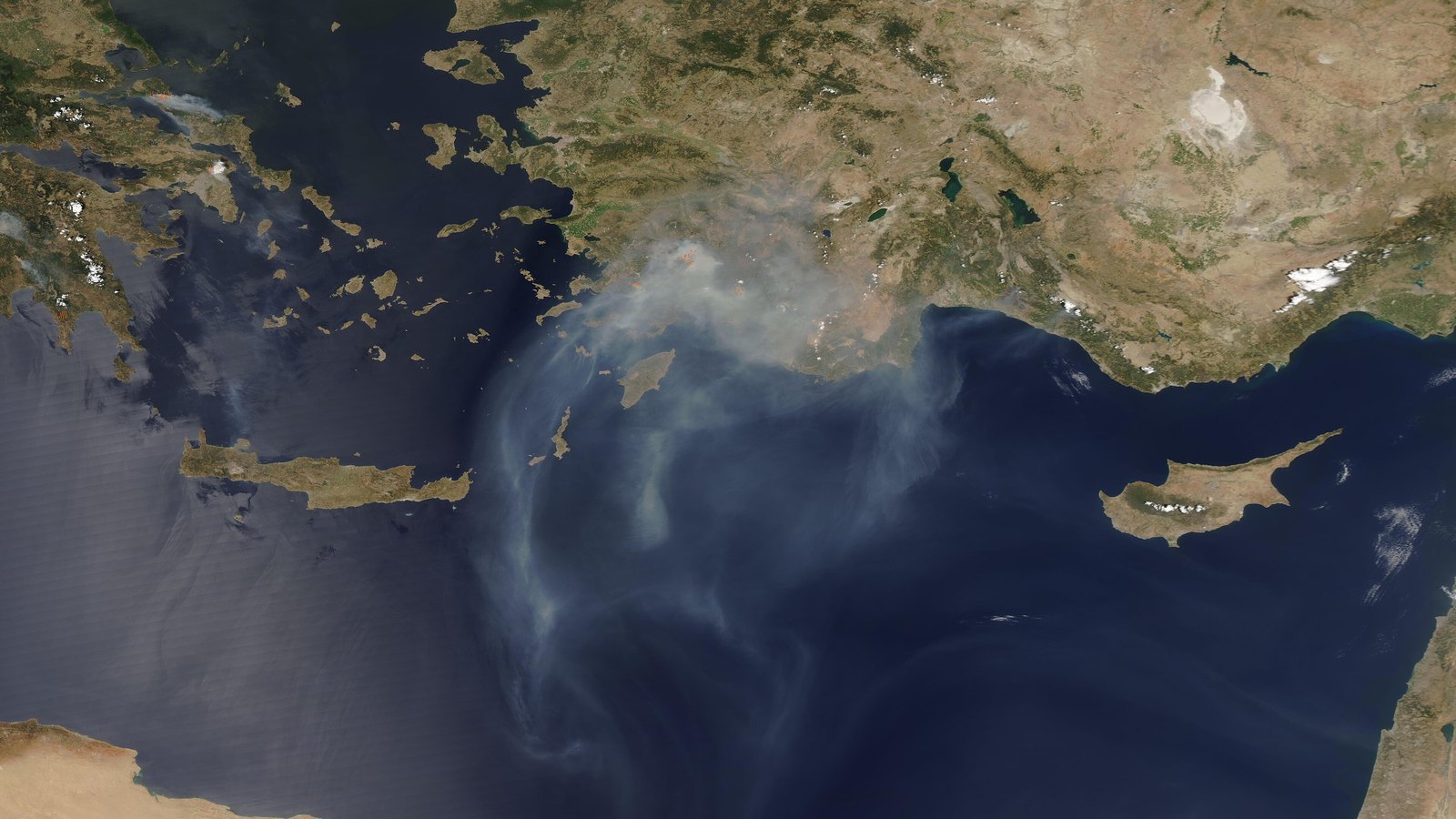
On 27 November 2026, atmospheric scientists from Dutch and German research institutions published a physical storyline attribution study in Communications Earth and Environment demonstrating that anthropogenic warming sharply intensified the extreme fire weather that drove disastrous wildfires across Southern Europe during summer 2025. By separating thermodynamic heating from atmospheric circulation dynamics, the investigation provides research universities and climate laboratories with a physically consistent methodology for quantifying global warming drivers behind regional wildfire extremes.
Atmospheric Warming Amplified 2025 Mediterranean Fire Weather
The peer-reviewed paper, titled Storyline attribution of fire weather during the 2025 Mediterranean summer, evaluates the atmospheric conditions that underpinned severe wildfire outbreaks across Southern Europe and North Africa during July and August 2025. Exceptional heatwaves affected the entire basin, with Spain registering its warmest June in 64 years. Wildfires consumed more than 1,025,224 hectares of land across the European Union by late September 2025 and generated record smoke emissions in the 23-year monitoring record of the Copernicus Atmosphere Monitoring Service Global Fire Assimilation System.
The research consortium was led by Dr. Linda van Garderen of Utrecht University’s Institute for Marine and Atmospheric Research and Van Garderen Scientific, together with Dalena León-FonFay and Dr. Frauke Feser from Helmholtz-Zentrum Hereon, Victoria Dietz from the Max Planck Institute for Meteorology and the International Max Planck Research School on Earth System Modelling, and Dr. Willem Jan van de Berg of Utrecht University. The team applied a spectrally nudged storyline attribution framework to quantify how summer 2025 would have evolved under pre-industrial conditions and across higher warming thresholds.
Unlike conventional probabilistic attribution methods that evaluate changes in event likelihood across broad model ensembles, conditional storyline attribution fixes large-scale atmospheric circulation—such as jet stream meanders and blocking ridges—while varying thermodynamic conditions, including sea surface temperatures and greenhouse gas concentrations. This enables researchers to isolate the direct thermodynamic contribution of human-induced climate change without confounding uncertainties from dynamic circulation variability.
Key Technical Specifications and Model Parameters
The investigators configured the ECHAM6 atmospheric general circulation model at T255 spectral horizontal resolution (roughly 50 kilometres) with 95 vertical levels, coupled to the JSBACH land surface model. Large-scale vorticity and divergence were spectrally nudged above 750 hectopascals at scales exceeding 1,000 kilometres toward NCEP-NCAR Reanalysis 1 fields, leaving local surface temperatures, relative humidity, and precipitation free to evolve unconstrained.
The team evaluated five distinct storylines using five-member ensembles: a counterfactual pre-industrial state (1850–1920 baseline with 1890 greenhouse gases), the factual 2025 climate (1.2 °C warming level under RCP4.5), and three future states at 2.0 °C, 3.0 °C, and 4.0 °C above pre-industrial levels. Daily fire danger was calculated via the Canadian Forest Fire Weather Index (FWI) using the xclim Python library and benchmarked against data from the European Forest Fire Information System, validated with ECMWF ERA5 reanalysis and Copernicus Emergency Management Service products.
The table below outlines the experimental design, forcing parameters, and predominant fire weather index categories across the simulated climate storylines.
| Storyline | Warming Level | Greenhouse Gas Baseline | Sea Surface Temperature Forcing | Regional Fire Danger Pattern |
|---|---|---|---|---|
| Counterfactual | 0.0 °C (1850–1920) | 1890 pre-industrial levels | Detrended pre-industrial SST anomaly | Low to Moderate in Western Europe; High in Greece |
| Factual (2025) | 1.2 °C (Observed 2025) | Observed 2025 RCP4.5 forcing | Observed 2025 NCEP SSTs | High to Extreme in Iberia, Italy, and Southern France |
| Plus 2 Kelvin | 2.0 °C target | RCP4.5 2.0 °C equivalent | MPI-ESM1.2-HR CMIP6 +2 K anomaly | Very High to Extreme across Mediterranean basin |
| Plus 3 Kelvin | 3.0 °C target | RCP4.5 3.0 °C equivalent | MPI-ESM1.2-HR CMIP6 +3 K anomaly | Extreme across Southern Europe, extending northward |
| Plus 4 Kelvin | 4.0 °C target | RCP4.5 4.0 °C equivalent | MPI-ESM1.2-HR CMIP6 +4 K anomaly | Very Extreme dominant; Low FWI confined to high Alps |
Fire danger categories followed the operational thresholds detailed in the EFFIS Fire Danger Forecast technical background, which classifies FWI values below 11.2 as Low, 11.2–21.3 as Moderate, 21.3–38.0 as High, 38.0–50.0 as Very High, 50.0–70.0 as Extreme, and values above 70.0 as Very Extreme. Spring vegetation condition anomalies from Sentinel-2 satellite data confirmed that antecedent dry fuels exacerbated fire-prone atmospheric conditions.
Historical Context and Climate Attribution Baselines
The Mediterranean basin is warming significantly faster than the global average, driving frequent compound droughts and heatwaves. Historical attribution analyses show that extreme fire-promoting heatwaves in the Iberian Peninsula, once expected once every 500 to 2,500 years, now recur every 13 to 15 years. In Turkey, Cyprus, and Greece, centennial events now recur every 10 to 20 years. Continental risk assessments in platforms such as Climate-ADAPT emphasize that European fire weather is expanding northwards into temperate forested zones.
The storyline attribution confirms that while southern Greece already exhibited high FWI values under pre-industrial conditions, the steepest relative increases occurred in areas historically experiencing low to moderate danger, such as northern Spain, southern France, and northern Italy. Rising surface temperatures formed the primary and most consistent driver across all countries, while localized rainfall reductions further amplified atmospheric drying.
Institutional Perspectives and Funding Disclosures
The research collaboration brought together climate modelers and atmospheric physicists from Utrecht University, the Institute of Coastal Systems at Helmholtz-Zentrum Hereon, and the Max Planck Institute for Meteorology. The authors noted that spectrally nudged storylines provide physically transparent causal attribution for specific extreme weather events, advancing process understanding beyond purely statistical assessments.
The study was funded by the German Federal Ministry of Education and Research under the ClimXtreme programme (projects ClimXtreme-A5, grant 01 LP 2322 B, and DecHeat2) and project WAKOS-2 (grant 01LR2003A1), with doctoral fellowship support from the International Max Planck Research School on Earth System Modelling. The authors declared no competing financial interests, maintaining reporting standards aligned with atmospheric physics venues such as npj Climate and Atmospheric Science.
Implications for University Researchers and Research Management
For university atmospheric science departments and climate research groups, storyline attribution offers an established method to investigate extreme weather events while constraining circulation uncertainties. However, high-resolution global ensembles generate tens of terabytes of data. Raw simulation files were deposited at the Deutsches Klimarechenzentrum (DKRZ) supercomputing facility in Hamburg because public repositories cannot accommodate multi-terabyte model outputs.
Research management offices supporting climate grants must plan for high-volume data storage and long-term preservation costs. Grant compliance frameworks increasingly demand data management protocols consistent with the RDA FAIR Data Maturity Model and computational reproducibility standards described in Environmental Modelling and Software.
Next Steps in Mediterranean Attribution Modeling
Within the ClimXtreme consortium, scientists plan to extend storyline attribution through 2027 under the DecHeat2 project. Upcoming research priorities include coupling spectrally nudged models with convection-permitting regional simulations to improve local wind representation across mountainous terrain in the Balkans, the Pyrenees, and the Peloponnese.
In addition, researchers are coordinating with European meteorological agencies to incorporate sub-daily weather variables and dynamic vegetation feedbacks into future model intercomparison projects, strengthening operational fire danger forecasting across Southern Europe.
Sources
- Communications Earth and Environment: Storyline attribution of fire weather during the 2025 Mediterranean summer, checked 2026-11-28
- Copernicus Emergency Management Service: EFFIS Fire Danger Forecast Technical Background, checked 2026-11-28
- European Commission Joint Research Centre: About the European Forest Fire Information System, checked 2026-11-28
- Helmholtz-Zentrum Hereon: Institute of Coastal Systems — Analysis and Modeling, checked 2026-11-28
- Deutsches Klimarechenzentrum: High Performance Computing for Earth System Research, checked 2026-11-28






