
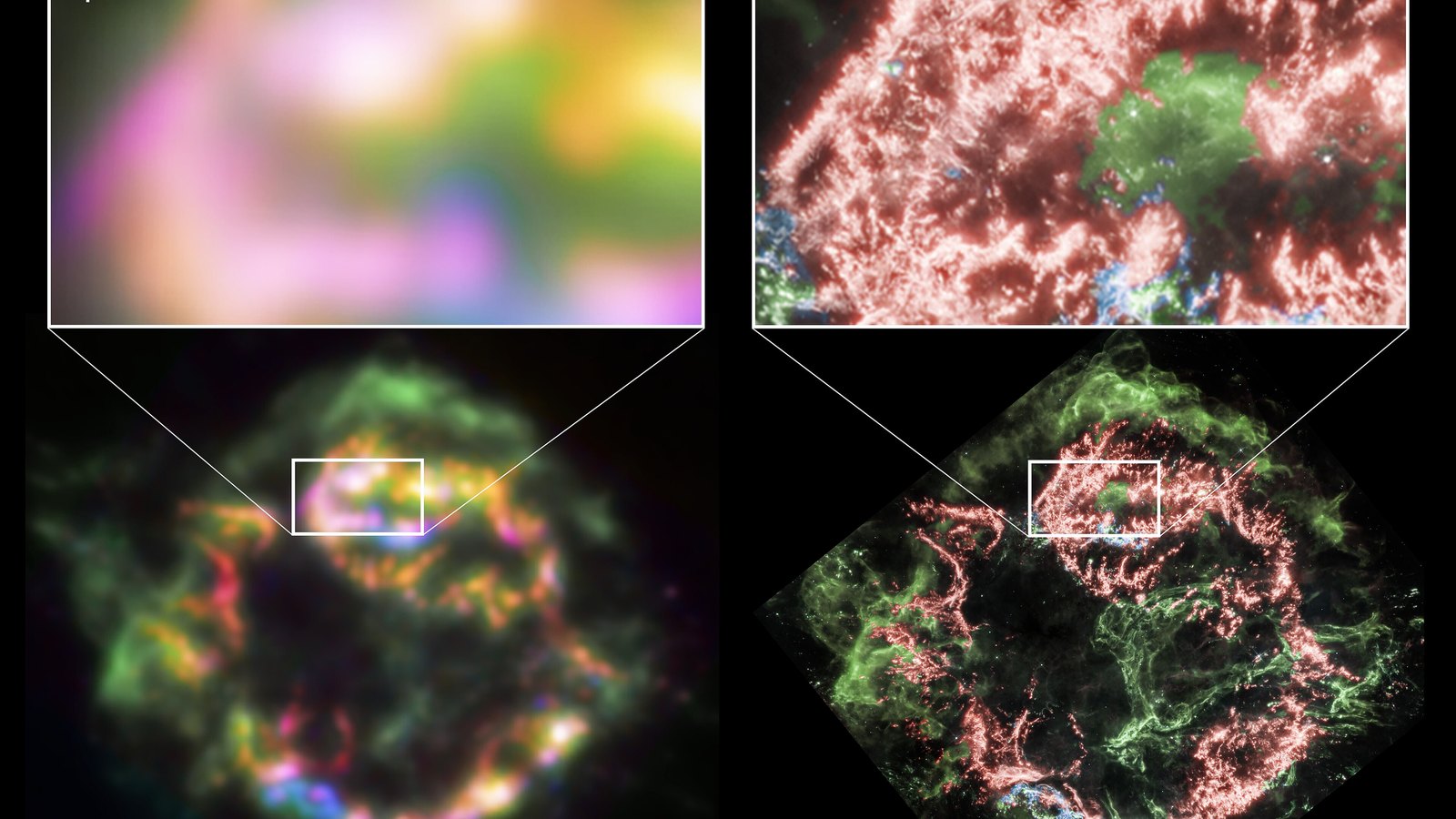
On November 24, 2026, international astrophysics teams collaborating across NASA, the European Space Agency, and the Canadian Space Agency announced that the James Webb Space Telescope revealed unprecedented structural details within the Cassiopeia A supernova remnant, resolving solar-system-sized ejecta clumps and identifying pre-collapse stellar shell mergers that alter theoretical models of nucleosynthesis, transform archival research workflows, and guide upcoming telescope observing proposals across university departments.
High-Resolution Infrared Observations of Cassiopeia A
Astronomers deploying the James Webb Space Telescope (JWST) have captured detailed mid-infrared observations of Cassiopeia A (Cas A), an archetypal core-collapse supernova remnant situated approximately 11,000 light-years from Earth in the northern constellation Cassiopeia. Created by the explosive death of a massive star approximately 340 years ago, Cas A represents one of the most rigorously scrutinized celestial remnants in modern astrophysics. However, previous space-based observatories lacked the angular resolution and spectroscopic sensitivity required to distinguish individual debris fragments from diffuse background emission.
Utilizing the Mid-Infrared Instrument (MIRI) Medium-Resolution Spectrometer (MRS), an international research team led by Dr. Tea Temim of Columbia University successfully resolved the infrared emission of distinct, solar-system-sized ejecta clumps across the expanding shock field. The team, which includes co-investigators from Purdue University, Ghent University, and the University of Maryland, Baltimore County, formally reported their peer-reviewed findings in The Astrophysical Journal Letters. High-resolution image processing conducted by Joseph DePasquale at the Space Telescope Science Institute (STScI) demonstrated that dust within the remnant is far more chemically varied and spatially segregated than previous low-resolution missions suggested.
Instrumental Capabilities and Structural Parameters Resolved by Webb
The high resolving power of JWST represents an instrumental leap over its predecessor, NASA’s retired Spitzer Space Telescope. While Spitzer initially flagged anomalous infrared emission regions within Cas A, its optics blended multiple clump emissions into averaged spatial spectra. Webb’s 6.5-meter segmented primary mirror and MIRI spectrometer isolated discrete gas-dust packets only arcseconds in diameter, revealing how diverse mineral species condensed out of the expanding fireball.
Spectroscopic mapping isolated three distinct compositional zones within the remnant. In two separate fields located within the interior reverse-shock region—where decelerated inner ejecta collide with an inward-moving shockwave—Webb detected drastically different dust chemistries: one zone is heavily dominated by pure silica (silicon dioxide) grains, while an adjacent clump is dominated by unburned carbon dust. Furthermore, examination of the enigmatic “Green Monster,” an intricate loop structure first uncovered by JWST in early imaging, demonstrated that it is composed predominantly of complex magnesium silicates. Unlike the interior reverse-shocked clumps, the Green Monster originated from circumstellar material expelled by the progenitor star thousands of years prior to its final explosion.
| Observational Feature | Spitzer Legacy Profile | JWST MIRI MRS Breakthrough | Physical Origin and Shock Association |
|---|---|---|---|
| Reverse-Shock Ejecta Clumps | Blended unresolved thermal profiles | Isolated solar-system-sized clumps | Pristine stellar interior layers shocked by reverse wave |
| Silica-Rich Dust Pockets | Averaged silicate continuum | Distinct sub-micron silica grains | Condensation in oxygen-silicon rich stellar core zones |
| Carbon Dust Formations | Unresolved faint infrared continuum | Spatially isolated carbon-dominant clumps | Carbon-burning shell ejecta bypassing complete oxidation |
| Green Monster Structure | Faint diffuse emission boundary | Complex magnesium silicate loops | Pre-supernova circumstellar shell impacted by blast wave |
| Multi-Messenger Synthesis | Standalone mid-infrared mapping | Coordinated Chandra X-ray and XRISM data | Hydrodynamic shock-boundary ionization mapping |
Stellar Evolution Theory and the Progenitor Shell Merger Mechanism
For decades, conventional stellar astrophysics modeled the final evolutionary phases of massive stars using an idealized “onion-skin” paradigm. Under this theoretical framework, stars fuse successively heavier elements in distinct, concentric shells: hydrogen burning occurs in the outermost mantle, followed downward by helium, carbon, neon, oxygen, and silicon layers, terminating at an inert iron-nickel core. In this classical model, little convective mixing occurs between adjacent shells prior to core collapse, implying that ejecta should be organized in predictable radial stratifications.
The chemical map produced by JWST directly contradicts this quiescent picture. The juxtaposition of pristine silica clumps directly alongside pure carbon pockets without widespread elemental homogenization points directly toward a violent hydrodynamic “shell merger.” As outlined in ESA/Webb scientific findings and detailed by Universe Today, convective instabilities during the final hours of the star’s existence caused the oxygen- and carbon-burning shells to breach their boundaries, violently churning interior elements immediately before gravitational collapse. This finding forces theoretical astrophysicists to update multidimensional explosion codes and aligns directly with open data frameworks governed by NASA open science guidelines.
Stakeholder Perspectives and Scientific Community Reactions
The publication of the Cas A spectroscopic map has elicited enthusiastic reactions from astrophysicists and stellar modelers worldwide. Academic researchers emphasized that resolving individual dust families provides an empirical diagnostic tool to study the terminal phases of massive stars that cannot otherwise be observed directly.
“Material within these shells churns and circulates, which can cause the shells to merge shortly before the supernova explosion,” stated Dr. Tea Temim, lead author and research scientist at Columbia University. “This would be something like the oxygen- and carbon-burning shells in a star merging together and changing the structure of the star significantly, altering the chemical abundances seen in the remnant.”
Co-author Dr. Dan Milisavljevic, associate professor of physics and astronomy at Purdue University, underscored the temporal resolution of the discovery: “With Webb, the vast improvement in being able to resolve at the individual clump level helps us do more sophisticated dust chemistry. As a result, we can tie the explosion back to the makeup of the progenitor star hundreds of years afterward, telling us about what was happening in the hours leading up to core collapse.”
Furthermore, Dr. Ilse De Looze of Ghent University emphasized the broader cosmic dust life cycle: “Identifying the different types of dust grains formed in the chemically distinct layers of a supernova brings us one step closer to understanding how much dust supernovae contribute to the interstellar dust reservoir in our galaxy, and how well these grains survive powerful reverse shocks.”
Implications for Astrophysics Researchers, Universities, and Research Offices
The release of these observations carries direct structural and operational significance for university departments, astrophysics research groups, and sponsored project offices managing federal awards:
- Archival Data Retrieval and Computational Pipelines: All raw, intermediate, and pipeline-calibrated data products from the JWST observing programs are preserved within the Mikulski Archive for Space Telescopes (MAST) at STScI. Research groups can programmatically interface with these catalogs via Astroquery to automate batch extraction of calibrated spectra for comparative modeling.
- Data Management and Repository Compliance: Principal investigators developing derivative spectral models or grain catalogs must archive curated outputs in an established institutional or subject-specific data repository, ensuring machine-actionable metadata satisfies federal public access mandates.
- FAIR Data Principles in Multi-Messenger Astronomy: Coordinated analyses integrating JWST infrared spectra with Chandra and XRISM high-energy datasets require strict adherence to FAIR data principles, preserving provenance workflows and reproducible analysis scripts across cross-institutional collaborations.
- General Observer (GO) Proposal Strategy: The empirical confirmation of shell mergers provides immediate justification for Cycle 6 JWST and future Nancy Grace Roman Space Telescope proposals targeting unresolved core-collapse remnants in nearby galaxies.
Next Steps, Archival Availability, and Upcoming Milestones
Following the public release of the Cas A mid-infrared spectra, STScI has finalized the ingestion of High-Level Science Products (HLSPs) into the MAST public archive, allowing investigators globally to conduct independent re-analyses without proprietary embargo periods. Astronomical software teams are currently deploying updated pipeline calibration routines to correct for residual instrument stray light in extended nebular targets.
In the coming months, astrophysics consortia plan to present expanded 3D hydrodynamic models of the Cas A explosion during dedicated scientific sessions at the 249th Meeting of the American Astronomical Society (AAS) in January 2027. Additionally, the JWST Cycle 6 Call for Proposals, scheduled for release in late 2026, will incorporate updated exposure time calculators reflecting the refined dust emission models established by the Temim et al. dataset.
Sources
- NASA: Webb Reveals New Details in Supernova Remnant, checked 2026-11-25
- The Astrophysical Journal Letters: JWST Resolves Dust Emission from Individual Ejecta Clumps in Cassiopeia A: Dominant Grain Compositions Point to a Shell Merger in the Progenitor, checked 2026-11-25
- ESA/Webb: Webb shows how supernova dust chronicles star evolution, checked 2026-11-25
- Universe Today: Making Sense of Chaotic Supernova Ejecta With the JWST, checked 2026-11-25






