
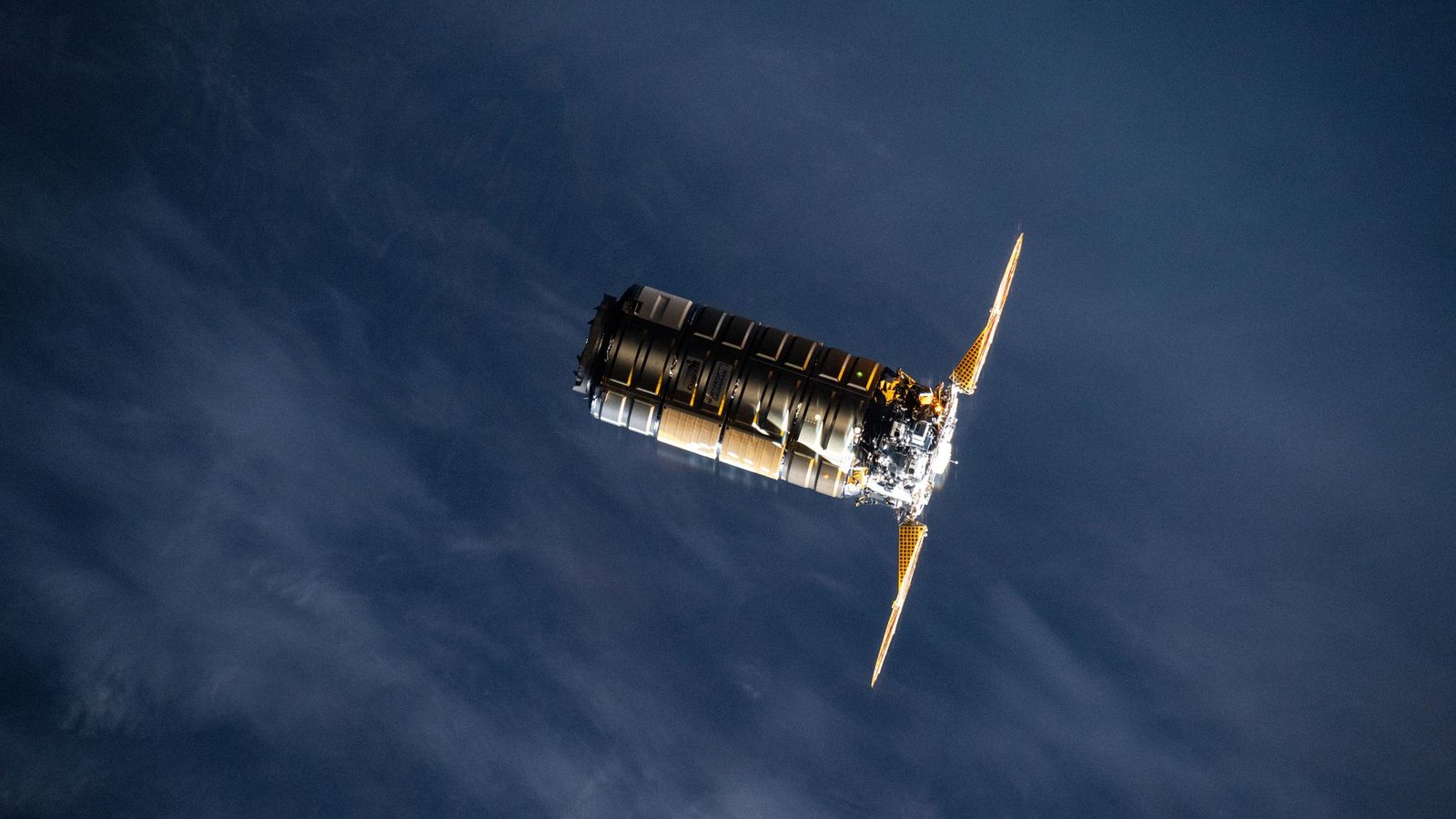
NASA announced on 27 November 2026 that its Biological and Physical Sciences Division will fly a first-of-its-kind space crop production system and a brain-tissue fluid-handling experiment to the International Space Station on Northrop Grumman’s 25th Commercial Resupply Services mission. Launch is targeted for 29 November, and the results bear on food supply for future Moon and Mars crews and on human tissue research on Earth.
What happened
NASA’s announcement says experiments from its Biological and Physical Sciences Division will travel to the station aboard the Northrop Grumman cargo flight, which NASA calls CRS-25 and the company calls NG-25. The agency describes the investigations as work that advances research benefiting life on Earth and future exploration, expanding knowledge of space crops and human health.
The first experiment is a prototype growth chamber. NASA says it will give insight into safe, nutritious and reliable crop production systems for future Moon Base habitats and Mars missions, and that what is learned could also inform vertical farming and indoor growing on Earth. Researchers will use the investigation to validate the system’s water delivery and volume optimization technology aboard the station.
The second is a precision health investigation that NASA calls the next step toward long-duration studies of human brain tissue in space. It builds on an earlier flight of miBrains, small laboratory-grown models of the human brain, and will validate a miniature fluid-handling system built to mix, deliver and maintain the nutrient-rich liquid that keeps the tissue alive.
Key details of the flight
NASA’s launch coverage advisory, dated 18 November, gives the schedule: NASA, Northrop Grumman and SpaceX are targeting no earlier than 10:47 a.m. EST on Sunday 29 November, with launch coverage beginning at 10:25 a.m. A SpaceX Falcon 9 will lift the Cygnus XL spacecraft from Space Launch Complex 40 at Cape Canaveral Space Force Station in Florida, carrying approximately 11,000 pounds of science investigations, supplies and equipment.
The advisory says NASA astronauts Jessica Watkins and Luke Delaney, who are living and working aboard the station, will use the Canadarm2 robotic arm to capture Cygnus XL on Tuesday 1 December. Ground controllers will then install it on the Earth-facing port of the Unity module for cargo unloading. The spacecraft is scheduled to remain at the station until May 2027, then depart with several thousand pounds of disposal items and other unneeded cargo and burn up harmlessly during re-entry. The advisory also notes that the previous mission for NASA, Northrop Grumman CRS-24, launched on 11 April 2026 on the same type of spacecraft and rocket.
The Northrop Grumman mission page confirms the 11,000-pound payload and the Falcon 9 launch from Space Launch Complex 40. It says the company has delivered more than 169,000 pounds of supplies, experiments and equipment to the station since 2013, and that the NG-25 Cygnus is named the S.S. James “Jim” A. Lovell in honour of the astronaut who flew Gemini and Apollo missions, including commanding Apollo 13.
| Item | Detail | Source |
|---|---|---|
| Target launch | No earlier than 10:47 a.m. EST, Sunday 29 November 2026 | NASA advisory |
| Rocket and pad | SpaceX Falcon 9, Space Launch Complex 40, Cape Canaveral | NASA advisory; Northrop Grumman |
| Cargo | About 11,000 pounds of science, supplies and equipment | NASA advisory; Northrop Grumman |
| Capture | Canadarm2, Tuesday 1 December 2026 | NASA advisory |
| Stay at the station | Until May 2027 | NASA advisory |
What the crop system is meant to show
NASA’s investigation page for Ohalo III calls the system the first operational crop production system in space, and a technology demonstration that will validate plant water delivery and volume optimization techniques. NASA frames the gap this way: the shelf-stable food system now used on the station becomes harder to manage as missions travel farther from Earth because of limited space and resupply opportunities.
The page lists the goals of the work. They include closing knowledge gaps in productivity, nutrition, safety and operational reliability for bioregenerative crop production; informing ways to produce safe, nutritious and reliable crops for long-duration missions beyond low Earth orbit; and advancing production of crops that give whole-food nutrition, variety and sensory experiences that help combat menu fatigue. A NASA image on the page shows red romaine lettuce, Twiggy Orange tomato, Prospera basil, amara mustard and mizuna mustard growing together in Ohalo III’s multi-cropping feature.
NASA also lists benefits for Earth-bound research: knowledge of controlled environment agriculture that could help vertical farming and indoor growing, water delivery and recovery innovations that could apply to precision agriculture and water conservation, and fundamental plant biology that could inform crop improvement and breeding for challenging growing environments.
The brain-tissue experiment
NASA’s page for the AVATAR-Org4 investigation says it aims to validate a specialised, automated system for maintaining human brain tissue models during spaceflight. The miBrains are three-dimensional tissues containing several types of human brain cell, which NASA describes as including glial cells, immune cells, vasculature and neurons. The experiment sends a miniature fluid-handling system to the station to test how well it mixes, delivers and maintains the culture liquid.
NASA lists as objectives determining whether the quality and stability of the culture media can be maintained reliably over extended periods in space, helping advance technologies that keep living tissue alive with minimal human intervention, supporting more advanced brain tissue models for studying neurological diseases, and laying the foundation for studies of how prolonged exposure to the space environment affects astronaut brain health.
Background and context
Independent space-industry coverage in Cosmic Herald, which draws on reporting from a NASA preview teleconference held on 23 November, adds detail on the flight: the Falcon 9 first-stage booster is making its ninth flight, and the science manifest also includes a follow-up study on muscle loss and a nanomedicine study. The same report notes that NASA said in a 25 November update that recent testing points to strawberries, cucumbers and lemon basil as potential crops for future explorers, and that a September paper in Life Sciences in Space Research compared a wild strawberry with NASA’s leading candidate variety, Delizz.
The water-delivery problem and the tissue problem are linked, the outlet observes: both experiments test fluid handling where liquids do not behave as they do on Earth, and both have to work before the science they enable can start.
What it means for researchers, universities and research offices
For plant scientists and controlled-environment agriculture groups, the Ohalo III demonstration is a source of future data on water delivery and crop volume in microgravity, and NASA itself ties the work to vertical farming and precision agriculture on Earth. Groups working on controlled environments can follow the demonstration as a reference for what a closed, resource-limited growing system has to prove.
For tissue engineering and neuroscience laboratories, the AVATAR-Org4 test addresses a practical bottleneck: keeping three-dimensional cultures alive without constant handling. NASA says the aim is better brain tissue models for studying neurological disease as well as astronaut health. Background on the underlying model type is in our guide to the organoid.
For research offices that support spaceflight investigators, the flight shows how these investigations reach orbit: NASA’s Biological and Physical Sciences Division sends them on a commercial resupply mission that Northrop Grumman and SpaceX fly for the agency. Offices advising investigators on data sharing can consult our guide to NASA open science rules, and those preparing proposals can see the NSPIRES registration and submission guide.
What happens next
Launch is targeted for 10:47 a.m. EST on 29 November, with NASA’s live coverage on NASA+ beginning at 10:25 a.m. Capture by Canadarm2 is scheduled for 1 December, after which the Cygnus XL will be unloaded at the Unity module. NASA says the spacecraft will stay until May 2027. NASA describes Ohalo III as a technology demonstration to validate its systems aboard the station, so results on crop production will follow the experiments once they run in orbit.
Sources
- NASA’s NG-25 Mission to Launch Pioneering Space Crops Research, NASA Science, 27 November 2026
- Ohalo III investigation page, NASA Science
- AVATAR-Org4 investigation page, NASA Science
- NASA Sets Coverage for Northrop Grumman CRS-25 Launch, Prelaunch, NASA, 18 November 2026
- NASA Commercial Resupply Mission NG-25, Northrop Grumman
- NG-25 Cygnus Carries a First-of-Its-Kind Space Crop Production System to the Station, Cosmic Herald, November 2026





