
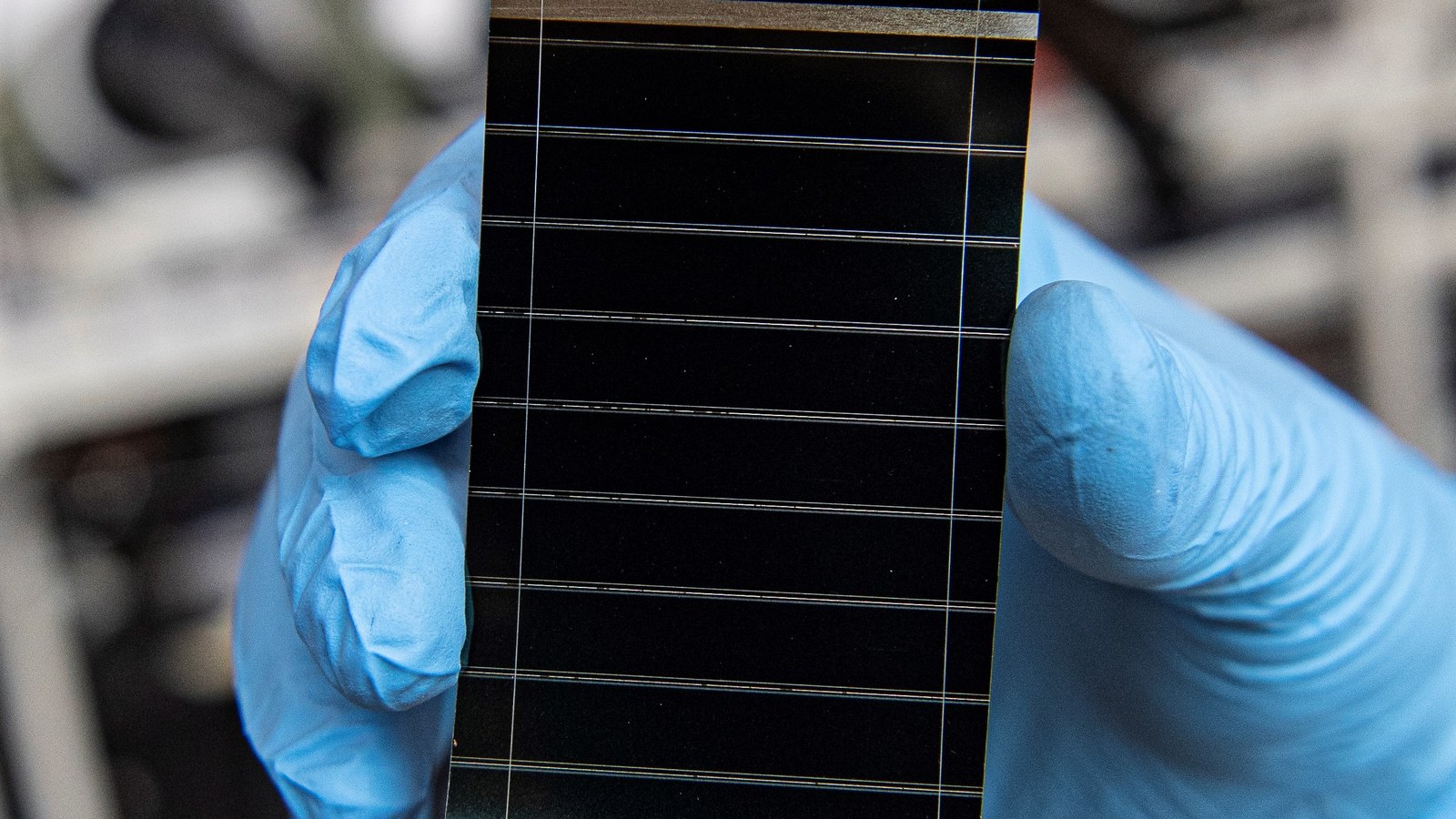
On November 25, 2026, researchers from The Hong Kong Polytechnic University and Southern University of Science and Technology published a study in Nature Sustainability demonstrating a green-solvent superspreading droplet deposition method that eliminates toxic polar aprotic solvents during perovskite solar cell fabrication while achieving a certified 26.11% power conversion efficiency on laboratory cells and 22.81% on large-area minimodules.
Breakthrough in Green Solvent Engineering and Perovskite Droplet Dynamics
The study, titled ‘Superspreading droplets for scalable and green perovskite photovoltaics’, addresses two major bottlenecks in commercializing perovskite solar cells: hazardous solvent exposure and substrate surface sensitivity. The research was conducted by an interdisciplinary team across seven institutions, including The Hong Kong Polytechnic University, Southern University of Science and Technology, Guang’an Institute of Technology, and Southeast University. First authors Tao Zhu, Peng Bai, Boyang Yu, Hongxiang Li, and Lian Wang, with corresponding authors Kuan Liu, Weiwei Deng, Xinyan Zhao, and Gang Li, demonstrated that tuning solvent evaporation rates and surface tension gradients forces liquid droplets to rapidly wet diverse surfaces regardless of their initial hydrophobicity.
Standard perovskite fabrication relies heavily on laboratory spin-coating with toxic polar aprotic coordinating solvents, primarily N,N-dimethylformamide (DMF). Spin-coating expels more than 90% of the dispensed precursor solution as hazardous chemical waste, which creates costly disposal demands and limits industrial scalability. While direct drop-coating offers an intrinsically waste-free deposition route, conventional precursor droplets pin to substrates and suffer from contact angle hysteresis. On hydrophobic hole transport layers such as poly(triarylamine) (PTAA), precursor drops contract instead of spreading, creating non-uniform films and pinhole defects.
To solve this wetting barrier, the researchers formulated precursor inks pairing volatile, low surface tension driving solvents (such as 2-methoxyethanol, methanol, ethanol, and methyl nonafluorobutyl ether) with high donor number coordination additives like 1-methyl-2-pyrrolidone and dimethyl sulfoxide. The steep gradient in surface tension and volatility amplifies outward Marangoni stress at the liquid interface. This outward flow propels droplets into rapid superspreading, accelerating deposition velocities by more than 30-fold and yielding pinhole-free crystalline thin films across broad substrate areas.
Performance Metrics and Solvent Chemistry Specifications
The superspreading deposition strategy delivered high efficiency across both small-area devices and scalable minimodules. Fully drop-coated n-i-p perovskite solar cells reached a laboratory power conversion efficiency of 26.36%, with an independently certified efficiency of 26.11%. The fluid dynamics preserve the underlying crystal self-assembly pathway during scale-up, enabling direct translation to automated blade-coating. A large-area minimodule fabricated by blade-coating achieved an efficiency of 22.81% across a 54.8 square centimeter aperture area.
Operational stability testing under standardized ISOS consensus protocols confirmed the durability of the resulting thin films. Encapsulated 3.6 by 3.6 square centimeter minimodules subjected to continuous maximum power point tracking under illumination at 55 degrees Celsius and 50% to 75% relative humidity (ISOS-L-3) achieved a projected T80 operational lifetime of 1,650 hours. Outdoor testing under ambient cycling conditions (ISOS-O-2) further demonstrated that the green solvent formulation prevents volatile adduct degradation.
A laboratory materials balance sheet highlights the material efficiency gains achieved by superspreading drop-coating compared to conventional spin-coating:
| Metric or Parameter | Conventional Spin-Coating | Superspreading Drop-Coating | Observed Improvement |
|---|---|---|---|
| Dispensed Ink Volume per 1.5 x 1.5 cm Cell | 30 microliters (1.3 M) | 1.5 microliters (0.65 M) | 95.0% volume reduction |
| Precursor Chemical Cost per Device (n-i-p) | $1.36 | $0.0425 | 96.9% cost reduction |
| Carrier Solvent System | N,N-Dimethylformamide (DMF) | 2-Methoxyethanol / Fluorinated Ethers | Eliminates REACH Annex XVII toxicant |
| Film Deposition Velocity | Baseline spin dynamics | Over 30-fold acceleration | High-throughput roll-to-roll compatibility |
| Small-Area Solar Cell Efficiency (PCE) | 24.0% to 25.5% baseline | 26.36% (26.11% certified) | Top-tier international benchmark |
| Minimodule Efficiency (54.8 cm2 Aperture) | 19.0% to 21.0% typical | 22.81% aperture efficiency | Minimal performance loss during scaling |
| Operational Lifetime (ISOS-L-3 at 55 deg C) | Variable thermal degradation | T80 = 1,650 hours | Validated long-term photothermal stability |
Overcoming Wetting Physics and the Limitations of Toxic Polar Solvents
The physical mechanism behind superspreading droplets relies on Marangoni-driven interfacial flow. In multi-component droplets containing solvents with different vapor pressures and surface tensions, faster evaporation near the contact line creates a steep surface-tension gradient. By pairing low surface tension driving liquids (surface tension between 14.1 and 31.0 millinewtons per meter) with slower-evaporating coordination additives, the meniscus generates continuous outward shear stress that drives the liquid boundary across hydrophobic barriers.
This development aligns with manufacturing priorities outlined by the U.S. Department of Energy Solar Energy Technologies Office, which emphasizes scalable, high-throughput coating techniques with reduced chemical footprints to accelerate commercial deployment. Historically, perovskite synthesis required strong coordinating solvents like DMF to dissolve lead halide precursors. However, DMF forms persistent intermediate adducts that desorb unevenly during thermal annealing, causing micro-voids that accelerate film decay. In contrast, the superspreading formulation decouples rapid liquid spreading from crystallite assembly, ensuring dense grain growth across both inorganic metal oxides and hydrophobic organic contacts.
Cleanroom Safety, Regulatory Compliance, and Institutional Perspectives
Replacing DMF with safer multi-component blends addresses strict occupational health standards. In the European Union, DMF is classified under REACH as a Category 1B reproductive toxicant and a substance of very high concern. Under Commission Regulation (EU) 2021/2030, industrial and professional uses of DMF are restricted unless facilities maintain worker exposure below derived no-effect levels of 6 milligrams per cubic meter for inhalation and 1.1 milligrams per kilogram per day for dermal contact.
In the United States, federal environmental and workplace regulations impose similar constraints on polar aprotic solvents. The U.S. Environmental Protection Agency actively regulates industrial solvents under the Toxic Substances Control Act, as reflected in its ongoing risk management actions for n-methylpyrrolidone and related chemical processing agents. In academic cleanrooms and pilot manufacturing centers, maintaining compliant ventilation and personal protective equipment for toxic solvent processing creates major infrastructure expenses. The superspreading ink provides an immediate route to lower compliance risks while improving manufacturing speed.
Implications for Cleanroom Operations and Research Administration
For academic research institutions and cleanroom facility managers, eliminating DMF transforms laboratory risk management. Cleanrooms housing multi-user fabrication equipment face ventilation and cross-contamination challenges when processing volatile reproductive toxins. Replacing DMF supports compliance with institutional laboratory chemical hygiene plan standards by substituting hazardous chemicals with lower-risk formulations.
Institutional safety committees apply strict handling rules to compounds designated as particularly hazardous substances in research laboratories. Transitioning to green solvent blends reduces the need for specialized vapor scrubbers and simplifies routine cleanroom maintenance standards. Furthermore, because droplet superspreading reduces chemical waste by 95%, research facilities can reduce hazardous waste shipments in line with formal institutional waste minimization plans.
Research administrators managing clean energy awards also gain compliance advantages. Major funding agencies—including the Research Grants Council of Hong Kong and the National Natural Science Foundation of China, which supported this study—increasingly integrate sustainability metrics into grant milestones. Demonstrating green, scalable fabrication protocols helps research teams satisfy environmental benchmarks without exposing researchers to toxic solvent vapors.
Next Steps for Scalable Photovoltaic Manufacturing
The participating research teams plan to transition the superspreading droplet process to roll-to-roll pilot manufacturing lines. Future development will focus on scaling aperture dimensions from 54.8 square centimeter minimodules to commercial panel sizes exceeding 1,000 square centimeters, while validating deposition on flexible substrates and textured glass.
The consortium is also evaluating superspreading ink formulations for perovskite-silicon tandem cells, where delicate underlying junctions are vulnerable to chemical attack by conventional polar solvents. Intellectual property licensing and industrial pilot testing are anticipated to proceed through university technology transfer offices as photovoltaic manufacturers seek green deposition methods that satisfy evolving chemical regulations.
Sources
- Nature Sustainability: Superspreading droplets for scalable and green perovskite photovoltaics, checked 2026-11-29
- U.S. Department of Energy: Perovskite Solar Cells, checked 2026-11-29
- EUR-Lex: Commission Regulation (EU) 2021/2030 on N,N-Dimethylformamide Restrictions Under REACH, checked 2026-11-29
- U.S. Environmental Protection Agency: Risk Management for n-Methylpyrrolidone (NMP) Under TSCA, checked 2026-11-29






