
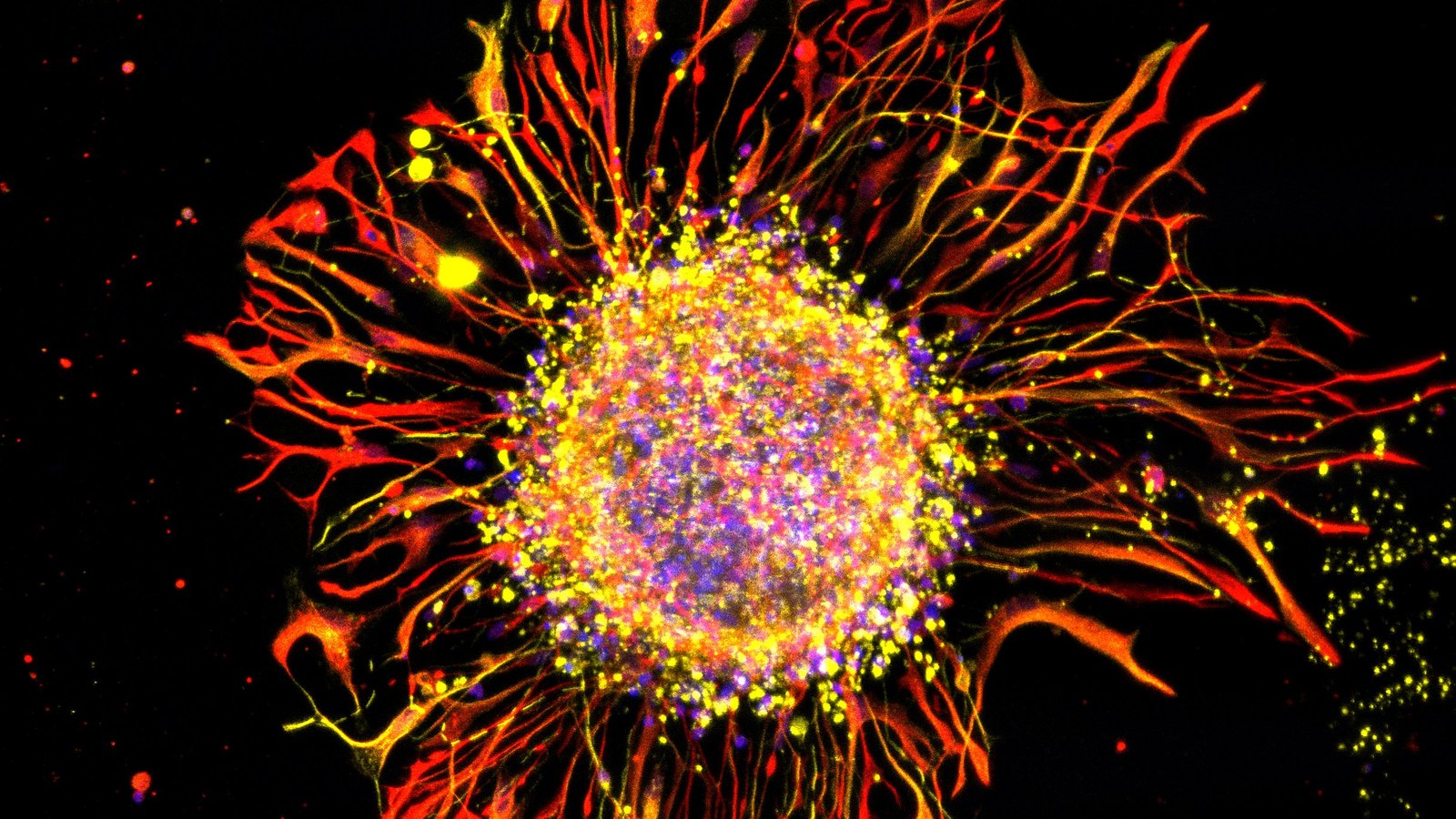
On November 24, 2026, researchers at the Allen Institute in Seattle announced the release of Bloom: a powerful AI model creates a universal language for scientists, introducing a transformer-based multimodal foundation model that unifies single-cell transcriptomic and chromatin accessibility profiles to align disparate brain data across global research laboratories.
What happened
The Allen Institute research team, directed by associate investigator Uygar Sümbül and scientist Rohan Gala alongside computational researchers Ian Convy and Yeganeh Marghi, made the architecture and model checkpoints public following the deposition of their research preprint on bioRxiv: Bloom unifies brain cell representations across modalities and contexts. Built in collaboration with Amazon Web Services through nonprofit computing credits and technical guidance from AWS machine learning engineers, the project establishes a shared mathematical coordinate space for heterogeneous single-cell neurobiology assays.
Single-cell neuroscience has historically generated isolated data silos. One laboratory may classify cortical interneurons using single-cell RNA sequencing (scRNA-seq) to quantify messenger RNA fragments, while another characterizes identical tissue regions through single-nucleus assay for transposase-accessible chromatin (snATAC-seq) to identify open chromatin peaks. Prior to Bloom, reconciling these observations required specialized pairwise alignment heuristics that frequently failed across experimental batches, anatomical subregions, or disparate sequencing protocols. Bloom resolves this integration bottleneck by training a transformer architecture on jointly measured single-cell transcriptomes and epigenomes, allowing computational algorithms to recognize when two orthogonal measurements describe the same underlying cell type.
Key details and model architecture
Bloom introduces a distinct design philosophy compared to prevailing single-cell foundation models. Rather than relying on brute-force pre-training across tens of millions of uncurated cellular profiles, the Allen Institute team trained Bloom on 300,000 adult mouse brain cells with paired transcriptomic and chromatin accessibility measurements. By employing broad-subclass balancing across anatomical structures, the model achieved state-of-the-art representation quality with roughly 100-fold fewer training cells than contemporary single-cell models.
The model architecture encompasses approximately 130 million parameters, contrasting with the 400 million to 700 million parameters typical of large unimodal genomic models. Bloom combines tokenized genomic sequence embeddings with randomly sampled multimodal views of each individual cell. During training, the self-attention mechanisms learn bidirectional associations between open regulatory regions and transcribed genes, identifying functional interactions between distal chromatin peaks and gene promoters separated by millions of genomic base pairs.
| Metric or Parameter | Allen Institute Bloom | Geneformer (Broad Institute) | scGPT (Tsinghua / Bo Wang Lab) | Universal Cell Embedding (UCE) |
|---|---|---|---|---|
| Primary Modalities | Paired scRNA-seq and snATAC-seq | Single-cell RNA-seq (transcriptomics) | Single-cell RNA-seq (transcriptomics) | Single-cell RNA-seq (transcriptomics) |
| Training Cell Count | 300,000 paired mouse brain cells | 30 million human cells | 33 million human and mouse cells | 36 million multi-species cells |
| Parameter Scale | 130 million parameters | 10 million parameters (V1) / 106M (V2) | 51 million parameters | 33 million parameters |
| Latent View Sampling | Randomized multimodal cell views | Rank-value gene tokens | Binned gene expression tokens | Protein sequence embeddings |
| Distal Loci Discovery | Direct gene-to-peak attention pairs | Gene-gene co-expression only | Gene-gene attention maps | Cross-species orthology transfer |
| Computational Infrastructure | AWS cloud cluster training | On-premise GPU cluster | Academic high-performance computing | Multi-GPU institutional server |
In quantitative evaluation benchmarks across annotation, continuous expression regression, and cross-dataset label transfer, Bloom matched or outperformed unimodal baselines while requiring substantially less training energy. Its internal representation groups brain cells into consistent geometric clusters even when supplied with fractional gene inputs, confirming robust latent stability across noisy, low-coverage experimental samples.
Background and cell census context
Over the past decade, international initiatives such as the National Institutes of Health BRAIN Initiative Cell Census Network (BICCN) and its successor, the BRAIN Initiative Cell Atlas Network (BICAN), have cataloged hundreds of distinct neuronal and non-neuronal cell types across mammalian brains. While these reference atlases established comprehensive nomenclatures, individual academic investigators often struggle to align their localized laboratory samples with national reference standards.
The challenge stems from technical discordance: variations in droplet microfluidics platforms, sequencing depth, reagent chemistry, and cell dissociation protocols create severe batch effects. Furthermore, laboratories frequently employ different metadata schema structures and indexing terminologies when uploading raw counts to an institutional or public data repository. Bloom addresses these discrepancies by translating disparate measurements into a standardized embedding space, reinforcing community-wide adherence to FAIR Data Principles by making complex single-cell observations findable, accessible, interoperable, and reusable across disparate scientific platforms.
Reaction and stakeholder perspectives
Researchers at the Allen Institute emphasized that Bloom functions primarily as an analytical bridge and hypothesis-generating engine. Associate investigator Uygar Sümbül explained that the model allows scientists to import collective biological insights from external studies directly into their own specialized projects. Sümbül noted that when an investigator can mathematically verify that their experimental cells correspond to cells profiled in an external study, they can reliably infer biological properties that were not directly measured in their own assays, unlocking deeper functional context without repeating costly experiments.
Highlighting the model efficiency, Sümbül observed that reading different editions of the same book ten times over yields limited additional wisdom compared to reading different books, illustrating why curated multimodal diversity outperforms massive uncurated data ingestion. Scientist Rohan Gala pointed out that as functional genomics expands, laboratories will capture increasingly diverse cellular features, positioning Bloom as an extensible framework to map genome-wide cellular landscapes and navigate incomplete, heterogeneous observations.
Amazon Web Services, which partnered on the computational execution, underscored the value of targeted architecture over raw compute scale. Rick Buettner, managing director of Global Nonprofits at Amazon Web Services, noted in an AWS brain mapping initiative analysis that the collaboration demonstrates how smarter training data structures allow scientific teams to accelerate discoveries while managing high-performance computing overhead.
What it means for researchers, universities and research offices
For academic principal investigators and core bioinformatics facilities, Bloom alters the operational economics of single-cell neuroscience. Institutional laboratories can download pre-trained model weights from open repositories and execute inference tasks—such as automated cell type classification, cross-assay label transfer, and missing modality imputation—on local workstations or modest campus clusters, bypassing the multimillion-dollar compute barriers typical of frontier artificial intelligence.
For university research offices and data compliance managers, the model supports compliance with data management and sharing mandates. Under the NIH Genomic Data Sharing (GDS) Policy, federally funded researchers must register genomic datasets and secondary analytical outputs in designated repositories. Because Bloom links gene expression to specific regulatory chromatin peaks, research administrators and compliance officers should ensure that secondary machine learning embeddings derived from human or animal subjects adhere to institutional review board consents and open-science repository metadata standards.
Research computing directors can also leverage the model efficiency to reduce high-performance computing queue congestion. By shifting from sprawling, multi-week foundation model pre-training to fine-tuning compact 130-million-parameter checkpoints, university facilities can conserve electrical power and optimize GPU cluster scheduling for biomedical departments.
What happens next
The Allen Institute has deposited the complete Bloom codebase, model configuration parameters, and inference demonstration notebooks in public repositories for academic review. The development team plans to extend the architecture to incorporate additional experimental modalities, including patch-clamp electrophysiology recordings and three-dimensional neuronal morphology reconstructions.
Ongoing research will evaluate the model performance on emerging human brain datasets generated through BICAN consortia, testing whether cross-species transfer learning can project mouse regulatory principles onto human cortical architectures. Independent computational biology teams are expected to benchmark Bloom against alternative foundation architectures through open community challenges in early 2027.
Sources
- Allen Institute: Bloom: a powerful AI model creates a universal language for scientists, checked 2026-11-26
- bioRxiv: Bloom unifies brain cell representations across modalities and contexts, checked 2026-11-26
- National Institutes of Health: The BRAIN Initiative Cell Census Network (BICCN), checked 2026-11-26
- Amazon Web Services: How scientists are using AWS AI and ML to map the whole human brain, checked 2026-11-26






