
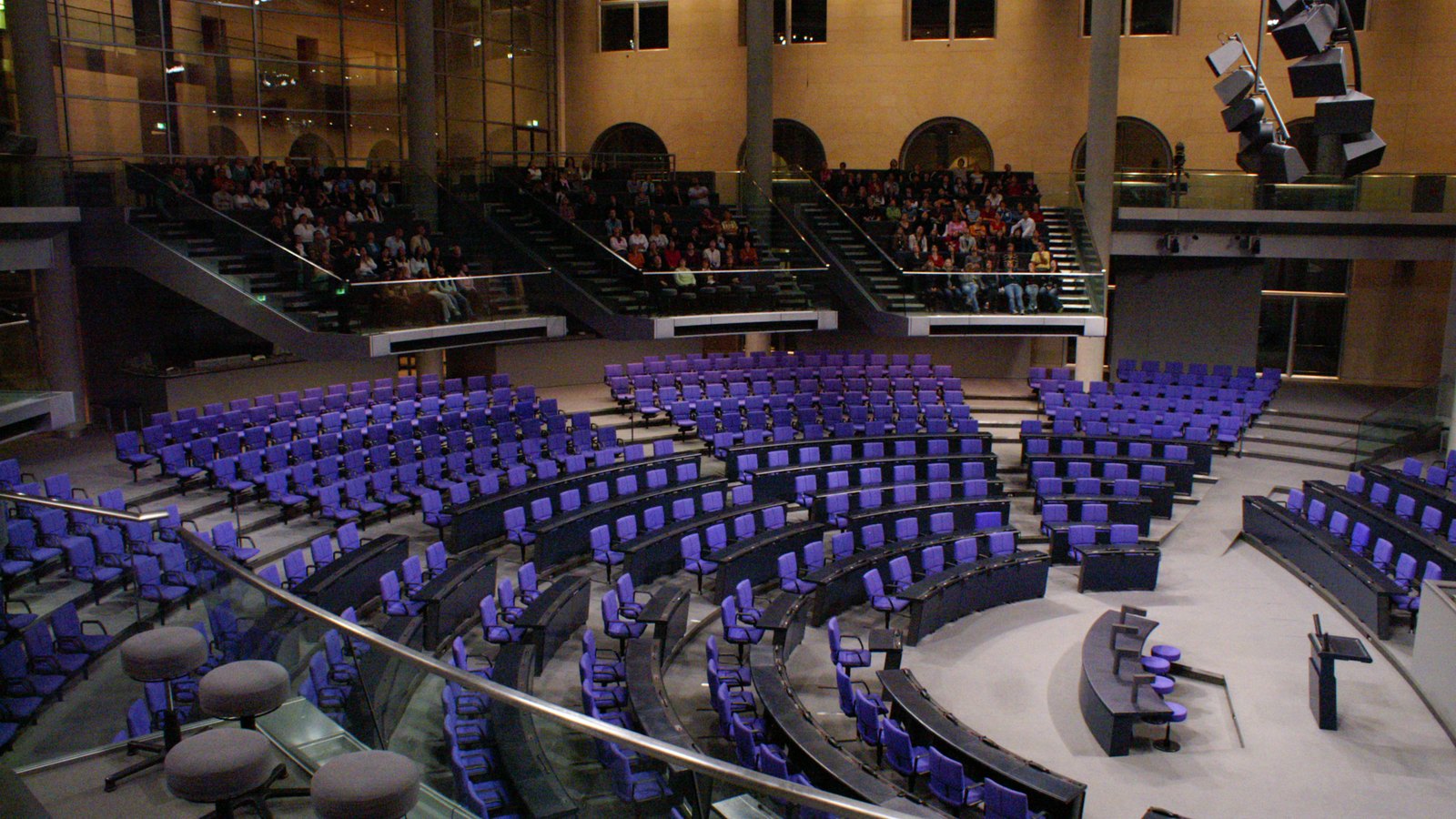
The German Bundestag is debating the 2027 budget of the Federal Ministry of Research, Technology and Space (BMFTR, Einzelplan 30) in second reading on Tuesday 24 November 2026, with a vote scheduled after a 90-minute debate, according to the Bundestag’s own page on the debate. The budget committee’s recommendation puts the ministry at €21.97 billion for 2027, against €21.82 billion in 2026, and ties part of that money to savings that fall on research organisations.
What happened
The Bundestag’s text archive lists the BMFTR budget for the sitting of 24 November 2026 and refers to the committee recommendation (Drucksache 21/9062) and its supplement (21/9061). The page, dated 24 November, shows the debate and the scheduled vote but no result, so no outcome is reported here. The full federal budget act goes to its third reading in the same sitting week, which runs from 24 to 27 November, as Forschung & Lehre notes.
The budget committee settled the whole 2027 federal budget in the early hours of Friday 13 November 2026, after a session that began on Thursday afternoon and ended at 5:55. According to the Bundestag’s parliamentary news service (hib 939/2026), the committee voted on about 2,000 motions and adopted the draft with the votes of CDU/CSU and SPD. Total spending is €560.92 billion, €5.48 billion more than the government draft (Drucksache 21/7300).
Key details of the research budget
The Bundestag page gives these figures for Einzelplan 30 in 2027.
| Item | 2027 figure |
|---|---|
| BMFTR budget in total | €21.97 billion (2026: €21.82 billion) |
| Hightech Agenda (chapter 3004) | €8.78 billion, €456 million above the 2026 target of €8.33 billion |
| Helmholtz centres within that chapter | about €3.17 billion |
| Fraunhofer-Gesellschaft within that chapter | about €887 million |
| Competitiveness of the science system (chapter 3003) | €8.45 billion, including about €2.21 billion for the Zukunftsvertrag Studium und Lehre stärken and €600 million for the Excellence Strategy |
| Education and talent (chapter 3002) | €2.56 billion, including €1.19 billion for BAföG for students |
| Space (chapter 3005) | €2.24 billion, of which about €1.05 billion for the European Space Agency |
| Investments | €3.91 billion, €267 million more than in 2026 |
Outside the ministry’s core budget, research and development spending from the special fund for infrastructure and climate neutrality is set at €1.71 billion for 2027, up from €1.07 billion in 2026. During the committee’s deliberations the national space infrastructure line in that fund was raised by €40 million to €100 million. The committee also created a new biotech budget title with €1 million, backed in the special fund by €199 million in commitment authorisations plus €140 million for Hightech Agenda biotech projects. Those funds are blocked until a concept involving the Länder is submitted.
The ministry’s savings target, the global spending reduction (globale Minderausgabe), stands at about €759 million in the Bundestag’s figures, against about €359 million in 2026, made up of €639 million general and €120 million for efficiency measures. Forschung & Lehre reports that about €100 million of the efficiency part was covered by cuts to individual budget lines and about €20 million was added, bringing the target to €660 million after the committee’s final session.
Background and context
The 2027 draft followed a tight spending round. Forschung & Lehre reported earlier that the ministry’s core budget was a narrow 0.7% plus, or €148 million, over 2026 in the cabinet draft, with the Pact for Research and Innovation guaranteeing the participating organisations such as the DFG annual increases of 3%, in a report that cites the Wiarda blog. Under that reading, the pact commitments, the Zukunftsvertrag and the Excellence Strategy take a growing share of a ministry budget that is itself flat. The same report notes the research money in the special fund rising from about €1 billion to €1.7 billion in 2027, much of it meant for the Hightech Agenda Deutschland.
The BMFTR is the federal research funder that carries the space and Hightech Agenda portfolios; the CASRAI guide to its predecessor ministry, the BMBF, explains how federal research funding in Germany is organised.
The reserve drawdown for research organisations
The most consequential decision for research organisations is not a line in the ministry’s headline total. According to Forschung & Lehre (20 November 2026), the budget committee obliged the large non-university research organisations and the DFG to draw down their reserves (Selbstbewirtschaftungsmittel) as planned, and signalled that future grants could be cut if they do not. The organisations named are the Helmholtz Association, the Fraunhofer-Gesellschaft, the Max Planck Society and the Leibniz Association, among others.
The report cites education journalist Jan-Martin Wiarda for federal-grant reserves of about €1.8 billion at the end of 2025, and CDU budget rapporteur for research Carsten Körber for an expected one-off €300 million to €400 million in 2027 toward the savings targets. Most of the reserves are tied to specific projects, and most of those finance construction, so Wiarda warns that delays could bring cuts.
Reaction
The Bundestag page records the positions taken in the debate. Minister Dorothee Bär (CSU) called the budget one that solves problems. Wiebke Esdar (SPD) said BAföG is an investment in equal opportunity and that its reform should not fall victim to spending cuts. Paula Piechotta (Greens) criticised accounting manoeuvres and high global spending reductions that she said could leave funds unused, and warned that large projects such as fusion reactors are not fully financed. Nicole Höchst (AfD) criticised the special fund for postponed decisions and unclear financing for fusion and quantum technologies. Nicole Gohlke (Die Linke) said BAföG funding is close to stagnant at about €50 million more.
On the university side, Forschung & Lehre quotes Walter Rosenthal, president of the German Rectors’ Conference (HRK), on 20 November calling on federal and state governments to meet their shared responsibility for a high-performing university system and saying that ending the annual increases would amount to a real cut. Wiarda, in a commentary of 19 November, calls the committee’s course a “Generalangriff” on the Pact for Research and Innovation and writes that it wants the pact organisations to cover gaps in the research budget already in 2027. He also reports that a BMFTR spokesperson said budget consolidation must not come at the expense of important future investments.
What it means for researchers, universities and research offices
For the DFG, Helmholtz, Fraunhofer, Max Planck and Leibniz, the practical change is that unspent project money is now counted against the 2027 savings target. Research offices at those organisations and at university-linked institutes that draw on them should expect closer scrutiny of reserves, particularly construction projects, where a slipping schedule could now translate into a cut instead of a carry-over. The Fraunhofer and Helmholtz lines sit inside the Hightech Agenda chapter, which grows by €456 million in the Bundestag’s figures, while the savings target presses on the ministry as a whole.
For universities, the bigger question is what happens after 2027. The Zukunftsvertrag’s annual increases are agreed only through 2027 and the Pact’s 3% guarantee currently runs through 2030, according to Forschung & Lehre and Wiarda. Rosenthal’s statement and Wiarda’s commentary both frame the budget as a test of whether those commitments continue. Researchers in biotech should note that the new title’s funds are blocked until the federal government and the Länder agree a concept.
What happens next
The Bundestag votes on the BMFTR budget on 24 November 2026 and takes the full federal budget in third reading in the same sitting week, 24 to 27 November. Forschung & Lehre and Wiarda both point to the Joint Science Conference (GWK) of federal and state ministers on 4 December 2026, chaired by Bär, where draft points on adjusting the Zukunftsvertrag and on the priorities of the pact organisations are expected on the agenda. Agreements that mainly concern universities require unanimity under Article 91b of the Basic Law.
Sources
- Deutscher Bundestag, text archive: Forschung, Technologie und Raumfahrt, Einzelplan 30, 24 November 2026
- Deutscher Bundestag, hib 939/2026: Haushaltsausschuss adopts the 2027 federal budget, 13 November 2026
- Forschung & Lehre: Budget decisions raise savings pressure on science organisations, 20 November 2026
- Forschung & Lehre: Only a narrow plus for the BMFTR core budget
- Jan-Martin Wiarda blog: Das Elf-Tage-Fenster, 19 November 2026






