
The Department of Energy’s National Nuclear Security Administration filed an official notice on November 24, 2026, convening a virtual public Molybdenum-99 Stakeholders Meeting scheduled for December 3, 2026. The annual forum reviews domestic non-highly enriched uranium production under the American Medical Isotopes Production Act, bringing together federal regulators, commercial isotope producers, university research reactors, and health systems to safeguard diagnostic radiopharmaceutical supplies.
Statutory mandate and meeting announcement
The Department of Energy (DOE) and the National Nuclear Security Administration (NNSA) filed Federal Register Notice 2026-23975 on November 24, 2026, scheduling an open stakeholder conference on domestic molybdenum-99 (Mo-99) production. As detailed in Federal Register Notice 2026-23975, the public session will take place virtually on Thursday, December 3, 2026, from 10:00 a.m. to 11:00 a.m. Eastern Standard Time.
The notice was signed in Washington, D.C., on November 23, 2026, by Scott W. Pappano, Principal Deputy Administrator of the NNSA, under delegated authority from the Secretary of Energy, with electronic filing certified by DOE Federal Register Liaison Officer Treena V. Garrett. The convening fulfills Section 3173(a) of the American Medical Isotopes Production Act of 2012 (AMIPA), enacted as Public Law 112-239 and codified at 42 U.S.C. 2065(a). The statute directs the Secretary of Energy to carry out a technology-neutral program supporting domestic Mo-99 production without proliferation-sensitive highly enriched uranium (HEU) and to update the national program plan annually through public workshops.
Inquiries regarding the proceeding are coordinated by Brett Cox in the NNSA Office of Reactor Conversion and Uranium Supply, reachable by phone at (202) 287-5191 or by email at [email protected].
Meeting logistics and public participation rules
The meeting will be conducted virtually via Zoomgov.com. Attendees must register through the portal hosted by Argonne National Laboratory (mo99.ne.anl.gov/2026stakeholders/) by Tuesday, December 1, 2026, at 5:00 p.m. EST. The NNSA confirmed that connection details and agenda updates will appear on that page, with accommodation options available for participants with disabilities who submit requests during registration.
The 60-minute agenda allocates 20 minutes to formal NNSA Mo-99 Program Updates, followed by 40 minutes of moderated open discussion and audience questions. Discussions will focus on irradiation infrastructure, regulatory licensing pathways, and radiopharmacy distribution networks.
To reflect AMIPA’s technology-neutral mandate, the following table outlines the main non-HEU domestic production routes funded through federal cooperative agreements:
| Technology Pathway | Primary Mechanism | Target Form | Key Proliferation Advantage |
|---|---|---|---|
| Subcritical Assembly | Accelerator-driven DT neutron source | Low-enriched uranium sulfate liquid | Eliminates critical mass and weapon-grade enrichment |
| Neutron Capture (n,gamma) | Reactor or accelerator irradiation of Mo-98 | Enriched or natural molybdenum metal | Eliminates uranium usage and fission product waste |
| LEU Fission in Research Reactors | Thermal neutron fission in core target | Low-enriched uranium solid foil or alloy | Uses existing reactor infrastructure without HEU |
| Photo-Neutron Reaction (gamma,n) | Superconducting electron linear accelerator | Sintered enriched molybdenum-100 | Zero uranium footprint with modular scaling |
Transitioning from foreign HEU to domestic non-HEU production
Molybdenum-99 is the parent isotope of technetium-99m (Tc-99m), which is used in roughly 80 percent of all diagnostic nuclear medicine procedures. Over 40,000 diagnostic scans occur daily in the United States, supporting non-invasive cardiac perfusion studies, cancer staging, and organ assessments. Because Mo-99 has a half-life of 66 hours and Tc-99m decays with a 6-hour half-life, neither can be stockpiled, requiring an uninterrupted weekly supply chain from target irradiation to radiopharmacy elution generators.
Historically, the United States relied entirely on foreign research reactors in Canada, the Netherlands, Belgium, and South Africa. Many of these aging facilities burned weapons-grade HEU containing up to 93 percent uranium-235. International shipments of civilian HEU created non-proliferation risks, while unplanned reactor maintenance outages caused clinical supply shortages across American healthcare systems.
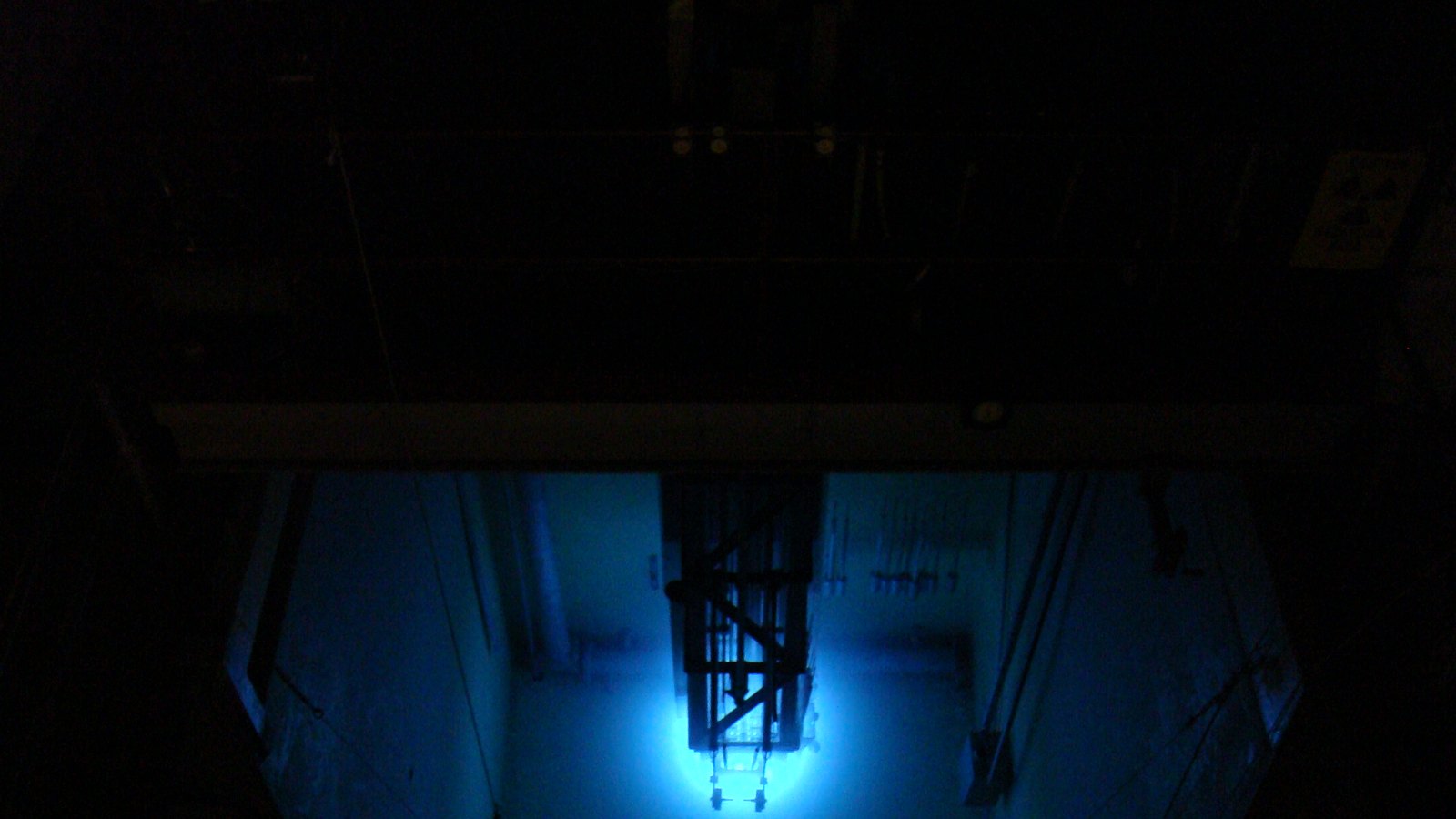
In response, AMIPA mandated a domestic supply strategy administered through the NNSA Molybdenum-99 Program under the Office of Material Management and Minimization (M3). The office established 50-50 cost-share cooperative agreements with private partners to build domestic non-HEU facilities while aiding global reactor conversions. Academic facilities and national laboratories examining high-flux isotope reactor neutron physics provided foundational data on target design, core flux benchmarks, and chemical separation to support the transition.
Commercialization milestones and public-private investments
Domestic commercialization efforts have reached critical operational milestones. In Wisconsin, SHINE Technologies has advanced construction on its Chrysalis isotope facility in Janesville, pairing accelerator-driven neutron sources with subcritical liquid LEU targets. Demonstrating ongoing federal support for domestic capacity, the DOE Office of Energy Dominance Financing announced a conditional loan commitment of up to $263 million to help complete the facility.
According to reporting from World Nuclear News, the federal loan commitment supports final construction and commissioning as the company scales commercial capacity. Industry analysis by the American Nuclear Society noted that expanding domestic production fulfills congressional objectives to eliminate civilian HEU trade while insulating domestic hospitals from foreign supply disruptions. Technical briefings and facility tours held during NNSA stakeholder proceedings, detailed in SHINE stakeholder updates, have allowed health network buyers and nuclear pharmacists to review production hot cells and extraction systems.
Other domestic projects backed by NNSA cooperative agreements, including NorthStar Medical Radioisotopes and Niowave, are developing complementary non-uranium methods utilizing electron accelerators and reactor neutron capture on molybdenum targets. The Nuclear Regulatory Commission (NRC) continues regulatory reviews across these sites, moving facilities from construction permits to Part 50 operating licenses.
What it means for researchers, universities and research offices
The growth of domestic non-HEU isotope manufacturing carries immediate operational implications for academic research facilities, university research reactors, and sponsored project offices:
- Research Reactor Utilization and Separation Science: University-operated research reactors holding NRC licenses play a direct role in testing novel target geometries and neutron capture yields. Chemistry programs focused on radioanalytical and nuclear chemistry benefit from federal research awards investigating automated chromatography, hot cell target processing, and rapid technetium-99m elution chemistry.
- Grants Management and Subaward Compliance: Academic institutions collaborating on NNSA, DOE, or NIH isotope consortia must manage complex award requirements. Projects involving cost-share commitments and equipment thresholds require rigorous monitoring under FSRS reporting guidelines to maintain compliance across subrecipients and commercial subcontractors.
- Capital Infrastructure and Laboratory Procurement: Radiochemistry facilities and campus nuclear pharmacies must account for long-term operational costs when upgrading shielded hot cells, radiation monitors, and elution systems. Department administrators budgeting for capital equipment must incorporate maintenance, calibration, and decommissioning liabilities into their total cost of ownership planning.
- Nuclear Workforce Training: The expansion of commercial and academic isotope facilities creates steady demand for trained radiochemists, health physicists, and reactor operators, prompting universities to expand nuclear science certificate and degree programs.
Upcoming milestones and implementation timeline
Academic, industrial, and clinical stakeholders should track several near-term deadlines and regulatory milestones:
- December 1, 2026 (5:00 p.m. EST): Registration deadline for virtual attendance at the NNSA stakeholders meeting via the Argonne host site.
- December 3, 2026 (10:00–11:00 a.m. EST): Annual NNSA Mo-99 Stakeholders Meeting held virtually on Zoomgov.com.
- First Quarter 2027: Expected release of the NNSA’s updated annual domestic Mo-99 program plan incorporating stakeholder feedback.
- Mid-2027: Scheduled NRC licensing reviews and commissioning milestones for domestic non-HEU commercial production facilities.
Sources
- Federal Register: Hearings, Meetings, Proceedings, etc.: Molybdenum-99 Stakeholders, checked 2026-11-24
- U.S. Department of Energy: NNSA’s Molybdenum-99 Program: Establishing a Reliable Domestic Supply of Mo-99 Without the Use of Highly Enriched Uranium, checked 2026-11-24
- American Nuclear Society: Shine receives $263M conditional DOE loan to complete isotope facility, checked 2026-11-24
- World Nuclear News: Conditional funding announced for US fusion-based isotope facility, checked 2026-11-24
- SHINE Technologies: SHINE tour part of NNSA’s Mo-99 Stakeholders Meeting, checked 2026-11-24






