
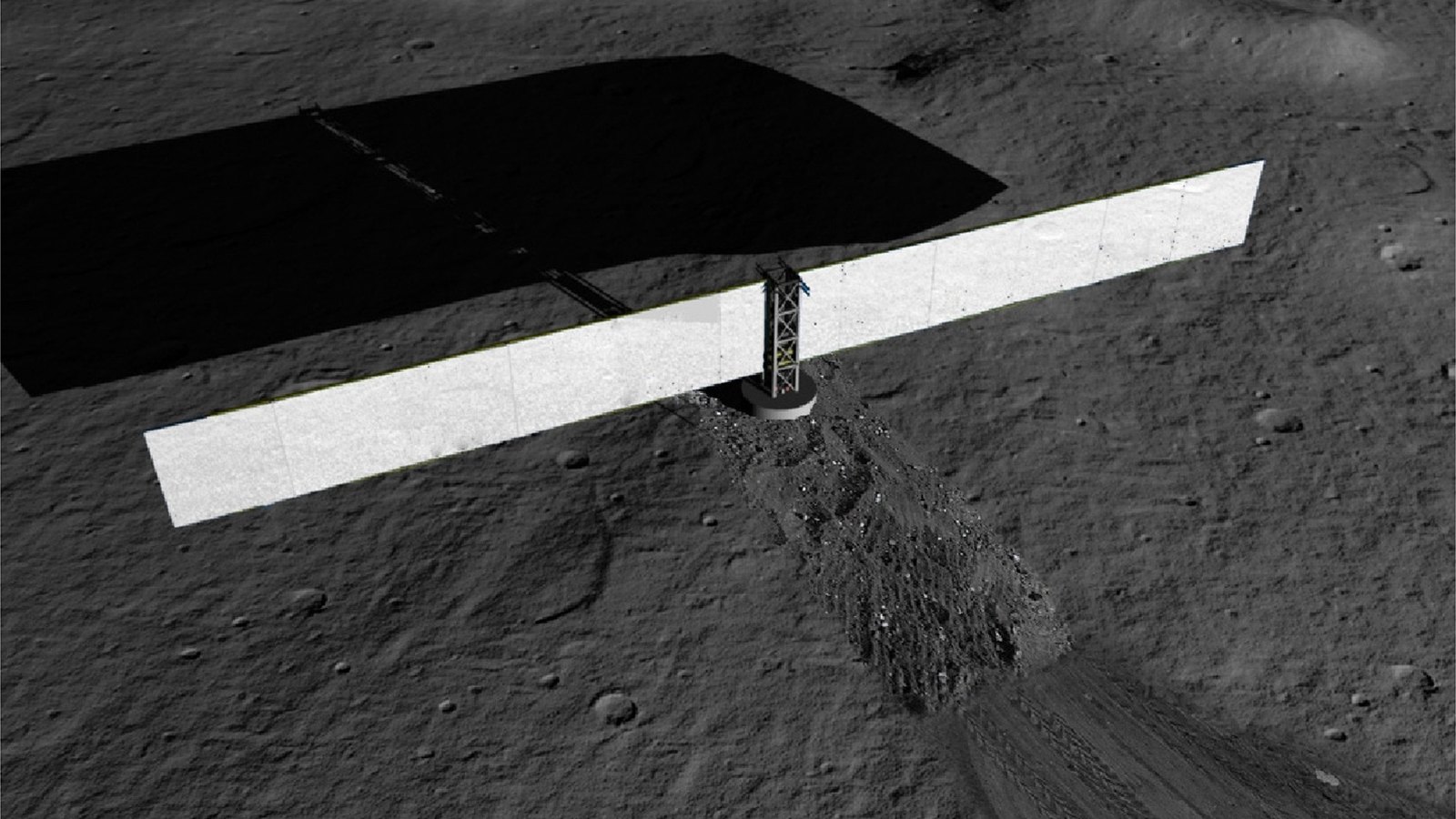
On November 23, 2026, NASA officially released a request for proposals seeking industry and research partners to design, build, and test Lunar Reactor-1, a 20-kilowatt nuclear fission power system scheduled to operate on the Moon by 2030. Managed alongside the Department of Energy, the initiative establishes commercial contracting mechanisms and research funding pathways for university nuclear engineering departments and national laboratory consortia developing space-qualified reactor fuels, power conversion systems, and extreme-environment instrumentation.
What Happened: NASA Solicits Proposals for Lunar Fission Power
On November 23, 2026, NASA released its formal request for proposals seeking industry and research teams to design and ground-test Lunar Reactor-1 (LR-1), the agency’s first operational fission power station for the lunar surface. As outlined in the official NASA announcement, the solicitation transitions exploratory fission surface power concepts into an active flight-hardware procurement. NASA aims to deliver a launch-ready reactor system by 2030 that will operate autonomously on the Moon for at least five continuous years.
The solicitation incorporates stakeholder feedback from a draft proposal released in August 2026 and an industry day held in September 2026 at the Ohio Aerospace Institute in Cleveland. Brian Giblin, program manager for Lunar Reactor-1 at NASA, emphasized the mission-critical role of surface fission: “This request for proposals represents an important step forward as NASA partners with industry to establish an enduring human presence on the lunar surface. A reliable source of safe and abundant energy will be vital to future exploration of the lunar and Martian surface. Space nuclear systems will provide continuous power to NASA assets in any environment without dependency on sunlight.”
The competition is administered under the Space Power and Reactor Capabilities initiative on SAM.gov, with formal bids due by December 21, 2026.
Key Technical and Procurement Specifications
Operating a fission system in the lunar polar environment requires balancing electrical output, thermal dissipation, and mass constraints. Lunar Reactor-1 is specified as a 20-kilowatt electric (kWe) class system, generating enough continuous electricity to power roughly 16 average U.S. households on Earth. At the lunar South Pole, this baseload capacity will support astronaut habitats, life support, rover recharging, communications infrastructure, and scientific drilling rigs.
Because the lunar vacuum prevents convective heat removal, reactor thermal energy must be converted via closed-loop dynamic power units—such as Brayton or Stirling cycle converters—with excess heat radiated into space through deployable panels. The entire flight package must fit within commercial lander payload fairings and meet rigorous spaceflight milestones, following review lifecycles established in standard spacecraft design frameworks.
| System Parameter | Requirement or Specification | Mission Rationale |
|---|---|---|
| Continuous Electrical Output | 20 kilowatts electric (kWe) | Baseload power for Moon Base habitats, rovers, and life support |
| Minimum Operational Life | 5 continuous years | Multi-year autonomous operation without refueling or servicing |
| Target Launch Readiness | 2030 | Synchronized with Artemis crewed lunar base infrastructure |
| Safety Oversight Body | U.S. Department of Energy (DOE) | Mandatory compliance with DOE nuclear operations safety standards |
| Thermal Power Conversion | Closed-loop Brayton or Stirling cycle | Optimizes thermal-to-electric conversion in vacuum environments |
| Procurement Mechanism | Firm-fixed-price milestone contracts | Incentivizes private innovation with progress tied to verified hardware |
| Proposal Due Date | December 21, 2026 | Accelerated bidding timeline to meet the 2030 deployment goal |
NASA is structuring the procurement around firm-fixed-price commercial contracts, releasing funds only upon verified milestone delivery. The solicitation also authorizes follow-on task orders to develop subsequent space nuclear power technologies.
Background and Lunar Power Context
Nuclear fission addresses fundamental constraints that limit solar arrays during long-duration lunar surface missions. Mid-latitude lunar regions endure approximately 354 consecutive hours (14 Earth days) of darkness, where ambient temperatures plunge to -130 degrees Celsius. Even at the lunar South Pole, deep impact craters containing water ice deposits are permanently shadowed from solar illumination. Chemical batteries or fuel cells capable of bridging two weeks of darkness impose prohibitive launch mass penalties, making nuclear fission the only viable option for continuous, multi-kilowatt surface power.
The LR-1 initiative builds upon prior technology maturation programs, including NASA’s 2018 Kilopower (KRUSTI) test. Core materials and fuel cladding studies have historically relied on national user facilities such as the High Flux Isotope Reactor to characterize neutron irradiation behavior under severe operating conditions. The current procurement formalizes long-term federal policy. As reported by World Nuclear News, NASA and the Department of Energy finalized interagency agreements supporting presidential directives to deploy a lunar surface reactor by 2030.
This mandate was further accelerated under National Science and Technology Memorandum 3 (NSTM-3), which established the National Initiative for American Space Nuclear Power, as reported by SpaceQ Media. Under this framework, NASA’s Space Reactors Division is managing LR-1 alongside Space Reactor-1 (SR-1) Freedom, a nuclear electric propulsion spacecraft scheduled for launch in 2028 to transport atmospheric exploration helicopters to Mars.
Stakeholder Reaction and Community Perspectives
Aerospace and nuclear industry stakeholders have welcomed the solicitation as a decisive move toward operational space hardware. Agency leadership noted that surface fission power is essential to transitioning from temporary lunar landings to an enduring Moon Base. Commercial contractors have praised the firm-fixed-price structure for accelerating domestic reactor component supply chains.
However, researchers have underscored the need for careful mission integration. In coverage by BBC Sky at Night Magazine, theoretical astrophysicist Dr. Ethan Siegel examined the engineering benefits of lunar nuclear power alongside potential operational trade-offs for scientific instrumentation. Key concerns include mitigating electromagnetic interference from power electronics that could compromise radio astronomy arrays on the lunar farside, as well as managing core radiation to avoid skewing sensitive gamma-ray spectrometers mapping lunar ice deposits. These factors make regolith shielding and physical separation between reactor and instrument sites critical design priorities.
What It Means for Researchers, Universities, and Research Offices
The solicitation creates substantial collaborative and sponsored research opportunities for university nuclear engineering departments, materials laboratories, and institutional research offices. Because commercial prime contractors require specialized expertise in reactor physics and extreme-environment engineering, academic institutions are vital partners.
For sponsored project offices, the procurement highlights several administrative and compliance mechanisms:
- Consortium Structuring: Industrial prime contractors are assembling academic teams under formal consortium agreement vehicles. Research offices must negotiate intellectual property rights, data management plans, and publication approvals during proposal drafting.
- Interagency Collaboration: Projects involving national laboratories—including Idaho National Laboratory and Los Alamos National Laboratory—frequently operate under interagency cooperative agreement structures and Strategic Partnership Projects.
- Subaward Compliance: Academic departments participating as sub-recipients will execute formal subaward instruments requiring adherence to DOE nuclear safety standards (ASME NQA-1) and federal research security regulations.
- Export Controls: Development involving reactor core physics codes, high-assay low-enriched uranium (HALEU) fuels, and refractory alloys requires compliance with International Traffic in Arms Regulations (ITAR) and Export Administration Regulations (EAR), necessitating Technology Control Plans for participating research teams.
Scientifically, the initiative offers funded research pathways in high-temperature ceramic composites, autonomous reactor control algorithms, Stirling power dynamics, and regolith-based radiation shielding.
What Happens Next
Industry and research consortia must submit final proposals via SAM.gov by December 21, 2026. Following proposal closure, NASA and the Department of Energy will conduct technical and safety evaluations, with Phase 2 engineering awards expected in early 2027.
Selected contractor teams will proceed through critical design reviews and terrestrial thermal-vacuum environmental testing. Under the current schedule, flight hardware integration will culminate in a 2030 launch to deliver the operational reactor to the Moon, establishing the foundation for continuous lunar surface exploration.
Sources
- NASA: NASA Seeks Partners to Design First Nuclear Reactor for the Moon, checked 2026-11-23
- SAM.gov: Space Power and Reactor Capabilities Solicitation, checked 2026-11-23
- U.S. Department of Energy: U.S. Department of Energy and NASA to Develop Lunar Surface Reactor by 2030, checked 2026-11-23
- World Nuclear News: NASA, DOE aim for nuclear reactor on moon by 2030, checked 2026-11-23
- SpaceQ Media: White House directs accelerated space nuclear power initiative, checked 2026-11-23
- BBC Sky at Night Magazine: NASA wants to put a nuclear reactor on the Moon. This US scientist says it could be a very bad idea, checked 2026-11-23






