
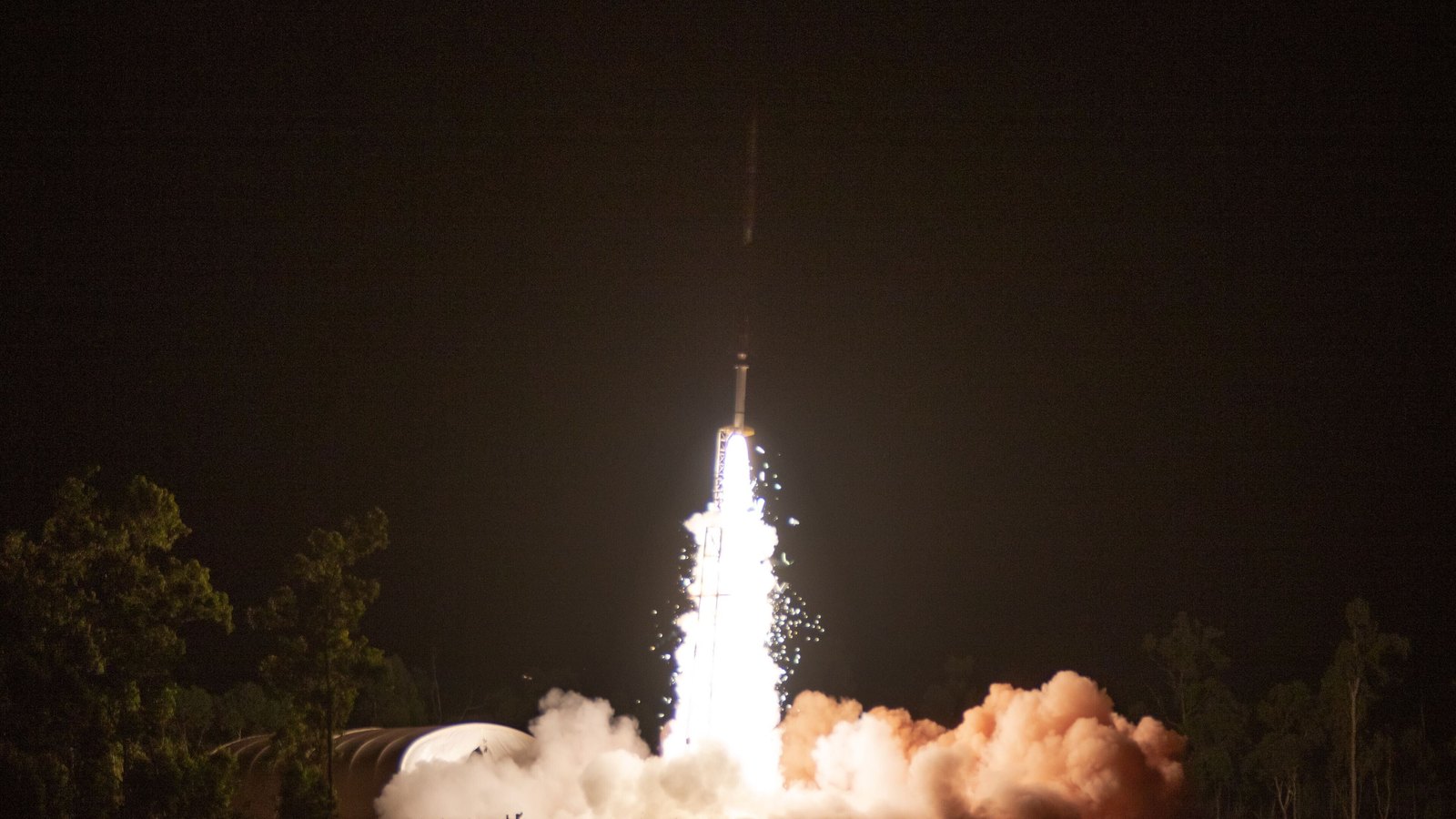
On November 25, 2026, the Federal Aviation Administration filed a public inspection notice announcing its intention to seek renewed clearance from the Office of Management and Budget for the information collection requirements governing experimental permits for reusable suborbital vehicles under 14 CFR Part 437, initiating a federal review of administrative burdens affecting commercial space developers, academic payload teams, and institutional flight-test programs.
Federal Aviation Administration Opens Information Collection Review
The Federal Aviation Administration (FAA), operating through its Office of Commercial Space Transportation (AST), issued Federal Register Document 2026-24096 under Docket Number FAA-2026-7591. The action initiates review under the Paperwork Reduction Act of 1995 for the renewal of Office of Management and Budget (OMB) Control Number 2120-0722, titled “Experimental Permits for Reusable Suborbital Vehicles.” The proceeding allows commercial rocket developers, aerospace researchers, and university research offices to evaluate whether the FAA’s data collection processes remain necessary, accurate in their burden estimates, and appropriately designed to minimize administrative friction without compromising public safety.
The notice was formally signed by James A. Hatt, Space Policy Division Manager within the FAA Office of Commercial Space Transportation. The filing confirms that public inspection opened on November 25, 2026, ahead of publication in the Federal Register on November 27, 2026. The agency invited comments on four statutory criteria: whether the collection is necessary for agency performance; the accuracy of the estimated burden; methods to enhance data quality and clarity; and techniques to minimize compliance burden using automated information technologies.
Key Provisions, Burden Estimates, and Regulatory Scope
Under the renewed clearance, the FAA maintains its framework for evaluating experimental permit applications under 14 CFR Part 437. The collection does not prescribe standardized agency forms. Instead, applicants submit technical safety assessments, hazard analyses, flight safety plans, and operational procedures directly to the Office of Commercial Space Transportation.
The following table outlines the reporting parameters and statutory benchmarks established in the FAA notice and associated Part 437 regulations:
| Regulatory Parameter | Specification / Requirement | Regulatory Authority |
|---|---|---|
| Collection Title | Experimental Permits for Reusable Suborbital Vehicles | OMB Control No. 2120-0722 |
| Governing Regulation | 14 CFR Part 437 (Subparts A through D) | 51 U.S.C. Chapter 509 |
| Annual Respondents | Approximately 10 permit applicants | FAA Docket No. FAA-2026-7591 |
| Average Reporting Burden | 18.6 hours per response | Paperwork Reduction Act Estimate |
| Total Annual Burden Hours | 2,533 hours per year across all respondents | FAA Space Policy Division |
| Statutory Review Timeline | 120-day maximum agency decision window | 51 U.S.C. § 50906(e) |
| Authorized Launch Scope | Unlimited launches/reentries for specified design | 14 CFR § 437.9 |
| Permit Validity Period | 1 year from issuance (renewable annually) | 14 CFR § 437.9(b) |
| Commercial Revenue Status | Strictly prohibited for compensation or hire | 51 U.S.C. § 50906(d) |
Under 14 CFR § 437.5, experimental permits are restricted to three statutory purposes: research and development to test new design concepts, equipment, or operating techniques; showing compliance with requirements to obtain an eventual vehicle operator license; and crew training before obtaining a commercial license. The permit carries strict statutory boundaries: operators cannot carry property or persons for compensation or hire, and permitted operations are not eligible for federal indemnification under 51 U.S.C. § 50915.
Background and Legislative Framework Under 14 CFR Part 437
The statutory basis for experimental permits originated in the Commercial Space Launch Amendments Act of 2004 (CSLAA), codified at 51 U.S.C. Subtitle V, Chapter 509. Congress designed experimental permits to provide aerospace innovators with an agile alternative to the full commercial launch licensing regime. While commercial vehicle operator licenses under 14 CFR Part 450 govern revenue flights, Part 437 supports iterative prototyping, allowing developers to execute envelope expansion flights without requiring separate regulatory authorizations for each hardware modification.
Official guidance from the FAA Office of Commercial Space Transportation requires permit applicants to demonstrate that vehicle operations will not jeopardize public health, public safety, or property safety within a designated operating area. Applicants submit comprehensive systems safety analyses, containment models, and flight safety procedures. Permit approvals also require environmental reviews under the National Environmental Policy Act (NEPA) and interagency foreign policy and national security reviews before authorization is granted.
Industry Perspectives and Commercial Spaceflight Analysis
Commercial space analysts emphasize that the 18.6-hour per-response figure reflects routine reporting and data maintenance rather than initial permit drafting. Independent regulatory analysis published by OrbitDocket points out that Part 437 offers aerospace teams crucial flexibility through its 120-day statutory review window and the equivalent level of safety standard, which permits alternative engineering demonstrations.
However, analysts also highlight the operational divide imposed by Part 437. Because permitted flights cannot carry commercial payloads for compensation, developers must transition to full Part 450 operator licenses once revenue operations begin. As launch cadence grows across suborbital spaceports, renewing OMB Control No. 2120-0722 ensures that the FAA maintains continuous administrative authority to collect safety and hazard data throughout developmental flight campaigns.
What It Means for Researchers, Universities, and Research Offices
Although experimental permits are issued directly to vehicle manufacturers, the regulatory structure directly influences university researchers and academic payload teams. Suborbital scientific investigations funded through mechanisms such as the NASA Flight Opportunities Program regularly fly on reusable vehicles during developmental flight campaigns.
University research offices, principal investigators, and compliance officers must account for several operational considerations:
- Contracting and CRADA Alignment: Academic institutions collaborating with commercial space providers often structure flight-test access through a CRADA or specialized payload agreement. Sponsored research offices must verify whether a mission operates under Part 437 or Part 450, as this directly affects indemnification rights, insurance requirements, and liability allocation.
- Export Controls and Hardware Classification: Flight test payloads and space-qualified telemetry modules frequently trigger federal export controls. Research institutions must maintain compliance with ITAR and EAR compliance for university research, particularly when experimental payloads involve articles categorized under USML Category XV. Compliance administrators must enforce technology control plans when foreign national students participate in ground integration for export-controlled research.
- Hazard Safety and Payload Containment: Under Part 437, vehicle operators are legally required to verify that onboard payloads introduce no uncontrolled risks. University teams providing microgravity biological enclosures, pressurized fluid systems, or specialized batteries must furnish complete hazard analyses and structural safety verifications months before launch.
- Flight Dynamics and Data Integration: Academic researchers evaluating upper-atmospheric physics and microgravity fluid behavior rely on precise flight-test telemetry. Applying core principles of flight mechanics enables engineering teams to calibrate sensor payloads against expected vehicle acceleration, vibration, and dynamic pressure profiles.
What Happens Next
Federal Register Document 2026-24096 was placed on public inspection on November 25, 2026, and is scheduled for official publication on November 27, 2026. Following publication, the public comment period opens via Regulations.gov under Docket Number FAA-2026-7591. Written comments may also be sent by mail to Doris Bishop, Federal Aviation Administration, 1200 New Jersey Avenue SE, Washington, DC 20590, or by email to [email protected].
After reviewing submitted comments, the FAA will refine its burden models and submit the formal clearance package to the Office of Management and Budget for a renewed three-year approval. Commercial launch providers, aerospace trade groups, and academic institutions have until the close of the comment window to submit formal recommendations regarding administrative burden reductions and flight-safety reporting processes.
Sources
- Federal Register: Agency Information Collection Activities: Proposals, Submissions, and Approvals: Experimental Permits for Reusable Suborbital Vehicles (Doc. 2026-24096), checked 2026-11-25
- eCFR: Title 14 CFR Part 437 — Experimental Permits for Reusable Suborbital Rockets, checked 2026-11-25
- Federal Aviation Administration: Experimental Permits for Reusable Suborbital Rockets, checked 2026-11-25
- NASA: Flight Opportunities Program, checked 2026-11-25
- OrbitDocket: What Is an FAA Experimental Permit (Part 437), checked 2026-11-25






