
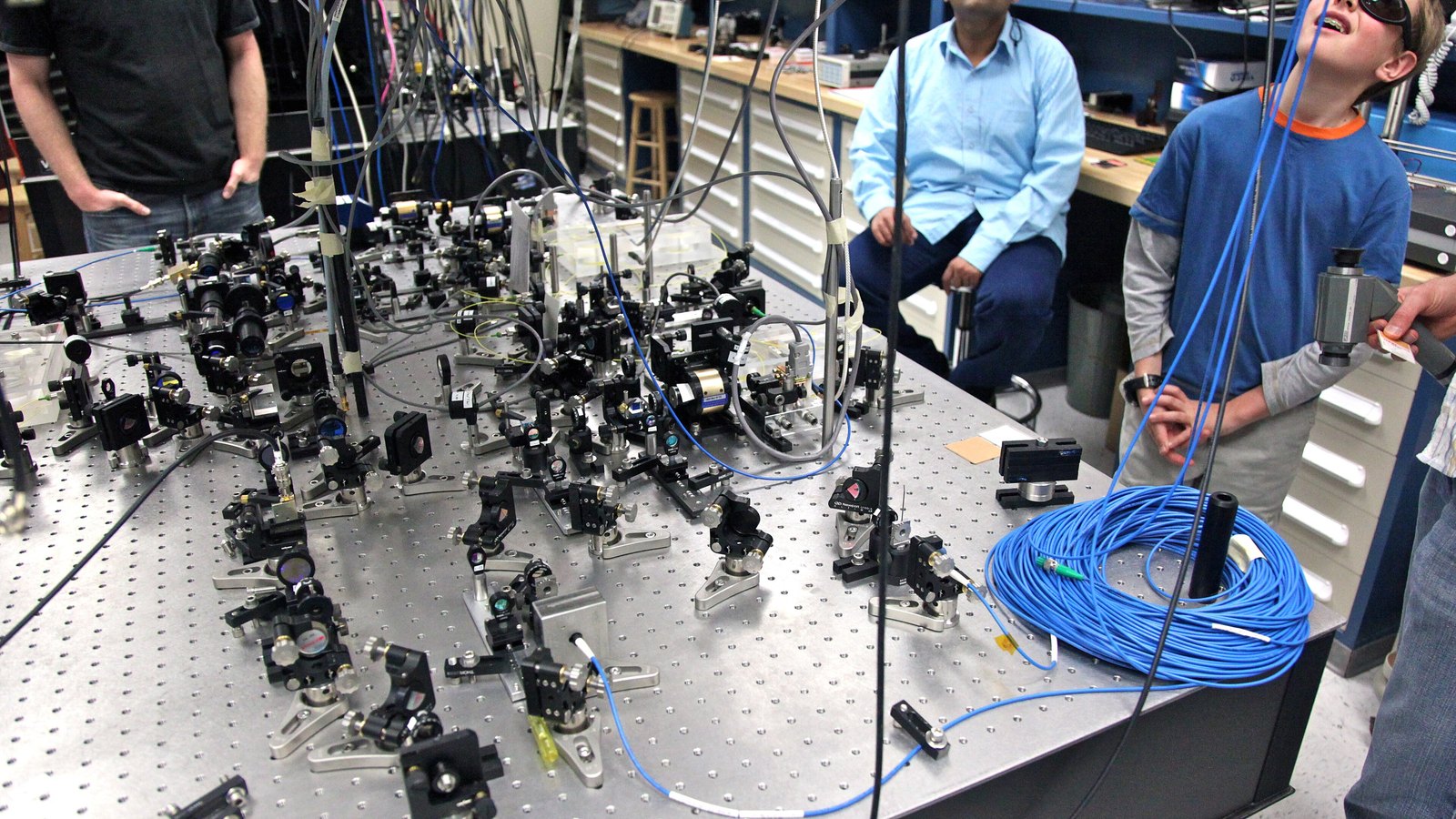
On November 18, 2026, researchers at the National Institute of Standards and Technology and collaborating institutions published experimental findings in Nature demonstrating the first loophole-free quantum position verification protocol across a 195-meter testbed in Boulder, Colorado. The milestone proves physical location using entangled photons and synchronized Bell tests without trusting remote devices, offering research institutions and critical facilities a physics-based mechanism to prevent geospatial spoofing and unauthorized remote access.
Experimental Proof Across a 195-Meter Testbed
The demonstration was led by NIST physicists Gautam Kavuri and Lynden Krister Shalm, alongside co-authors from the University of Colorado Boulder, Oak Ridge National Laboratory, and international research centres. Classical positioning and ranging protocols rely on timing signals sent between stations, but coordinated adversaries using proxy relays or high-speed channels can spoof their apparent coordinates. Quantum position verification eliminates this vulnerability by binding location checks to the laws of quantum mechanics.
To execute the protocol, the team established two trusted verification stations separated by 195 meters (640 feet) within the corridors of a laboratory building on NIST’s Boulder campus. An untrusted party, known as the prover, occupied a designated coordinate between the two verifier terminals. One verifier generated pairs of polarization-entangled photons, retaining one photon while transmitting the other across low-loss optical fiber toward the prover. Concurrently, both verifiers dispatched synchronized classical random bits calibrated to arrive at the prover’s location at the exact same instant.
Upon receiving the random instructions, the prover performed an assigned polarization measurement on the incoming photon and broadcast the binary outcome back to both verifiers. Because physical signals cannot exceed the speed of light, any imposter attempting to relay the quantum challenge to an external accomplice outside the perimeter introduced an unavoidable transmission delay. In an official NIST announcement detailing the location verification findings, Shalm explained that the protocol anchors digital network authentication directly into the physical world, ensuring administrative commands cannot originate from unauthorized remote nodes.
Key Technical Specifications and Performance Metrics
The experimental architecture combined high-speed entanglement generation, real-time classical control electronics, and ultra-low-noise superconducting nanowire single-photon detectors developed by NIST. The system operated at an interrogation rate of approximately 250,000 trials per second, requiring between 30 million and 60 million individual challenge rounds to complete a high-confidence location verification. As reported by Live Science on the quantum position verification experiment, each complete verification run lasted between two and four minutes.
Over two consecutive testing days in fall 2024, the researchers conducted 335 full verification routines. Nearly all trials successfully satisfied the stringent statistical criteria required to confirm the prover’s location. The resulting spatial confidence region was 4.53(5) times smaller in volume than the theoretical minimum achievable by classical localization protocols operating under identical latency constraints, while the one-dimensional localization uncertainty was 2.47(2) times smaller.
| Metric or Parameter | Demonstrated NIST Value | Classical Baseline / Comparison |
|---|---|---|
| Baseline Verifier Distance | 195 meters (640 feet) | Corridor-routed fiber and electrical links |
| System Interrogation Rate | ~250,000 trials per second | Continuous high-repetition pulsed source |
| Rounds per Verification | 30 million to 60 million rounds | 2 to 4 minutes acquisition time per test |
| Consecutive Trials Evaluated | 335 verification runs over two days | Consistent passing rate across test runs |
| 1D Localization Precision | 2.47(2) times smaller uncertainty | Optimal non-remote classical protocol limit |
| 3D Spatial Volume Reduction | 4.53(5) times smaller volume | Classical protocol with identical latencies |
| Detection Technology | Superconducting nanowire single-photon detectors | Near-unity system detection efficiency |
| Device-Independence Status | Fully loophole-free Bell test validation | Prover hardware operates untrusted |
Overcoming Decades of Theoretical and Hardware Loopholes
Theoretical proposals for position-based quantum cryptography first surfaced in the late 2000s, motivated by vulnerabilities in satellite navigation, IP geolocation, and cryptographic key distribution. However, early theoretical frameworks faced severe roadblocks. Most early protocols required unconditional trust in the prover’s hardware or depended on unproven computational complexity assumptions. Furthermore, theoretical proofs showed that colluding adversaries sharing pre-existing quantum entanglement could circumvent simple quantum position checks by executing teleportation-based attacks.
Earlier experimental attempts were also hindered by the detection loophole. In standard photonic networks, transmission losses and inefficient detectors permit photon losses exceeding 50 percent, allowing dishonest parties to disguise cheating attempts as lost signals. As highlighted by Quantum Zeitgeist in technical reporting on the NIST verification protocol, the Boulder team resolved these challenges by integrating an untrusted-device Bell test with superconducting single-photon detectors that capture almost every transmitted light particle.
By enforcing a loophole-free Bell inequality test across the distributed testbed, the verifiers do not need to inspect the internal circuitry or software of the prover’s measurement apparatus. If the prover’s device is compromised, the measured Bell correlations drop below the quantum threshold, immediately flagging the transaction as invalid. The no-cloning theorem ensures an adversary cannot duplicate unknown quantum states to measure them simultaneously at multiple locations without introducing detectable noise.
Independent Scientific Reactions and Cryptographic Analysis
The achievement has drawn broad attention across the international quantum networking and cybersecurity communities. In reporting by Gizmodo on the quantum position verification trial, University of Florence quantum physicist Davide Bacco, who authored an accompanying analytical perspective in Nature, characterized the demonstration as the first to achieve verifiable device-independent spatial security.
Bacco emphasized that while the NIST demonstration is fully secure against adversaries possessing classical resources or weak initial entanglement, attackers endowed with massive, multi-qubit entangled states could theoretically coordinate more sophisticated attacks. Entanglement serves as a dual-edged resource in quantum communication, providing robust protection for honest participants while potentially offering attack vectors for well-resourced adversaries.
NIST study co-author Scott Glancy acknowledged these considerations, noting that widespread commercial or institutional adoption remains at least a decade away. Operational implementations will require mature quantum repeater networks capable of distributing high-fidelity entanglement across metropolitan distances without reliance on cryogenic laboratory setups.
Implications for University Networks and Research Security
For universities, research institutes, and high-performance computing facilities, the experimental validation of quantum position verification highlights how physical infrastructure will increasingly integrate with identity and access management. Academic environments manage repositories of sensitive intellectual property, high-consequence laboratory controllers, and export-controlled scientific datasets. Classical perimeter defenses, including multi-factor authentication and virtual private networks, remain vulnerable to credential theft and remote session hijacking.
Research institutions subject to federal research security mandates face obligations to verify that personnel accessing controlled computational assets reside in authorized jurisdictions. Position-authenticated access controls could eventually allow sensitive data enclaves to reject administrative logins unless the operator physically resides within an accredited trusted research environment or designated university research room.
Additionally, research security officers overseeing compliance with the Export Control Reform Act must track physical and digital access to dual-use scientific equipment. Incorporating location verification protocols into institutional cybersecurity profiles—such as frameworks aligned with NIST SP 800-61 Rev. 3 incident response guidelines—provides a roadmap for transitioning from software-defined access tokens to physically grounded quantum authentication once metropolitan quantum fiber testbeds expand.
Future Development Milestones and Network Scaling
Following the successful 195-meter proof-of-principle, the NIST consortium is focusing on expanding operating distance, temporal throughput, and environmental robustness. A primary near-term objective is reducing the verification duration from several minutes down to approximately one second. Achieving sub-second verification will require integrating faster optical electro-optic modulators, streamlined FPGA processing pipelines, and higher-rate entangled photon pair sources.
NIST and regional quantum alliance partners plan to evaluate extended-range field trials connecting separate campus buildings and regional research centers across metropolitan fiber loops. In an analysis published by Help Net Security on quantum position verification applications, initial operational deployments are anticipated within financial clearing houses and defense communications before transitioning to broader academic and telecommunications backbones. Federal funding through national quantum initiatives is expected to support pilot testbeds exploring multi-verifier geometries capable of verifying three-dimensional coordinates across complex facilities.
Sources
- Nature: Quantum position verification with remote untrusted devices, checked 2026-11-21
- National Institute of Standards and Technology: Quantum Physics Can Verify a Person’s Location, NIST Researchers Show, checked 2026-11-21
- Live Science: Quantum entanglement could thwart hackers and scammers, physicists reveal in new experiment, checked 2026-11-21
- Gizmodo: Quantum Trick Can Catch People Faking Their Location, checked 2026-11-21
- Quantum Zeitgeist: Quantum Physics Confirms A Person’s Location, NIST Scientists Demonstrate, checked 2026-11-21
- Help Net Security: Quantum position verification could lock remote hackers out, NIST shows, checked 2026-11-21


