
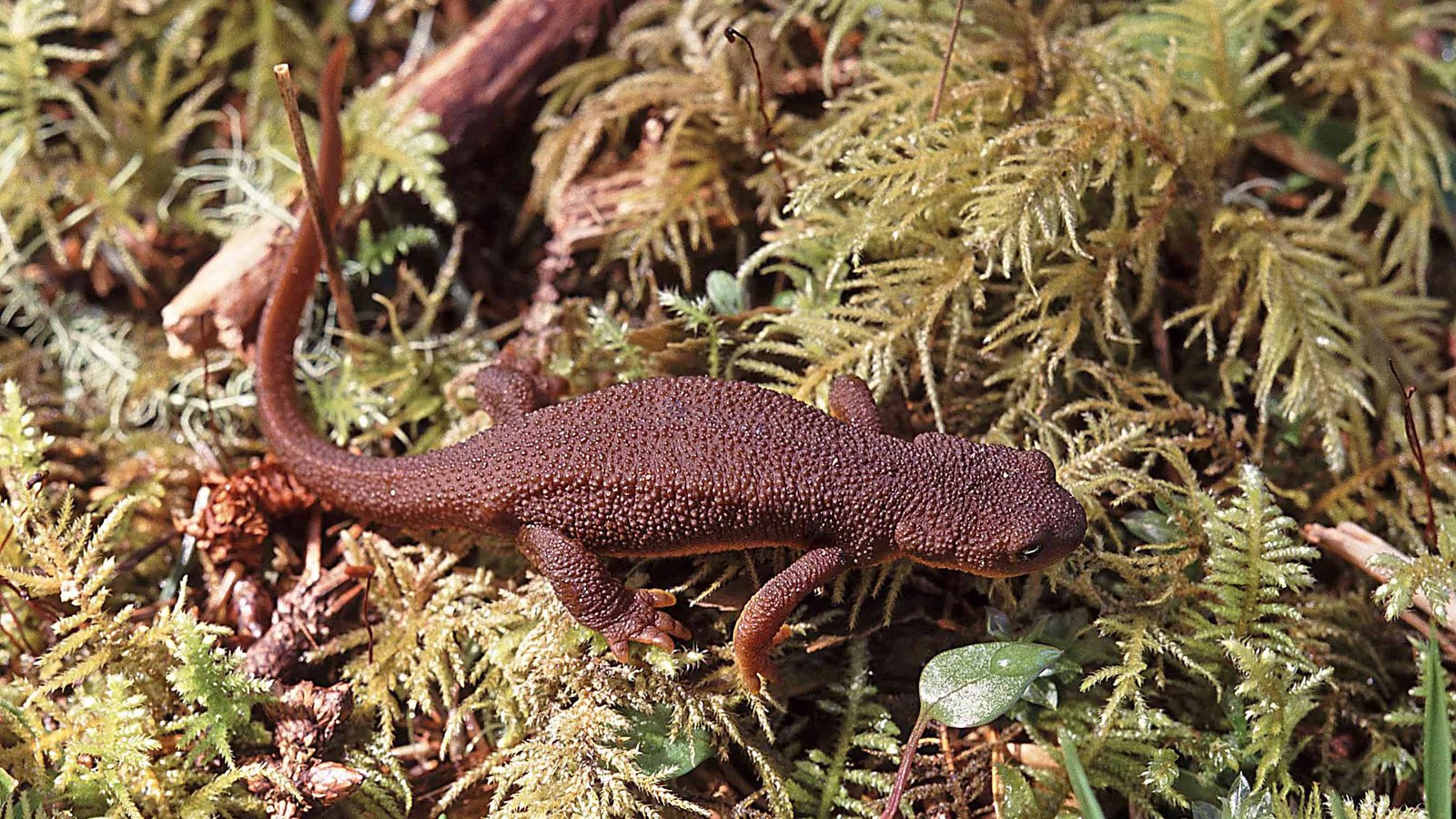
On November 20, 2026, the U.S. Fish and Wildlife Service published a proposed rule in the Federal Register to list the Mazama newt (Taricha granulosa mazamae), an endemic amphibian restricted to Oregon’s Crater Lake caldera, as an endangered species under the Endangered Species Act. The action initiates federal recovery protections and opens a 60-day scientific comment period following catastrophic population declines driven by non-native crayfish and trout.
Federal Listing and Proposed Protections
The formal proposed rule published in the Federal Register (Docket No. FWS-R8-ES-2026-2938) represents the agency’s 12-month finding on a petition to grant Endangered Species Act (ESA) safeguards to the Mazama newt. After reviewing the Species Status Assessment, the service determined that the newt faces an imminent risk of extinction across its range. Under the U.S. Fish and Wildlife Service announcement, the proposed endangered designation invokes Section 9 take prohibitions under 50 CFR 17.21, making it unlawful to harass, harm, capture, collect, or kill the amphibian without federal permits.
The service determined that designating critical habitat is not determinable at this time. Under ESA Section 4(a)(3), economic analyses across the caldera’s infrastructure must precede designation. The statute affords the agency an additional 12 months beyond the proposed rule to finalize economic reviews and propose critical habitat boundaries.
Population Collapse and Crayfish Invasions
The Mazama newt, or Crater Lake newt, occupies the rocky shoreline and deep waters of Crater Lake within Crater Lake National Park. Standardized snorkel surveys conducted by National Park Service biologists revealed that wild populations have collapsed along historical shoreline index sites. Annual visual surveys located only four individual newts across transects in 2025, down from 35 individuals in 2023, while recent 2026 surveys detected zero wild newts across several primary index areas.
Ecologists evaluate these population trends by comparing sampling vs census designs across cryptic life stages. The primary driver of the collapse is the introduced signal crayfish (Pacifastacus leniusculus), stocked into Crater Lake in 1915 as forage for introduced trout. Listed in the Global Invasive Species Database as high-impact ecological invaders, signal crayfish prey directly on newt egg masses, larvae, and adults while monopolizing protective littoral rock cover.
| Metric / Survey Focus | Historical Benchmark | Recent Survey Findings (2025–2026) | Observed Ecological Impact |
|---|---|---|---|
| Shoreline Snorkel Counts | Widespread in nearshore cobble | 4 detected in 2025; 0 in 2026 surveys | Near-total extirpation from historical rocky shoreline sites |
| Benthic Prey Density | 325 invertebrates per m² (2009) | 6 invertebrates per m² in crayfish areas | 60% loss in macroinvertebrate density; 35% drop in taxa diversity |
| Signal Crayfish Distribution | Introduced in 1915; localized | Continuous invasion fronts along shoreline | Competitive displacement of newts into open waters where trout prey on them |
| Captive Assurance Colonies | 0 individuals in human care | 50 founder newts secured since 2024 | Genetic ark established; first-ever captive breeding achieved in 2026 |
Crayfish foraging has also triggered trophic cascades by consuming benthic invertebrates that graze on periphyton, threatening the exceptional optical clarity of Crater Lake.
Evolutionary Isolation and Predator Vulnerability
The evolutionary divergence of the Mazama newt explains its unique vulnerability. Isolated in the caldera for roughly 7,000 years following Mount Mazama’s eruption, the newts evolved as the lake’s apex aquatic predator in an ecosystem free of native fish and decapods. Consequently, the subspecies lost the high levels of tetrodotoxin (TTX) characteristic of mainland rough-skinned newts, leaving them defenseless against introduced predators.
Taxonomic records catalogued in the Zoological Record document that Mazama newts also exhibit facultative paedomorphism, retaining larval gills into adulthood to feed on deep zooplankton. When invasive crayfish occupy shallow rocky refuges and predatory trout patrol deep waters, paedomorphic individuals face severe mortality.
Conservation Partnerships and Wizard Island Trials
In response to the decline, Crater Lake National Park joined with the Oregon Zoo Conservation Lab in Portland and the High Desert Museum in Bend, bringing 50 wild Mazama newts into captive facilities since 2024. In mid-2026, Oregon Zoo biologists achieved the first-ever captive breeding of the subspecies in specialized laboratories engineered to match the lake’s water chemistry, cold temperatures, and lighting.
In the field, park managers secured funding in 2026 to remove non-native fish and crayfish from an isolated pond on Wizard Island, testing whether isolated refuge habitats can be restored without immediate reinvasion. Interventions involving captive rearing and assisted colonization are assessed under bioethics vs research ethics frameworks to align animal care with species preservation objectives.
Stakeholder Reaction and Legal Background
The proposed listing follows multi-year legal advocacy. In 2023, the Center for Biological Diversity petitioned the USFWS to list the newt. Following missed statutory deadlines, the organization filed a federal lawsuit that produced a court-supervised settlement in May 2026 establishing the November listing deadline.
Chelsea Stewart-Fusek, endangered species attorney at the Center for Biological Diversity, highlighted the urgency in a Center for Biological Diversity statement, emphasizing that Crater Lake newts require immediate protections to avert extinction. Regional reporting by the Rogue Valley Times and conservation coverage in The Bulletin noted that while federal status unblocks resources, eliminating established crayfish across a deep caldera lake presents unprecedented technical hurdles.
Implications for Field Biology and University Research Offices
Listing the Mazama newt reshapes scientific research protocols across the caldera. All field biology activities that could result in incidental take—including non-invasive environmental DNA (eDNA) water collection, littoral transects, and specimen handling—will require federal recovery permits under Section 10(a)(1)(A) of the Endangered Species Act and 50 CFR 17.22.
Because Crater Lake National Park is federally administered, all research projects funded or permitted by federal agencies must complete formal Section 7 interagency consultation with the USFWS Klamath Falls Ecological Services Field Office. Academic institutions and sponsored projects offices must incorporate extended review timelines and utilize institutional regulatory compliance software to track permit validity, IACUC animal protocols, and agency reporting milestones.
Public Comment Timeline and Next Regulatory Steps
The publication of the proposed rule initiates a 60-day public comment period running from November 20, 2026 through January 19, 2027. The service is soliciting biological data, survey results, and taxonomic assessments from academic researchers, state and tribal agencies, and public stakeholders. Submissions must be filed via Regulations.gov under Docket No. FWS-R8-ES-2026-2938.
Under statutory guidelines, the USFWS has until November 2027 to review public feedback and issue a final determination. Biologists in the Klamath Falls office will concurrently prepare the required economic analysis to propose designated critical habitat within the statutory timeline.
Sources
- Federal Register: Endangered and Threatened Wildlife and Plants; Endangered Species Status for Mazama Newt (Docket No. FWS-R8-ES-2026-2938), checked 2026-11-21
- U.S. Fish and Wildlife Service: Mazama Newt Proposed as Endangered, checked 2026-11-21
- Center for Biological Diversity: Crater Lake Newt Proposed for Endangered Species Act Protections, checked 2026-11-21
- Rogue Valley Times: Crater Lake newt proposed for endangered species listing, checked 2026-11-21
- The Bulletin: Crater Lake newt proposed for endangered species listing, checked 2026-11-21


