
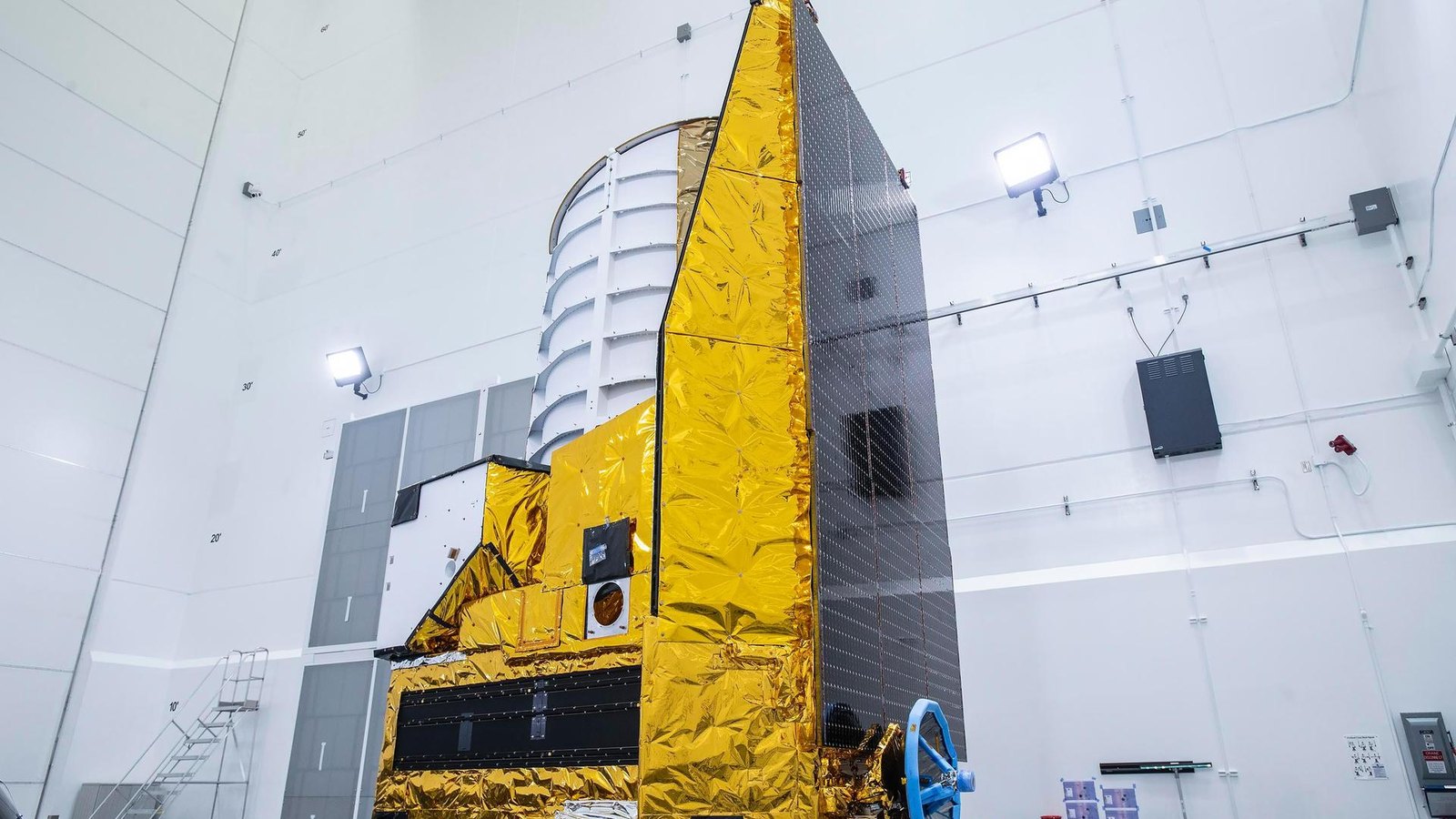
On 24 November 2026 the European Space Agency announced that its Euclid space telescope has found the most distant quasar known: J1504+6252, nicknamed Dún Aonghasa, seen 630 million years after the Big Bang and powered by a black hole of about 360 million Suns. It extends the record Euclid set in July, which casrai reported at the time, by roughly 40 million years.
What happened
ESA said that Euclid identified J1504+6252 in about 18 months of survey data, picking it out from millions of objects. The agency describes it as the first quasar identified beyond a redshift of 8: the object sits at redshift 8.13, which corresponds to seeing the Universe as it was roughly 13.1 billion years ago, when it was about 5% of its current age.
Euclid’s survey images were only the start. ESA says an extensive follow-up campaign by the W.M. Keck Observatory, the Large Binocular Telescope Observatory, the NASA/ESA Hubble Space Telescope and, finally, the NASA/ESA/CSA James Webb Space Telescope confirmed what the object was. Webb showed that the quasar is powered by a black hole with a mass of approximately 360 million Suns. The results are published in Astronomy and Astrophysics on 24 November 2026 in the paper by J. Wolf and colleagues, DOI 10.1051/0004-6361/202662243.
The Associated Press, in a report carried by WSLS, quotes Julien Wolf, who led the study and is affiliated with the European Southern Observatory, saying that the previous two records each moved the frontier back by about 15 million years or less, while this one takes it back by nearly 40 million years, “the biggest advance in nearly a decade”. The AP also reports that the team’s findings were corroborated by the Hubble and Webb space telescopes and other observatories on the ground and in space.
Popular Science, reporting the same paper, notes that Euclid has now flagged 31 quasars in barely 1.5 years, 12 of them beyond redshift 7, and that J1504+6252 is the first with a redshift beyond 8.
Key details
The figures below come from ESA’s November announcement and its July announcement of the earlier record; the 7.77 object is the previous record holder.
| Object | Redshift | Age of the Universe when seen | Status |
|---|---|---|---|
| J1504+6252 (Dún Aonghasa) | 8.13 | About 630 million years | New record, announced 24 November 2026 |
| EUCL J172902.75+641018.1 | 7.77 | Within the first 670 million years | Previous record, announced July 2026 |
| EUCL J125308.55+705432.3 | 7.69 | Within the first 670 million years | Second in the July announcement |
A quasar is an intensely bright galaxy core powered by gas falling into a supermassive black hole, ESA explains; it is a brief phase in a galaxy’s life during which the nucleus can outshine the rest of the system. Redshift measures how far light has been stretched on its way to us across the expanding Universe, so a higher redshift means a more distant, and therefore earlier, source.
Unlike other distant quasars, ESA says, Dún Aonghasa consumes material at a relatively slow rate. That means its black hole must have reached its present mass through extremely rapid growth episodes very early in cosmic time, which ESA says puts pressure on models of early black hole formation and growth.
Background and context
In July 2026 ESA announced that Euclid had discovered 31 quasars in the early Universe, led by a paper from Daming Yang of Leiden University. Two of them, at redshifts 7.77 and 7.69, were then the most ancient quasars ever observed. ESA noted that the first ten or so quasars at redshift 7 or above took astronomers more than a decade to find, while Euclid had found more than that in a single year. Our earlier coverage of that announcement is in the report on Euclid’s 31 record-early quasars.
Euclid launched in 2023. Its main task, as the AP describes it, is surveying galaxies to shed light on the dark matter and dark energy that fill the Universe and keep it expanding. The quasar discoveries come from the same data: the July paper drew on the Euclid Wide Survey, which ESA says will cover more than one-third of the total sky once complete. ESA says the combination of sensitive infrared imaging and very wide sky coverage is what makes Euclid suited to finding extremely rare, distant sources.
Quasars at this distance matter because they date from the epoch when the first stars and galaxies transformed a dark Universe into one filled with light, a period ESA calls the epoch of reionisation. A black hole of 360 million Suns that already existed 630 million years after the Big Bang is a hard test for any account of how the first supermassive black holes formed. For readers new to the field, our guides explain what astrophysics research covers and what cosmology studies.
Reaction
Wolf told the AP by email: “This time the leap in cosmic time is huge!” He also said the object poses a direct challenge: “About 630 million years after the Big Bang, its black hole had already grown to about 360 million times the mass of the sun. But how?” In the AP’s account he called the quasar a new deadline for the early Universe and said the black hole’s size is what makes the find rarer still, given how slowly it is feeding.
Wolf named the object after the prehistoric stone fort on Inis Mór in Ireland’s Aran Islands, which ESA describes as sitting at the Atlantic edge of Ireland where land gives way to a vast oceanic horizon; ESA says the quasar likewise stands at the current observational frontier. The AP adds that Wolf’s wife and daughter are Irish and that he was moved by a visit to the fort.
What it means for researchers, universities and research offices
For astrophysicists and cosmologists, the immediate consequence is a theory problem. A massive, slowly accreting black hole at redshift 8.13 constrains how heavy early black hole seeds were and how fast they could grow, and groups modelling early galaxy and black hole formation now have a new, better-measured anchor point at the edge of the observable quasar population.
The way the discovery was made is also instructive for research administrators who support astronomy groups. A single survey mission supplied the candidate; confirmation needed time on ground-based facilities at Keck and the Large Binocular Telescope, then on Hubble and Webb. Groups that want to follow up such a candidate will need proposals, observing time and data-management plans across several observatories, usually with international co-authors and consortium rules on data use. Offices that handle collaboration agreements and authorship for survey consortia should expect more of this kind of multi-facility work as Euclid’s catalogue grows. Researchers tracking results of this kind can use the astrophysics preprint server guide to follow related papers as they appear.
The result also shows how a space-agency survey can be turned into discoveries by university-based teams: the July discovery paper was led from Leiden University, and the November paper was led by a researcher at the European Southern Observatory.
What happens next
ESA says that at redshift 8 quasars are so rare that at most a few tens are expected in Euclid’s entire survey, and Popular Science reports that astronomers expect Euclid to find more quasars beyond redshift 8 in the coming years. Wolf cautioned in the AP report that the record “could fall again in a few months or it could stand for years.” Further observations of J1504+6252 and of the 12 Euclid quasars beyond redshift 7 will test whether the early black holes in the sample share the slow-feeding, rapid-growth pattern that ESA describes for Dún Aonghasa.
Sources
- European Space Agency: Euclid breaks own quasar record by 40 million years, 24 November 2026
- Associated Press via WSLS: Scientists discover quasar formed within a mere 630 million years of the Big Bang, setting a record, 24 November 2026
- Popular Science: Oldest known quasar formed 630 million years after the big bang, 24 November 2026
- European Space Agency: Euclid discovers the most ancient quasar in the Universe, 6 July 2026





