
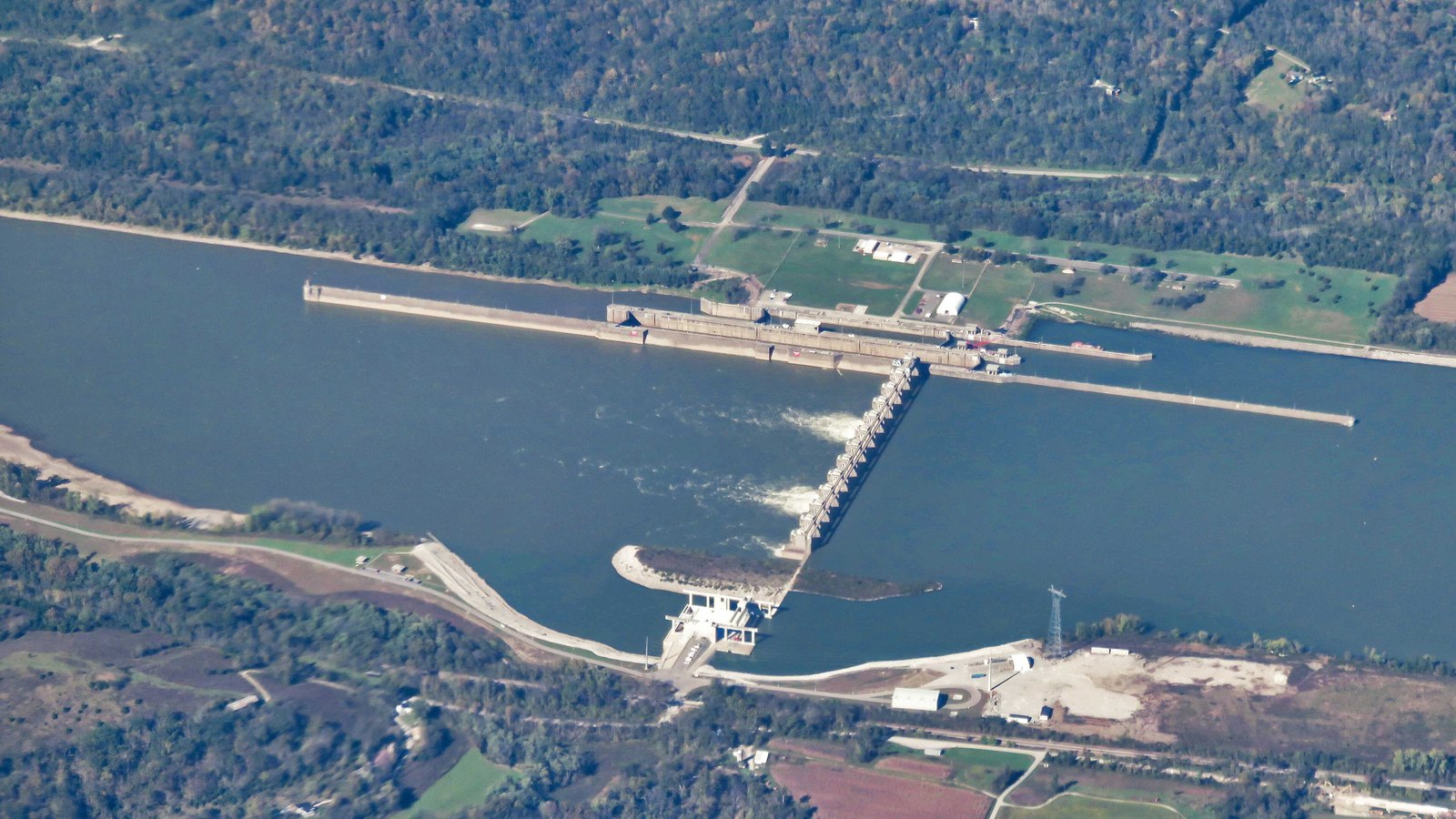
On November 24, 2026, the Federal Energy Regulatory Commission published a notice of availability for the staff environmental assessment of the Greenup Hydroelectric Project relicensing application, concluding that continued operation of the 70.2-megawatt facility at Greenup Locks and Dam on the Ohio River would produce no significant environmental impacts when paired with staff-recommended ecological protection measures.
The relicensing application, filed jointly by the City of Hamilton, Ohio and American Municipal Power, Inc. (AMP) under Project No. 2614-042, seeks a new major license for the run-of-the-river hydroelectric plant. Located at the U.S. Army Corps of Engineers Greenup Locks and Dam on the Ohio River, the project occupies 12.74 acres of federal land across Scioto County, Ohio and Greenup County, Kentucky. Commission staff in the Office of Energy Projects concluded that relicensing the facility with proposed environmental measures will not constitute a major federal action significantly affecting the quality of the human environment, recommending a Finding of No Significant Impact under the National Environmental Policy Act (NEPA).
Project Specifications and Key Environmental Parameters
The Greenup project harnesses flow through an auxiliary bypass canal adjacent to the federal navigation locks. Operating continuously since the early 1980s under an original 50-year license, the powerhouse contains three horizontal bulb turbine-generator units with an aggregate capacity of 70.2 megawatts. Because the facility operates in an auxiliary channel rather than across the full river section, water intake, dissolved gas exchange, and aquatic passage require specific operational constraints to maintain riverine ecological stability.
| Parameter | Project Specification / Baseline | Staff-Recommended Environmental Measure |
|---|---|---|
| Licensed Capacity | 70.2 MW (3 × 23.4 MW bulb turbines) | Maintain run-of-the-river mode adhering strictly to navigation pool elevations |
| Federal Land Footprint | 12.74 acres (USACE Huntington District) | Mandatory USACE Section 4(e) land stewardship and erosion control conditions |
| Tailrace Dissolved Oxygen | ORSANCO standard minimum: 5.0 mg/L daily average | Continuous seasonal DO monitoring with supplemental spillway aeration protocols |
| Fish Entrainment Mitigation | Trashracks with 3.5-inch clear bar spacing | Periodic trashrack cleaning, velocity monitoring, and fish impingement tracking |
| NEPA Tracking Identifier | EAXX-019-20-000-1769181282 | Formal 24-day public and agency review period closing December 18, 2026 |
Regulatory Framework and Multi-Agency Dam Jurisdiction
Hydropower development at federal navigation dams is governed by dual-agency jurisdiction under the Federal Power Act. Pursuant to 16 U.S.C. 797 (Section 4(e) of the Act), the Commission holds licensing authority on navigable waters, but projects on federal reservations must incorporate mandatory conditions stipulated by the custodial agency to protect reservation purposes. At Greenup Locks and Dam, commercial navigation managed by the U.S. Army Corps of Engineers maintains operational primacy. In periods of extreme hydrological deviation or navigation maneuvers, Corps lockmasters retain authority to direct river flows through dam spillways rather than power turbines.
Operating renewals proceed under 16 U.S.C. 808 (Section 15 of the Federal Power Act), which mandates comprehensive environmental re-evaluation before a new license term is granted. Commission staff conducted this assessment under 18 CFR Part 380, the Commission’s regulations implementing NEPA procedural duties. In evaluating resource trade-offs, FERC followed the federal environmental review hierarchy outlined in the EPA National Environmental Policy Act review process, determining whether an Environmental Impact Statement was warranted or whether staff-recommended mitigation justified a finding of no significant impact.
For institutional environmental analysts, these multi-tiered federal reviews reflect established administrative standards. Comparable regulatory workflows are documented across research sectors in the National Environmental Policy Act compliance guide, illustrating how federal scoping, inter-agency consultations, and categorical thresholds govern public infrastructure authorizations. Just as academic compliance offices rely on frameworks like the non-human subjects regulatory determination process to evaluate jurisdiction and documentation criteria, hydropower relicensing requires structured administrative coordination between FERC, the Corps of Engineers, state environmental protection agencies, and interstate river basin commissions.
River Ecology, Dissolved Oxygen Dynamics, and Fishery Protections
The main stem of the Ohio River supports rich warmwater aquatic communities, including migratory and resident sportfish, benthic macroinvertebrates, and federally protected freshwater mussels. A primary environmental issue evaluated in the Greenup assessment is dissolved oxygen (DO) dynamics during warm summer periods. The Ohio River Valley Water Sanitation Commission (ORSANCO) establishes a basin-wide standard requiring a minimum daily dissolved oxygen concentration of 5.0 milligrams per liter (mg/L). During low-flow conditions, hydro turbines drawing intermediate pool waters can depress tailrace oxygen saturation.
To satisfy ORSANCO standards and state Clean Water Act Section 401 certifications, the environmental assessment recommends requiring an intensive Water Quality Monitoring and Management Plan. Automated sensors deployed in the forebay and tailrace will continuously record dissolved oxygen and water temperature. If concentrations approach regulatory thresholds, operators must adjust generation dispatch, initiate turbine aeration mechanisms, or coordinate with the Corps of Engineers to increase aerating spill over dam gates to rapidly re-oxygenate downstream waters.
Fish entrainment and turbine-induced mortality were also evaluated in detail. Species such as sauger, walleye, freshwater drum, channel catfish, and paddlefish traverse the pool. Existing 3.5-inch trashracks exclude adult fish, while bulb turbines operate at low rotational speeds that limit blade-strike injuries for smaller fish. Staff also determined that maintaining stable sediment transport and tailrace hydraulics will protect downstream beds of unionid mussels—including the endangered fanshell and sheepnose mussels—from scouring or siltation.
Implications for Hydrology and River Ecology Researchers
The relicensing of major Ohio River infrastructure generates valuable long-term empirical data for freshwater scientists, hydrologists, and aquatic ecologists. Continuous water quality and biological monitoring datasets produced through FERC-mandated compliance plans feed directly into national hydrological research platforms. Academic researchers investigating riverine carbon fluxes, dissolved oxygen modeling, and aquatic migration corridors can access open digital archives curated through the HydroSource national hydropower data infrastructure, which aggregates environmental and operational metrics across U.S. fleets.
Additionally, the Greenup environmental assessment provides a field-validated case study for ecological researchers publishing comparative monitoring analyses in peer-reviewed journals such as the Environmental Monitoring and Assessment journal. Documenting the efficacy of spillway re-aeration versus mechanical turbine venting offers critical baseline parameters for eco-hydraulic modeling. For university research groups and environmental policy scholars, the public proceeding provides transparent insight into how municipal clean energy targets align with federal freshwater biodiversity conservation mandates.
Public Comment Timeline and Next Procedural Steps
Publication of the notice of availability marks the commencement of a formal 24-day public review window. In accordance with Commission notice specifications, all interested individuals, municipal agencies, non-governmental organizations, and academic institutions may submit substantive comments on the environmental assessment until 5:00 p.m. Eastern Time on December 18, 2026. Submissions must reference docket number P-2614-042 on the first page.
FERC strongly encourages stakeholders to submit comments electronically through the Commission’s eFiling portal or via the unauthenticated eComment system, which accepts text entries of up to 10,000 characters. Paper filings may also be dispatched through the U.S. Postal Service to Secretary Debbie-Anne A. Reese in Washington, DC, or via commercial delivery to Rockville, Maryland. Project inquiries can be directed to FERC environmental project managers Patrick Ely and Casey Knight or through the Office of Public Participation.
Following closure of the comment period on December 18, 2026, Commission staff will review public and agency submissions, evaluate any supplementary ecological data, and finalize recommendations for the Commission’s consideration. A final Commission licensing order establishing binding operational, water quality monitoring, and Corps navigation coordination requirements is anticipated in mid-2027.
Sources
- Federal Register: City of Hamilton, Ohio and American Municipal Power, Inc.; Notice of Availability of Environmental Assessment (Project No. 2614-042, Doc. 2026-23832), checked 2026-11-28
- Electronic Code of Federal Regulations: 18 CFR Part 380 — Regulations Implementing the National Environmental Policy Act, checked 2026-11-28
- Cornell Law School Legal Information Institute: 16 U.S.C. 797 — General Powers of Commission Under the Federal Power Act, checked 2026-11-28
- Cornell Law School Legal Information Institute: 16 U.S.C. 808 — New Licenses and Renewals Under the Federal Power Act, checked 2026-11-28
- U.S. Environmental Protection Agency: National Environmental Policy Act Review Process, checked 2026-11-28






