
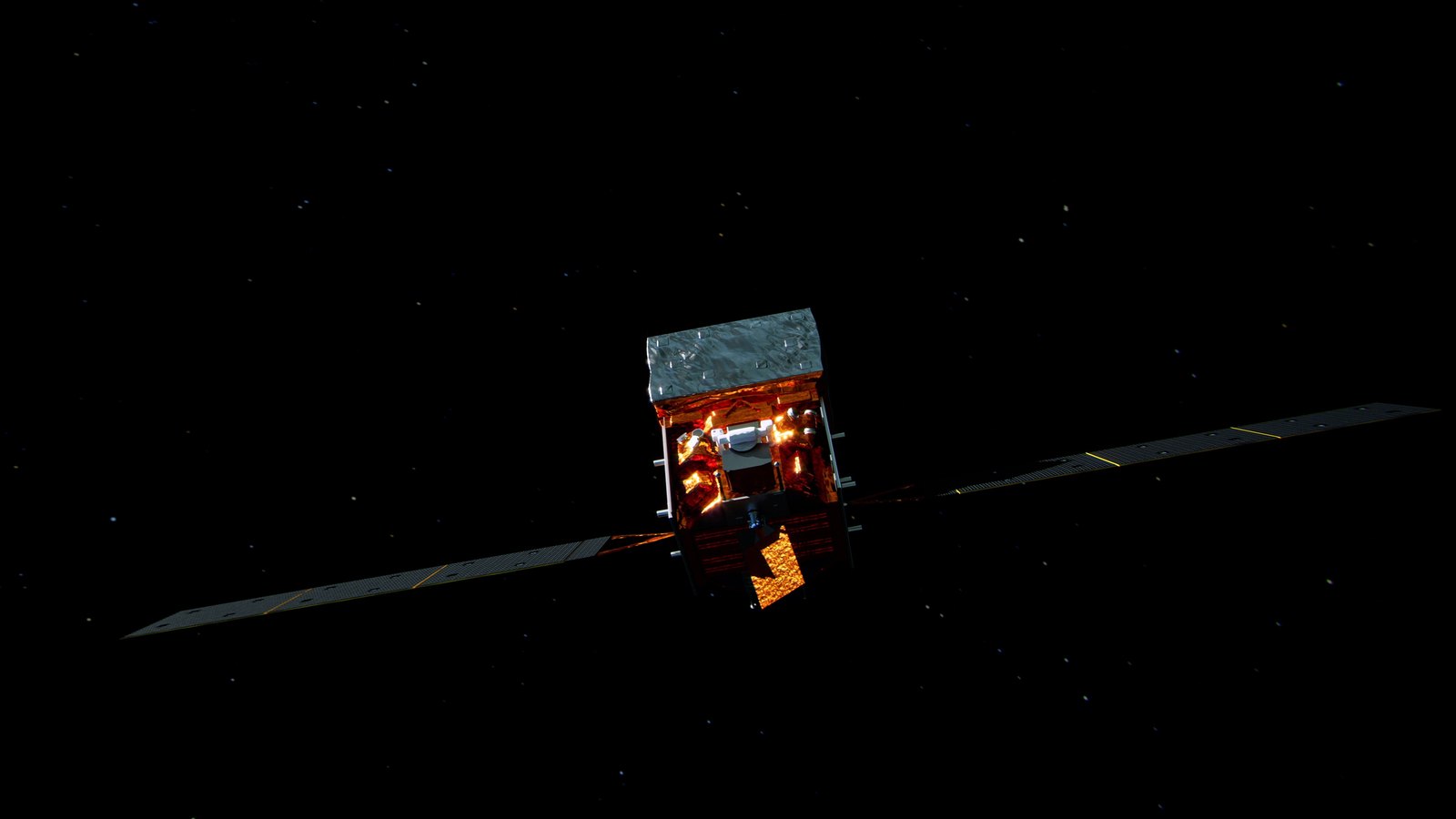
On November 19, 2026, an international research team demonstrated in Physical Review Letters that lattice cryptography algorithms accelerate blind gamma-ray pulsar searches in NASA Fermi satellite archives by one million times. For university research offices and high-performance computing facilities, the cross-disciplinary technique eliminates hundreds of CPU years of cluster time, turning public astronomical repositories into immediate discovery engines.
What happened
An international team of physicists and mathematicians from the Max Planck Institute for Gravitational Physics (Albert Einstein Institute), the Weizmann Institute of Science, and Chalmers University of Technology discovered a previously missed gamma-ray pulsar, designated PSR J1622-7204, using cryptographic algorithms. The newly found neutron star spins 261 times per second and was uncovered within 15 years of public data from the Large Area Telescope aboard NASA’s Fermi Gamma-ray Space Telescope.
The researchers pinpointed the pulsar using roughly 10 CPU hours on a single processor core, finishing initial screening in about 100 minutes on a standard workstation. Conventional blind searches previously run across the same archival dataset failed to detect the object despite expending compute power equivalent to 600 CPU years. By treating sparse photon arrival times as a high-dimensional lattice problem, the team achieved an effective computational speedup of roughly one million times over prior state-of-the-art methods.
The study was led jointly by Daniel Pook-Kolb of the Albert Einstein Institute and Dotan Gazith of the Weizmann Institute, together with co-authors Colin J. Clark, Erik Agrell, Barak Zackay, and Bruce Allen. The team confirmed the discovery by tracing the pulsar’s coherent pulsations across the full 15-year Fermi archive.
Key details
Pulsars are dense neutron stars that sweep beams of radiation across space as they rotate. Detecting pulsars in gamma rays is notoriously difficult because instruments record only sparse photon arrivals. Over 15 years, the Fermi telescope captured only about 16,000 total candidate photons from the sky region containing PSR J1622-7204, with the signal buried in diffuse Galactic background noise.
Conventional searches use semicoherent grid algorithms to probe a four-dimensional space spanning celestial position, rotation frequency, and spindown rate. Scanning billions of discrete grid points requires massive computing power. In contrast, the new method converts signal detection into a geometric shortest-vector problem within computational geometry, applying algorithms cryptographers use to test post-quantum encryption. The algorithm identified PSR J1622-7204 using an initial sample of just 80 randomly chosen photons before validating the signal against the complete dataset.
| Metric | Conventional Semicoherent Search | Lattice-Based Method |
|---|---|---|
| Mathematical Formulation | Discrete 4D parameter grid scanning | Shortest vector search in high-dimensional lattices |
| Compute Time for PSR J1622-7204 | Estimated ~600 CPU years (undetected) | ~10 CPU hours (~100 minutes on a workstation) |
| Acceleration Factor | Baseline (1x) | Roughly 1,000,000x faster |
| Initial Photon Requirement | Full multi-year photon sets | ~80 randomly sampled photons |
| Hardware Footprint | Distributed volunteer supercomputing | Standard scientific laptops and local workstations |
| Binary Pulsar Feasibility | Intractable for blind searches | Feasible for blind multi-dimensional orbital searches |
Background and context
NASA launched the Fermi Gamma-ray Space Telescope in 2008 to observe the high-energy universe. Under federal open-science policies, all Fermi data is released publicly through the High Energy Astrophysics Science Archive Research Center, serving as an institutional model for accessible open data.
For two decades, blind gamma-ray searches relied on Einstein@Home, a distributed computing project founded by Bruce Allen that pools idle processing power from global volunteers. While Einstein@Home has found dozens of pulsars, identifying a single faint source regularly required months of collective computing. Meanwhile, cryptographers at the Weizmann Institute were researching high-dimensional lattices for post-quantum security. Dotan Gazith and Barak Zackay recognized that identifying periodic pulses in sparse data mathematically mirrors finding the shortest vector in a lattice, bridging cryptography and astrophysics.
Reaction
Collaborating researchers and mission scientists highlighted the operational significance of the algorithmic breakthrough. “We do not see every rotation from the pulsar, and we cannot just count the rotations to work out where the photon came from,” said lead author Daniel Pook-Kolb in statements published by the Max Planck Institute for Gravitational Physics. “We have a four-dimensional grid, and we must search each direction with millions of trials in it. There is just not enough computing power on Earth to do it.”
Dotan Gazith of the Weizmann Institute of Science underscored the cross-disciplinary transfer: “We have nothing to do with cryptography in our analysis here, but those algorithms can help us solve the problem of searching for pulsars in our data.” Gazith noted that calculations show PSR J1622-7204 will slow by roughly five rotations per second over the next 100 million years.
Senior co-author Barak Zackay noted the implications for binary systems: “What has slowed the discovery of pulsars in binary systems until now is that we had to characterize the companion star before studying the pulsar itself. The new, efficient method will allow us to find pulsars in binary systems blindly, without prior information about the companion, and even to learn about the companion properties through observations of the pulsar.”
NASA officials emphasized how open archives facilitate external innovation. In findings reported by NASA Science, Fermi Project Scientist Elizabeth Hays stated: “Any search that one team is doing, another team can just go and do that and check the search. It has made all of the science better.” AEI astrophysicist Colin J. Clark added: “The nice thing about NASA data is it is all open. All 18 years of Fermi data have been made public, and the data just keeps growing.”
What it means for researchers, universities and research offices
The successful application of lattice methods provides practical advantages across academic research administration and infrastructure management:
- Reduction in High-Performance Computing Costs: By accelerating blind searches by one million times, researchers can run complex parameter scans on local workstations, mitigating institutional computational complexity while cutting cluster energy use and cloud computing budgets.
- Higher Value from Public Data Archives: The discovery demonstrates that mature federal archives hold undiscovered scientific signals. University research offices can leverage these findings in grant narratives to justify investments in curated archival repositories.
- Enabling Blind Binary Searches: Binary pulsar searches involve additional orbital parameters that previously made blind discovery computationally impossible. The lattice algorithm makes multi-dimensional binary scans achievable within standard institutional computing allocations.
- Interdisciplinary Methodology Transfer: The project highlights the value of pairing theoretical mathematicians and cryptographers with domain scientists, supporting institutional funding for cross-departmental data science centers.
- Reinforcement of Open-Access Compliance: Achieving landmark results through public archival datasets affirms federal open-science directives and demonstrates the importance of computational reproducibility across astrophysics and computational science.
What happens next
Participating institutions have scheduled several concrete operational milestones for 2026 and 2027:
- December 2026: The Albert Einstein Institute will begin integrating the lattice search pipeline into the Einstein@Home distributed software client, enabling volunteers worldwide to participate in lattice-accelerated searches.
- Early 2027: The research team plans a blind survey of approximately 2,000 unidentified gamma-ray sources in the latest Fermi catalogs, aiming to discover compact binary millisecond pulsars.
- Mid-2027: Radio astronomers will conduct follow-up observations of PSR J1622-7204 using the Parkes Radio Telescope (Murriyang) in Australia and the MeerKAT array in South Africa to test for radio pulses and measure dispersion.
- Late 2027: Theoretical physicists plan to adapt the lattice algorithm to continuous gravitational-wave datasets from the LIGO-Virgo-KAGRA detector network to accelerate searches for rotating asymmetric neutron stars.
Sources
- Physical Review Letters: Gamma-Ray Pulsar Discovery Using a Lattice-Based Method, checked 2026-11-21
- NASA Science: NASA Science Data Powers New Method to Discover Hard-to-Find Pulsars, checked 2026-11-21
- Max-Planck-Gesellschaft: Finding gamma-ray pulsars a million times faster, checked 2026-11-21
- Weizmann Institute of Science: From a Complex Problem to a Dizzying Discovery: A New Method for Finding Cosmic Lighthouses, checked 2026-11-21


