
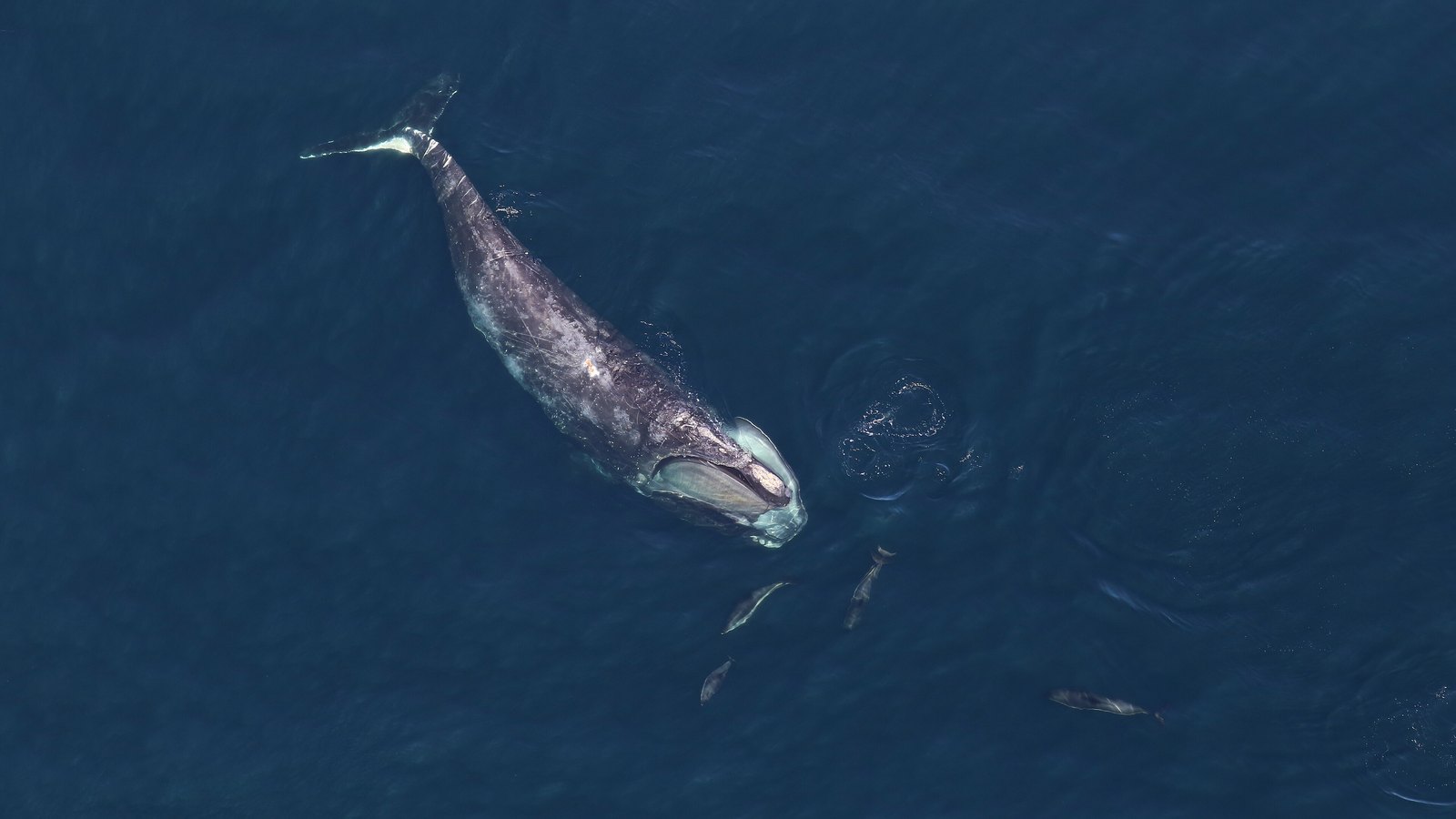
On November 18, 2026, the National Oceanic and Atmospheric Administration (NOAA) and the National Fish and Wildlife Foundation (NFWF) announced $8.4 million in competitive grant awards across 16 marine technology projects designed to prevent lethal vessel strikes on endangered North Atlantic right whales. The awards fund academic laboratories, oceanographic institutes, and industry developers deploying artificial intelligence computer vision, satellite analytics, fiber-optic acoustic sensing, and real-time mariner alert networks, establishing vital technical infrastructure for university research offices navigating federal marine conservation priorities.
Federal and Foundation Partnership Directs $8.4 Million to Vessel-Strike Tech
The 16 awards represent the second competitive cohort under the Vessel Strike Avoidance Fund (VSAF), established jointly by NOAA Fisheries and NFWF. The federal grants total $8,362,400 and leverage $1,218,800 in grantee matching contributions for $9,581,200 in total conservation impact. Combined with eight inaugural grants in 2025, the VSAF initiative has deployed nearly $12.3 million across 24 projects, generating $14.3 million in cumulative investment.
Vessel collisions remain a primary driver of lethal blunt-force trauma for the North Atlantic right whale (Eubalaena glacialis), whose population is estimated at fewer than 380 individuals. Because migration corridors, feeding areas, and calving grounds intersect congested East Coast shipping routes, visual lookouts cannot reliably prevent strikes, especially at night, during fog, or while whales skim-feed beneath the surface.
The funded portfolio tackles this risk through four technology tracks: passive acoustics, automated optical and thermal imaging, satellite remote sensing, and navigation integration. Rather than treating detection solely as surveillance, the awards fund operational data pipelines that turn sensor triggers into geo-referenced alerts delivered directly to commercial vessel bridges, dynamic management platforms, and maritime pilots.
Funded Technology Portfolios, Grant Allocations, and Matching Commitments
The 16 awards distribute resources across academic laboratories, oceanographic research centers, and marine technology enterprises. The official 2026 VSAF grant slate outlines funding allocations and non-federal matching commitments across all selected investigators.
| Grantee Institution | Project Scope and Core Technology | Grant Funding | Matching Funds | Total Project Investment |
|---|---|---|---|---|
| National Offshore Wind R&D Consortium | Dual thermal and visible camera integration for mid-size vessels | $739,800 | $50,000 | $789,800 |
| Ocean Science Analytics | Satellite tracking of non-AIS vessels under 65 feet in core habitats | $221,100 | $0 | $221,100 |
| Sofar Ocean Technologies | PodCast regional real-time acoustic monitoring buoy networks | $677,000 | $75,000 | $752,000 |
| Coonamessett Farm Foundation | Long-term satellite telemetry tags attached to whale head callosities | $756,800 | $0 | $756,800 |
| Triton Systems | Non-invasive, long-duration satellite tags for tracking | $565,000 | $177,900 | $742,900 |
| CSA Ocean Sciences | Simulated whale-blow generator to benchmark thermal camera systems | $446,200 | $0 | $446,200 |
| Duke University | Whale-Aware navigation platform integrating density models and alerts | $750,000 | $0 | $750,000 |
| UMCES | Fine-scale acoustic tracking of whale behavioral reactions to vessels | $440,100 | $451,000 | $891,100 |
| California Marine Sanctuary Foundation | AIS data synthesis and voluntary strike reduction in the Gulf | $259,900 | $80,100 | $340,000 |
| Arizona State University | Machine learning detection of right whales in high-res satellite imagery | $502,300 | $0 | $502,300 |
| Conserve.io | Real-time detection data integration for the Whale Alert platform | $375,000 | $90,000 | $465,000 |
| New England Aquarium | Vessel hydrodynamic data analysis for bow-carrying strike zones | $277,300 | $55,100 | $332,400 |
| UC Santa Cruz | Spatiotemporal and vertical distribution modeling of strike risk | $597,400 | $0 | $597,400 |
| Stony Brook University | Vessel routing risk models and thermal camera response feasibility | $755,000 | $219,700 | $974,700 |
| Cornell University | Distributed Acoustic Sensing (DAS) on subsea fiber-optic cables | $750,000 | $0 | $750,000 |
| University of South Carolina | Movement modeling to evaluate competing vessel management options | $249,500 | $20,000 | $269,500 |
Technical approaches vary across disciplines. In bioacoustics, Cornell University investigates Distributed Acoustic Sensing (DAS), transforming commercial subsea fiber cables into continuous seafloor hydrophone arrays. Concurrently, Sofar Ocean Technologies deploys its PodCast system, using smart surface buoys with edge processing to identify whale up-calls and transmit alerts over satellite links.
In remote sensing, Arizona State University develops transfer-learning models to detect whales in high-resolution satellite imagery. Simultaneously, scientists at the New England Aquarium analyze hydrodynamic data to study bow-wave entrapment, assessing why large container ships frequently carry struck whales without the crew noticing.
Regulatory Pressures, Extinction Risks, and the Road to Recovery
The grant slate arrives during active regulatory review of Atlantic vessel speed restrictions. Under the 2008 North Atlantic Right Whale Vessel Speed Rule, vessels 65 feet and longer must maintain speeds of 10 knots or less in Seasonal Management Areas. However, an Unusual Mortality Event ongoing since 2017 confirmed that vessels between 35 and 65 feet cause a substantial share of lethal strikes.
In 2022, NOAA proposed extending the 10-knot limit to craft between 35 and 65 feet and establishing dynamic speed zones. Maritime shipping associations, port authorities, and recreational boating groups opposed the draft rule, citing potential commercial delays. Congress directed NOAA to test technological alternatives that provide dynamic, pinpoint warnings rather than relying solely on broad speed caps.
Funding from the Inflation Reduction Act of 2022 provided the resources to support this initiative. Through an $82 million appropriation dedicated to right whale recovery, NOAA formed partnerships with NASA, MITRE, and NFWF. The VSAF program operationalizes these funds by awarding competitive grants to academic labs and marine technology firms.
Institutional Leadership and Marine Conservation Stakeholder Reactions
Agency leadership and conservation foundation executives characterized the awards as an effective path toward integrating wildlife protection into navigation practices.
“Providing better and faster information on the water will advance conservation efforts in cooperation with mariners to protect whales and other marine species from vessel strikes,” stated Jeff Trandahl, executive director and CEO of NFWF. “These projects build upon successful technology and research efforts that are already underway. The projects will support the development of promising new tools to give mariners timely information to make safe decisions on the water.”
NOAA Fisheries underscored that technological innovation is central to its recovery strategy. “Promoting further development, testing, and implementation of vessel strike avoidance technologies remains a top priority for us,” stated Eugenio Piñeiro Soler, assistant administrator for NOAA Fisheries. “The partnership between NFWF and NOAA launches new and innovative projects and advances existing technologies to better detect whales and disseminate accurate, timely information for mariner decision-making. These advancements will help empower mariners, enhance on-water safety, and conserve our large whale populations.”
Investigators also emphasized cost efficiency. The Cornell bioacoustics and digital agriculture team noted that using existing optical telecom cables allows broad ocean acoustic monitoring without the high cost of dedicated survey ships.
Implications for Academic Marine Labs, Oceanographic Consortia, and Research Offices
For university sponsored projects offices, marine laboratories, and oceanographic consortia, the VSAF awards reflect a clear shift toward applied technology deployment alongside basic ecological research. Administrators overseeing these awards must maintain strict compliance.
First, sponsored projects offices must track mandatory and voluntary matching commitments. With grantee contributions exceeding $1.2 million, fiscal managers must document cost-sharing under federal standards detailed in the overview of cost sharing rules, verifying that matching expenditures remain auditable and allowable.
Second, multi-institutional projects require structured subrecipient monitoring. Lead grantees partnering with technology vendors or academic collaborators must establish defined milestones and intellectual property provisions, adhering to established practices for subaward agreement negotiation.
Third, research teams must manage post-award compliance schedules and equipment inventories. Project directors should evaluate administrative workflows against the federal grant compliance checklist, verifying that offshore sensor deployments comply with 2 CFR 200 Subpart D post-award requirements. Additionally, teams sharing acoustic or satellite datasets should register a grant DOI to ensure clear attribution in federal research archives.
Project Milestones, Operational Field Tests, and Regulatory Timelines
The 16 funded projects begin work immediately, targeting field trials across the 2027 and 2028 migration seasons. Early 2027 milestones focus on bench testing, including CSA Ocean Sciences’ simulated whale-blow generator and National Offshore Wind Consortium’s camera systems, to standardize detection baselines prior to open-water deployment.
Operational field trials will take place in key maritime bottlenecks, including the Great South Channel, Cape Cod Bay, Boston Harbor approaches, and southeastern calving grounds. By late 2027, software teams at Conserve.io and Duke University plan to integrate updated risk algorithms into commercial navigation consoles and mariner alert apps.
Concurrently, NOAA Fisheries will evaluate detection accuracy and false-positive rates as part of its ongoing speed rule evaluations. Performance data from these 16 projects will help determine whether real-time dynamic detection systems can reliably supplement or adjust seasonal vessel speed restrictions.
Sources
- National Fish and Wildlife Foundation: NFWF Announces $8.4 Million for Innovative Technologies to Reduce Whale-Vessel Collisions, checked 2026-11-21
- National Fish and Wildlife Foundation: Vessel Strike Avoidance Fund 2026 Grant Slate Full Project Summaries, checked 2026-11-21
- NOAA Fisheries: Biden-Harris Administration Announces $82 Million for Endangered North Atlantic Right Whale Conservation, checked 2026-11-21
- New England Aquarium: Building the Tools to Study Vessel Strikes, a Leading Threat to Right Whales, checked 2026-11-21
- Cornell University: Repurposing the Internet’s Backbone to Advance Whale Monitoring, checked 2026-11-21
- Sofar Ocean Technologies: Webinar: How Real-Time Acoustic Monitoring Is Transforming Marine Mammal Protection, checked 2026-11-21


