
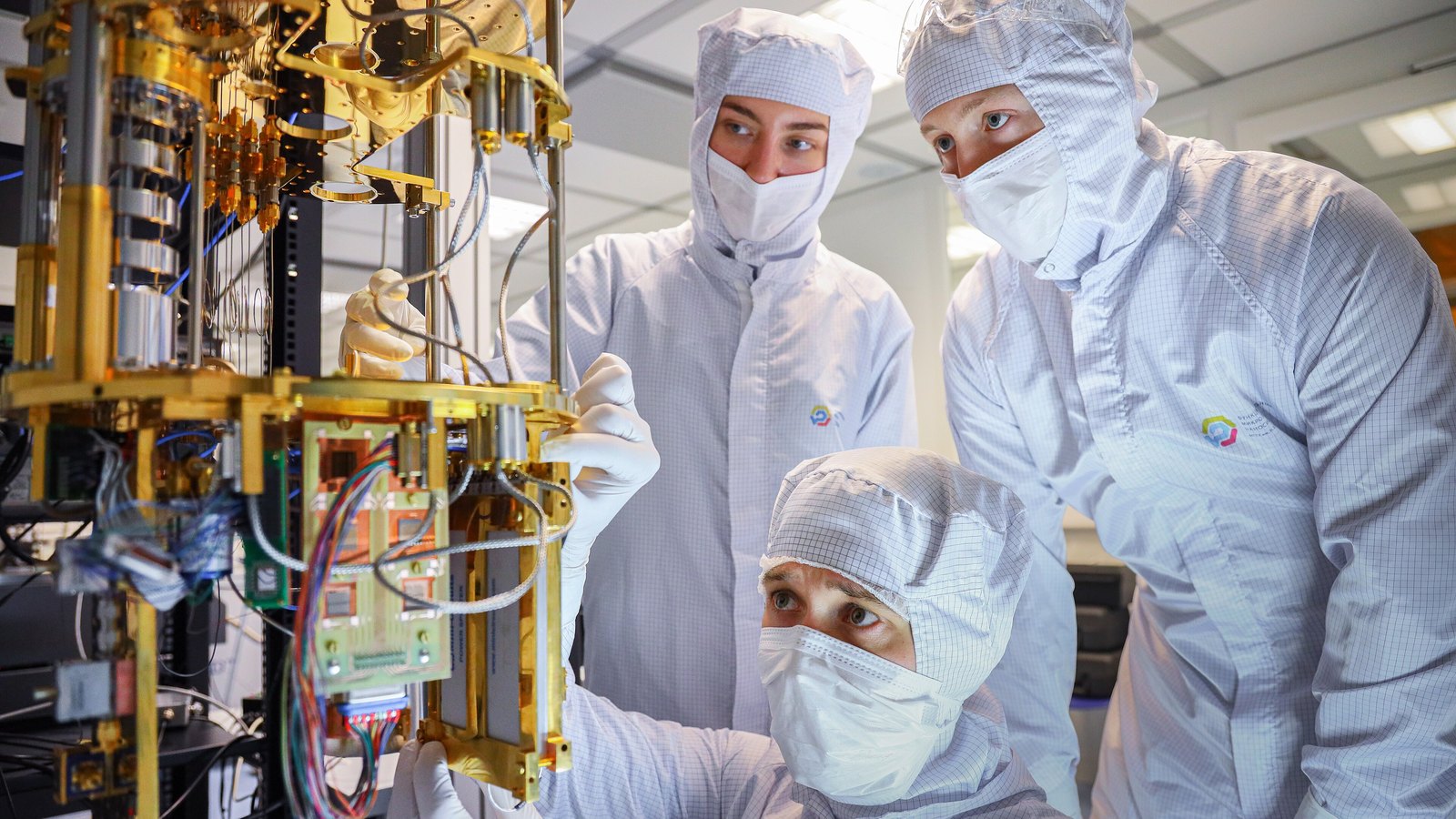
On November 21, 2026, the National Institute of Electronics and Information Technology (NIELIT) inaugurated the transit campus of India’s first dedicated Artificial Intelligence and Quantum University at Acharya Nagarjuna University (ANU) in Guntur district, Andhra Pradesh, backed by an approved central government grant-in-aid of Rs 730.70 crore from the Ministry of Electronics and Information Technology (MeitY).
Inauguration of the Transit Campus in Guntur
The transit facility, housed in the Centre for Distance Education (CDE) building on the Acharya Nagarjuna University campus near Guntur, marks the operational launch of India’s first university campus dedicated exclusively to quantum technologies and artificial intelligence. The inaugural ceremony on Saturday, November 21, 2026, operationalized the initiative within nine months of the bilateral agreement between central and state authorities, as outlined in the official Press Information Bureau announcement from MeitY.
Dr. A. Prathibha, Economic Advisor to MeitY, formally opened the transit campus alongside NIELIT Director General Dr. Madan Mohan Tripathi. Dr. Prathibha noted that the institution will deliver specialized education, research, and industry-oriented training in quantum computing, quantum communications, and very large scale integration (VLSI) semiconductor design. Regional reporting by The Hindu confirmed that laboratory training sessions and academic courses will commence on December 1, 2026.
The event convened regional academic and policy leaders, including Bhaskar Katamneni, Secretary of the Andhra Pradesh Information Technology Department; C.V. Sridhar, Mission Director of the Andhra Pradesh State Quantum Mission; Professor S. Vijaya Bhaskara Rao, Chairman of the Andhra Pradesh State Council of Higher Education (APSCHE); and Professor K. Gangadhara Rao, Vice-Chancellor of ANU. State officials committed comprehensive administrative support to ensure rapid academic rollout across the interim facility.
Phase-1 Deep-Tech Laboratories and Capital Allocation
To support immediate experimental research ahead of permanent campus construction, NIELIT deployed an initial capital outlay of Rs 47 crore to establish four specialized laboratories at the ANU transit facility, as reported by the Deccan Chronicle:
- Quantum Computing Laboratory: Houses cryogenic instrumentation, quantum circuit simulators, and microwave control hardware for superconducting qubit experimentation.
- Quantum Communication Laboratory: Equipped for quantum key distribution (QKD), quantum random number generation, and post-quantum cryptographic protocol evaluation.
- VLSI and Chip Design Facility: Configured with electronic design automation (EDA) software suites and FPGA prototyping clusters for physical semiconductor layout.
- Artificial Intelligence Laboratory: Optimized for accelerated machine learning, deep neural network training, and domain-specific edge AI systems.
Capital investment in advanced instrumentation aligns with national programs analyzed in casrai’s review of research infrastructure funding. The following table contrasts the transit setup with the planned permanent campus:
| Project Dimension | ANU Transit Campus (Phase 1) | Amaravati Permanent Campus (Full Scale) |
|---|---|---|
| Operational Timeline | Inaugurated November 21, 2026; courses start December 1 | Five-year phased construction across 2026–2031 |
| Physical Land and Site | Centre for Distance Education building, ANU, Guntur | 8.5 acres allocated at Nidamarru, Amaravati |
| Capital Outlay | Rs 47 crore for phase-1 specialized laboratories | Rs 730.70 crore approved central grant-in-aid from MeitY |
| Core Physical Facility | Four deep-tech teaching and testing laboratories | 1.25 lakh sq. ft. Quantum Research, Innovation and Incubation Block |
| External Compute Access | Quantum testbeds at Medha Towers and SRM University | Direct access to Amaravati Quantum Valley IBM quantum hardware |
| Five-Year Training Target | Initial certificate, diploma, and faculty cohorts | 8,250 learners (1,650 degree students and 6,600 certifications) |
Curriculum Architecture and Frontier Technology Focus
The academic curriculum addresses acute national talent shortages across deep-tech sectors. Initial coursework launching in December 2026 includes specialized tracks in quantum communication, AI for science and engineering, embedded systems, and Internet of Things (IoT) architectures. Short-term applied modules will cover automotive electronics, battery management systems, and semiconductor assembly testing marking and packaging (ATMP).
NIELIT will also conduct faculty development programs across ten technical disciplines to prepare engineering college professors throughout India. Centralizing rare, capital-intensive apparatus within an open academic facility reflects best practices for shared instrumentation examined in casrai’s guide to the core facility research core.
Strategic Alignment with India Deep-Tech Missions
The establishment of the campus advances three major federal roadmaps: the National Quantum Mission (NQM), the IndiaAI Mission, and the India Semiconductor Mission (ISM). As reported by The Quantum Insider, the initiative follows a memorandum of understanding signed on February 20, 2026, during the India AI Impact Summit in New Delhi by NIELIT and the Government of Andhra Pradesh in the presence of Chief Minister N. Chandrababu Naidu and MeitY Secretary S. Krishnan.
As a Deemed-to-be-University, NIELIT operates twelve approved university campuses nationwide, with its main center at Ropar, Punjab. The Amaravati campus will serve as its primary center of excellence for quantum science and cognitive computing, operating alongside NIELIT’s Tirupati campus, which is developing a permanent three-acre facility at Sri Venkateswara University for electronics design.
The permanent Amaravati campus is designed as a Net-Zero energy installation, using on-site solar generation to mitigate the power draw of cryogenic refrigeration units and high-density computing clusters. Managing high electrical loads is central to controlling the compute carbon footprint in accelerated research computing, a technical challenge also seen in international facilities like the Frontier supercomputer.
Stakeholder Responses and Institutional Commitments
NIELIT Director General Dr. Madan Mohan Tripathi stated that the Amaravati campus represents a critical step in building domestic deep-tech engineering capabilities. He noted that the center will link directly with NIELIT Tirupati to create an integrated electronics and semiconductor skill corridor across Andhra Pradesh.
State IT Secretary Bhaskar Katamneni pledged complete administrative support to address institutional requirements as operations scale. C.V. Sridhar, Mission Director of the Andhra Pradesh State Quantum Mission, noted that enrolled students and researchers will gain access to operational quantum testbeds at Medha Towers and SRM University, connecting coursework directly to commercial and defense use cases.
Implications for Researchers, Universities and Research Offices
The launch of NIELIT’s dedicated university campus offers several operational advantages for research administrators and academic faculties:
- Shared Specialized Equipment: Academic departments rarely possess capital budgets to acquire sub-Kelvin dilution refrigerators or semiconductor packaging lines. NIELIT provides shared regional access, reducing redundant institutional expenditures.
- Collaborative Consortia: NIELIT is establishing research partnerships with regional institutions, including IIT Tirupati, IIIT Sri City, Andhra University, and JNTU, enabling sponsored doctoral dissertations and joint grant proposals.
- Accelerated Technology Transfer: Locating the permanent campus within Amaravati’s planned Quantum Valley facilitates intellectual property licensing, commercial prototyping, and deep-tech startup incubation.
- Specialized Technical Training: Research offices experiencing shortages of cryogenic technicians, quantum programmers, and VLSI engineers can utilize NIELIT certification courses to train staff and graduate researchers.
Upcoming Milestones and Permanent Site Roadmap
Following the transit campus inauguration, NIELIT will start inaugural certificate courses on December 1, 2026. Formal degree admissions across undergraduate, postgraduate, and doctoral programs will open during the 2027 academic admissions cycle following curriculum approvals.
Concurrently, site development is proceeding on the 8.5-acre plot in Nidamarru, Amaravati. The permanent campus will feature a 1.25 lakh square foot Quantum Research, Innovation, and Incubation Block (QRIIB) equipped with cleanrooms and specialized photonics labs. By its fifth operational year, the institution aims for an annual intake of 3,913 learners, achieving its cumulative target of 8,250 trained specialists.
Sources
- Press Information Bureau: NIELIT to Establish India’s First Dedicated Quantum & AI University Campus in Amaravati, checked 2026-11-21
- The Hindu: India’s first AI, Quantum University campus inaugurated in Guntur of Andhra Pradesh, checked 2026-11-21
- Deccan Chronicle: Amaravati Gets World’s First Quantum AI University Campus, checked 2026-11-21
- The Quantum Insider: India to Establish Quantum and AI University Campus in Amaravati, checked 2026-11-21


