
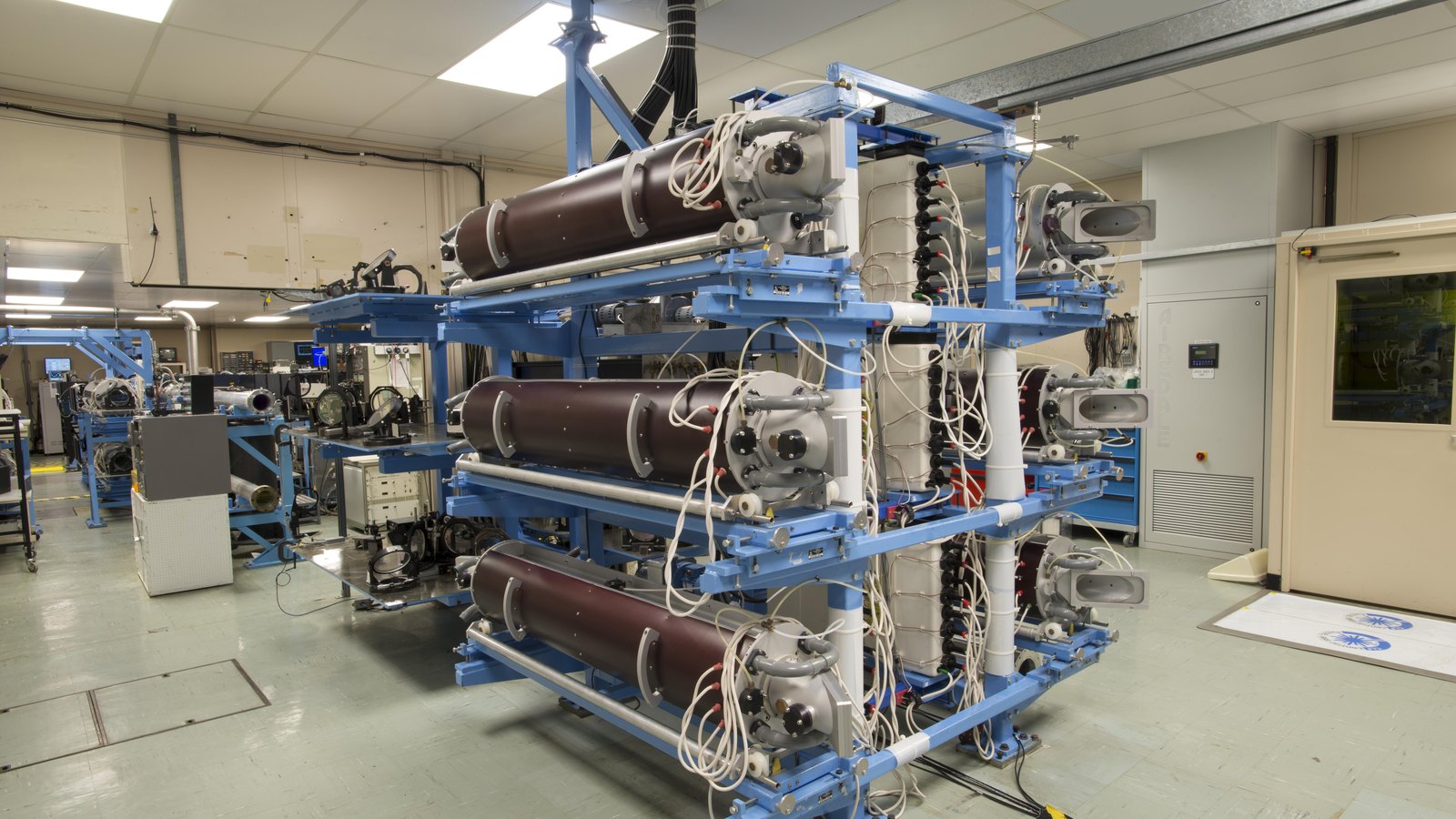
The Science and Technology Facilities Council’s Central Laser Facility (CLF) at the Rutherford Appleton Laboratory has begun working with Oxfordshire company First Light Fusion on the fast ignition physics of First Light’s FLARE approach to inertial fusion, UK Research and Innovation (UKRI) announced on 18 November 2026. The work covers the laser-heating step of fusion, and the CLF’s modelling is expected to inform laser requirements over the next year.
What happened
UKRI’s news item, dated 18 November 2026 and filed under STFC, says the CLF has begun working with First Light Fusion to develop the fast ignition physics behind FLARE. Trade outlets reported First Light’s own announcement of the effort on 12 November 2026, including the American Nuclear Society’s Nuclear News and Interesting Engineering.
Fast ignition splits inertial fusion into two steps. In the first, deuterium-tritium fuel is compressed. In the second, a short, intense laser pulse rapidly heats the compressed fuel so that fusion burn starts. According to UKRI, First Light has already validated the compression step by testing FLARE’s multi-shell compression architecture on its M3 facility. The CLF will work on the heating step, drawing on its experience with short-pulse lasers.
Dr Jonathan Skidmore, chief scientist at First Light Fusion, said in the UKRI item: “The next phase is to heat that dense fuel rapidly.” He added: “Bringing these two phases together gives us a clear route towards integrated FLARE experiments.” Professor John Collier, director of the STFC Central Laser Facility, said: “This collaboration applies CLF’s fast ignition modelling and experimental expertise to a clearly defined system challenge.”
Key details of the collaboration
The UKRI item sets out the technical scope in specific terms:
- CLF scientists will model how a short, intense laser pulse generates energetic electrons, how those electrons travel through plasma, and how efficiently they deposit their energy in dense fusion fuel.
- The work will explore engineered target structures and magnetic fields intended to guide the electrons into the ignition region.
- The aim is to reduce the laser energy needed for ignition, building on savings already offered by FLARE’s target concept.
- FLARE’s cylindrical geometry gives direct access to a large area of compressed fuel, which UKRI says widens the design options compared with standard laser fast ignition.
- Over the next year, the CLF’s modelling will help define the laser requirements for ignition and, later, for a potential high-gain demonstrator.
Nuclear News reports that First Light compresses fuel using magnetic pressure and then ignites it with a high-intensity laser pulse, and that the CLF work targets the second step. It adds that, for a fusion power facility, the target would be surrounded by lithium to aid heat conversion, and that First Light intends the method to be high-gain and low-repetition-rate, with a self-sustaining fuel cycle. Interesting Engineering describes the compression stage as a pulsed-power system and says the programme will also assess engineering requirements, costs and scalability for commercial use.
UKRI explains the economic logic: high fusion gain lowers the repetition rate a power plant would need, which eases the demands on the driver, the chamber and fuel delivery, and which the item presents as a lower-cost route to commercial fusion power.
Background: where the CLF and First Light stand
First Light Fusion is described by UKRI as having 15 years of work in inertial fusion energy. Earlier, in February 2023, The Chemical Engineer reported that the UK Atomic Energy Authority had signed an agreement with First Light for a purpose-built facility at Culham, Oxfordshire, to house its Machine 4, with construction then planned for 2024 and operations likely from 2027. That report described a projectile-driven approach rather than a laser-driven one. The current announcement concerns FLARE, in which a laser plays the heating role.
The CLF is part of STFC and is based at the Rutherford Appleton Laboratory. The CLF’s own modernisation page lists three programmes that are reshaping its capability. HiLUX upgrades the Ultra and Artemis systems and has already had its first users; Ultra will be fully sunset when HiLUX is fully commissioned in 2028. EPAC, the Extreme Photonics Applications Centre, is the successor to Gemini for laser-plasma accelerators, with operations expected to start in 2027 on a new site near the existing CLF. Vulcan 20-20, the successor to the original Vulcan (1977) and Vulcan PW (2002) for high energy density science, broke ground in 2025 and is being built by expanding the R1 building.
The same page names the funders: the UKRI Infrastructure Fund for HiLUX; the UKRI Strategic Priorities Fund, STFC and the Ministry of Defence for EPAC; and the UKRI Infrastructure Fund, STFC and AWE Nuclear Security Technologies for Vulcan 20-20.
Reaction
The statements from both partners are the on-record reaction. Collier frames the work as applying the CLF’s fast ignition modelling and experimental expertise to a defined system challenge. Skidmore, quoted by Nuclear News, says: “The CLF has world-leading expertise in laser and plasma physics to accelerate this step.”
What it means for researchers, universities and research offices
This is an editorial reading of the sourced facts, not a claim made by the partners.
- Researchers in laser-plasma and fusion physics. A national facility is putting its short-pulse laser and plasma expertise behind a privately developed fusion concept. The topics named in the announcement, such as energetic-electron generation and transport and energy deposition in dense fuel, are questions that academic groups also work on, so the modelling results may shape what experiments are proposed next.
- Facility users. The CLF page says EPAC and Vulcan 20-20 have capacity built in for academic, industrial, and national security and defence use, and that HiLUX’s design allows four end stations to operate independently, giving more capacity for industrial use alongside academic use. It also says around 70% of academic experiments at the CLF are supported by Research Council grants. Industrial collaborations such as this one sit alongside that academic programme.
- Research offices. Universities whose staff collaborate with a national facility and a company on the same topic will usually need clear agreements on intellectual property and publication. The Lambert Toolkit and the guide to collaborative research contract clauses cover those points, and research infrastructure funding explains how facilities of this kind are financed.
- Funding context. The facility behind this work is funded through UKRI, so the partnership is a case of public research infrastructure being used for industry-linked research. See UKRI funding for how the organisation is structured.
For earlier casrai.org coverage of fusion research policy, see the IAEA’s World Fusion Outlook 2026 report.
What happens next
According to UKRI, the CLF’s modelling over the next year will help define the laser requirements for ignition and, later, for a potential high-gain demonstrator. First Light says it plans to seek partners to build fusion energy facilities using FLARE, as reported by Nuclear News, and describes the combination of the compression and heating work as a route to integrated FLARE experiments.
Sources
- UKRI: Central Laser Facility partners with First Light Fusion, 18 November 2026
- STFC Central Laser Facility: Modernisation of the CLF
- American Nuclear Society, Nuclear News: STEP begins major procurements; First Light collaborates with U.K. laser facility, 12 November 2026
- Interesting Engineering: Strong lasers could unlock cheaper ignition for nuclear fusion fuel, November 2026
- The Chemical Engineer: UK partners to advance inertial confinement fusion, 3 February 2023


