
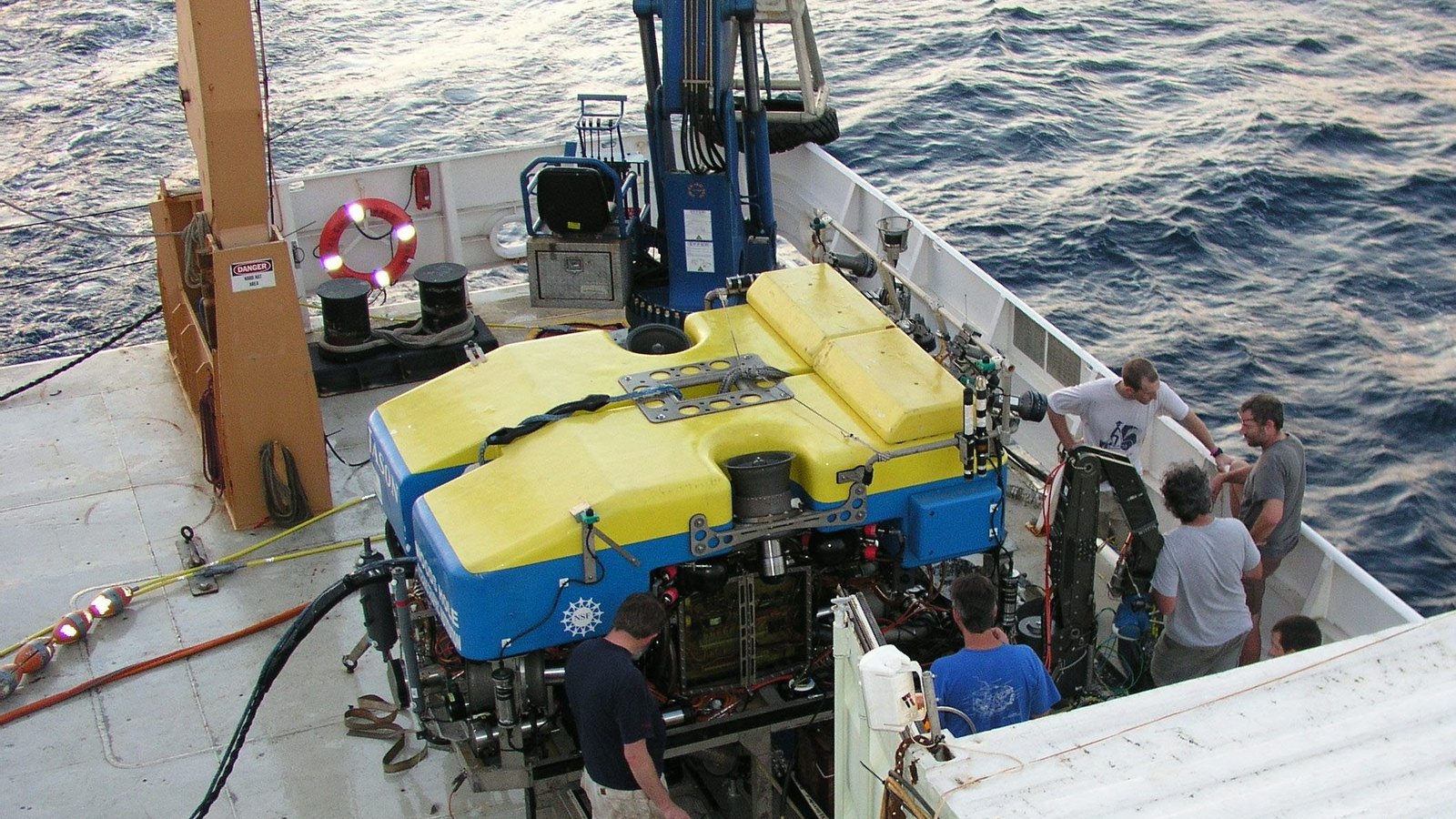
A team led by geologist Robert J. Stern of the University of Texas at Dallas reported on 23 November 2026 that a robotic dive programme in the southern Mariana Trench recovered what the authors describe as the deepest known pyroclastic deposits in the ocean, at about 6,148 metres near the Challenger Deep. The rocks, described in a paper in Frontiers in Earth Science, were collected with an NSF-funded remotely operated vehicle (ROV), and the authors present their explosive origin as a hypothesis rather than a settled result.
What happened
The study, titled “ROVing in the deep: tectonic and magmatic complexities of the Challenger Deep forearc segment, Southern Mariana convergent margin”, appeared on 23 November 2026 in the Solid Earth Geophysics section of volume 14 of Frontiers in Earth Science (DOI 10.3389/feart.2026.1929806). Frontiers’ press release on EurekAlert names Stern as lead author and the U.S. National Science Foundation as the funder.
The team sailed to the Mariana Trench in late 2024 and used the ROV Jason, working with its support vehicle Medea. According to the release, seven dives covered about 300 km of a 550 km forearc segment near the Challenger Deep. The paper reports that the vehicle reached its operating limit of 6,500 m below sea level, and that 155 rock samples came from seven dives on the Challenger Deep forearc segment.
In the western part of that segment the team found thin, flat layers of pyroclastic rock on the seabed, with one sample site at 6,148 m. “These are the deepest pyroclastic rocks documented to date from anywhere in the ocean,” Stern said in the release. “Explosive volcanism near trenches is unusual, so we were very surprised.”
Key details
| Item | As reported |
|---|---|
| Journal and date | Frontiers in Earth Science, 23 November 2026 |
| Lead author | Robert J. Stern, University of Texas at Dallas |
| Funding | U.S. National Science Foundation |
| Vehicle and ship | ROV Jason/Medea, launched from the R/V Thomas G. Thompson on cruise TN438 |
| Dives | Ten in total: seven on the forearc segment, three farther north |
| Deepest pyroclastic site | About 6,148 m |
| Depth limit of the vehicle | 6,500 m, against almost 11,000 m at the Challenger Deep |
The paper describes the rocks as welded tuffs, a texture-based interpretation that they formed in explosive seafloor eruptions. The authors use hedged wording throughout (“We hypothesize”, “We suspect”), and they say special conditions may be required because explosive volcanism at these pressures has not been reported before. They have not found the vents or volcanoes that produced the deposits, and their reading of the flows, including the lobate margins and regular cooling fractures, is an interpretation. Final rock compositions are still under study; the authors say petrology shows andesitic and more felsic rocks, not the basalt first logged on deck.
The authors propose that supercritical fluids drove the eruptions, which they suggest were less explosive than shallow-water equivalents. The release explains why: high pressure limits how far magma gases can expand, so eruptions cannot be as powerful as those on land.
The segment also divides in two. The eastern part is dominated by older mantle peridotites that the authors attribute to mechanical stretching, while the western part is dominated by younger volcanic rocks that they attribute to magma added during extension. The release says more sampling and radiometric dating are needed to test that picture. The authors describe the forearc as tectonically unstable and magmatically active.
Background and context
The Mariana Trench formed about 52 million years ago, when the Pacific plate began to slide beneath the Philippine Sea plate, according to the release. The Challenger Deep, its deepest point, lies almost 11,000 m down. The authors link the trench’s depth to weak coupling between the plates and a narrow, short sinking plate that bends sharply and so dips steeply.
The cruise itself was described earlier. A Scripps Institution of Oceanography account published on 5 February 2025 describes a three-week, NSF-funded cruise on the University of Washington’s R/V Thomas G. Thompson that ran an east-to-west transect over the Challenger Deep. It notes that Jason, tethered by a 10 km fibre-optic cable and rated to 6,500 m, had not dived this deep since 2003. Strong trade winds delayed operations and cancelled some planned dives, though the team sampled both ends of the transect.
Reaction
Outside geologists have commented on the finding and on the mechanism. Writing in Physics World on 23 November 2026, James Dacey quotes Stern: “We’re at the limits of our intuition as geologists.” The article says the supercritical-fluid mechanism is described as likely, not confirmed, and that Stern says the team does not yet know what supercritical explosive volcanism would look like.
David Pyle of the University of Oxford, who was not involved, offered alternatives for the fracturing seen in some samples: thermal shock when hot melt meets cold seawater or wet sediment, or internal stresses from bubbles forming in magma. He said that “we can discover features that challenge our assumptions about how the Earth works.” Reeve of the University of Bergen, also not involved, said that delivering hydrogen to such a deep, energy-poor environment “would be like opening a free bar in the desert”, a hypothetical remark about possible deeper, hotter vents, none of which have been found here.
In Science News on 23 November 2026, William Chadwick, a geologist at Oregon State University, called the discovery “surprising and unprecedented” and said the Challenger Deep may be the only place on Earth “with the ingredients to produce explosive volcanism in the super-deep ocean”. Science News adds that the deposits lie about 100 km from the trench, closer than is typical for a subduction zone, and that the authors suggest a sharp bend in the subducting plate may partly explain both the depth and the nearby volcanism. Popular Science, also on 23 November, notes that the authors raise this explanation as a possibility, not a conclusion.
What it means for researchers, universities and research offices
The result is a case study in what a single ship-based, federally funded campaign can return. One cruise, ten dives and 155 samples from the forearc segment produced a record-depth deposit, and the authors’ own account is that the work leaves open where the eruptions came from. For principal investigators, the open questions listed in the paper, the eruption sites, radiometric ages and the magma-versus-stretching picture, define the follow-up sampling and dating that a next proposal would have to justify.
The depth ceiling is the practical constraint for research offices. Jason/Medea cannot dive below 6,500 m, so the 4,500 m or so between its limit and the bottom of the Challenger Deep remains unsampled by this system. Stern said that only Chinese scientists and some wealthy entrepreneurs currently have tools that reach that depth; Physics World names China’s Fendouzhe and the U.S. submersible DSV Limiting Factor as the crewed options. Work that needs samples from the deepest part of the trench therefore depends on different platforms from the one used here, which research offices should factor in when scoping such proposals. Our guides on research infrastructure funding and the NSF Major Research Instrumentation program explain how instrument and facility support is typically structured, and the facilities and other resources section is where ship and vehicle access is documented in a proposal.
The cruise’s weather losses also illustrate schedule risk: the Scripps account reports that wind cancelled some planned dives, a reminder that planned dive and sample counts can fall short of targets. See National Science Foundation (NSF) for the funder’s role, and our note on how appropriations affect award timing for the funding side.
What happens next
The authors say more sampling and radiometric dating are needed to test whether the western forearc is gaining magma while the east stretches mechanically. Physics World reports that a full analysis of the volcanic material is still to be published, and the paper says final compositions are under study. No further dive programme is described in the sources.
Sources
- Stern et al., “ROVing in the deep”, Frontiers in Earth Science, 23 November 2026 (Frontiers, primary source)
- Frontiers press release, EurekAlert, 23 November 2026
- Physics World, 23 November 2026 (IOP Publishing)
- Science News, Carolyn Gramling, 23 November 2026
- Popular Science, Mack DeGeurin, 23 November 2026
- Scripps Institution of Oceanography, 5 February 2025






