
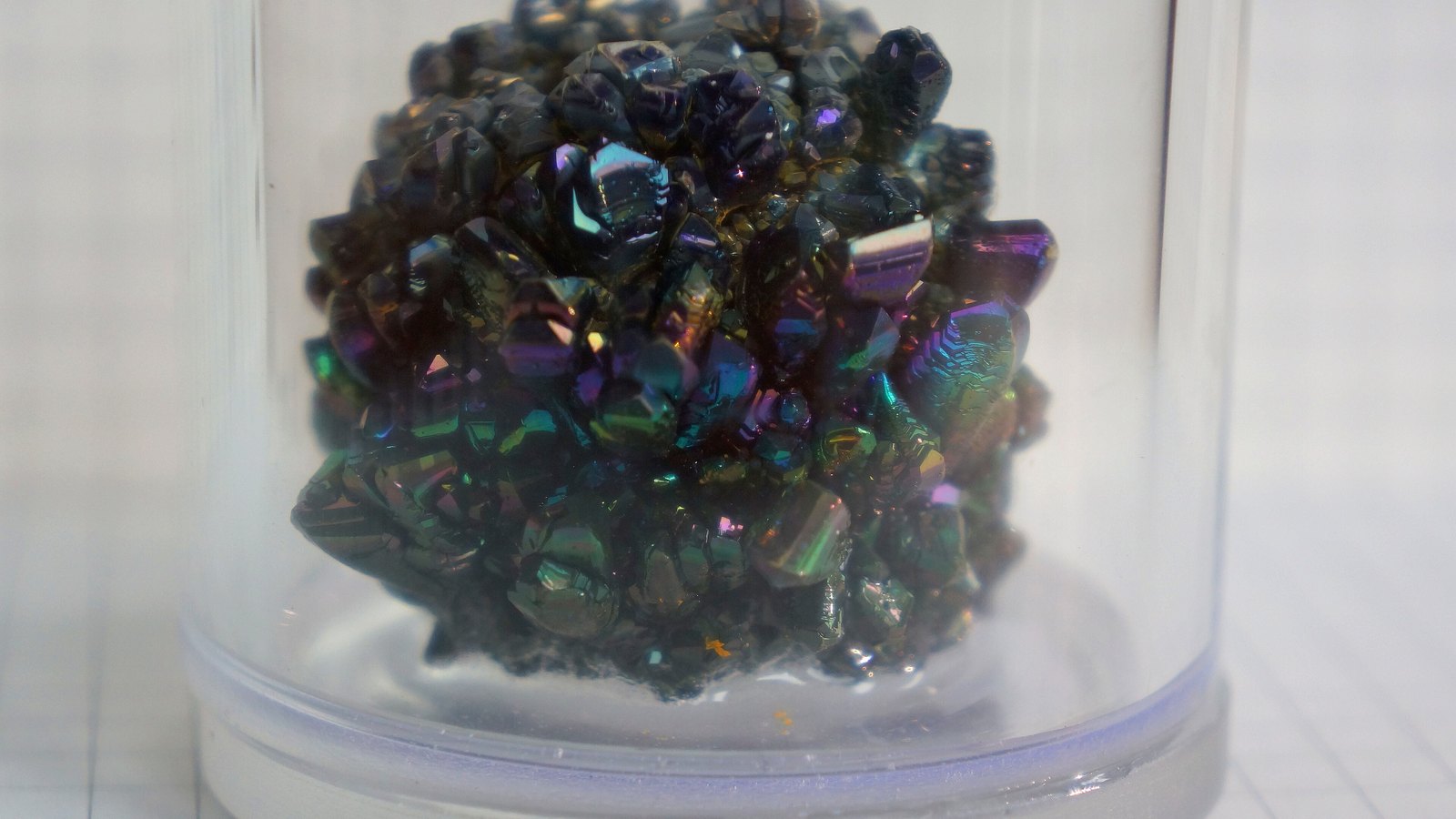
On November 18, 2026, an international research team led by the Max Planck Institute for Chemical Physics of Solids in Dresden reported in Nature the experimental discovery of unconventional p-wave magnetism in metallic europium silicide (EuSi). The breakthrough establishes a stoichiometric metallic platform where momentum-dependent spin polarization occurs without macroscopic magnetization, presenting major implications for university physics laboratories, quantum materials synthesis facilities, and low-power spintronic device engineering.
Experimental Confirmation of P-Wave Magnetism in Europium Silicide
The discovery originated at the Max Planck Institute for Chemical Physics of Solids (MPI CPfS) in Dresden, where Dr. Erjian Cheng synthesized high-purity single crystals of stoichiometric europium silicide. Initial photoemission spectroscopy revealed that magnetic order exerted an unexpectedly large influence on the electronic band structure, displaying energy splittings far exceeding standard magnetic metals. According to an official release from the Max Planck Institute for Chemical Physics of Solids, this unexpected electronic reconstruction prompted an international investigation to verify whether EuSi hosted unconventional p-wave magnetism.
“When we first measured the electronic structure of EuSi, we were surprised by the exceptionally large effect of magnetism on the electrons,” said Dr. Erjian Cheng, lead author and group leader at MPI CPfS. “That observation led us to investigate whether this simple compound could host a much more unusual magnetic state. The combination of crystal growth, neutron scattering and spin-resolved spectroscopy now provides compelling evidence for p-wave magnetism.”
Independent coverage by EurekAlert! and ScienceDaily highlighted that while ferromagnets produce net fields via aligned spins and antiferromagnets cancel fields via opposing sublattices, EuSi arranges spins into an ordered helical spiral. Although the local magnetic moments balance externally to yield zero net magnetization, the underlying magnetic symmetry dictates how electrons propagate. Reporting in Quantum Zeitgeist noted that this marks the first clear observation of an odd-parity p-wave spin texture in a stoichiometric binary metal.
Spectroscopic Measurements, Band Splitting, and Magnetic Symmetry
To establish the magnetic state, the consortium combined multiple scattering and spectroscopic techniques across international user facilities. Single-crystal neutron diffraction confirmed that between approximately 33.4 K and 62 K, divalent europium moments form an incommensurate chiral spiral. In this phase, the vector sum of atomic moments cancels completely, producing zero net macroscopic magnetization while breaking spatial inversion symmetry.
Angle-resolved photoemission spectroscopy (ARPES) showed that this spiral order reconstructs electronic bands near the Fermi level with exchange-driven splittings exceeding 100 millielectronvolts (meV). Spin-resolved photoemission tracked the spin polarization of conduction electrons, confirming that electrons moving in opposite directions possess opposite transverse spin polarization. This polarization reversed sign across successive magnetic Brillouin zones and vanished at predicted nodal lines, providing direct spectroscopic verification of odd-parity p-wave symmetry.
Using magnetic force microscopy and spatially resolved photoemission with circularly polarized synchrotron light, researchers also identified chiral magnetic domains measuring approximately 10 micrometers across. Each domain exhibited a distinct electronic response under circular dichroism, proving that magnetic handedness directly couples to the electronic structure.
The operational and symmetry distinctions across magnetic classes are summarized below:
| Magnetic Order Classification | Net Magnetization | Momentum-Dependent Spin Splitting | Spin Texture Parity | Primary Mechanism |
|---|---|---|---|---|
| Conventional Ferromagnetism (FM) | Yes (net dipole field) | Uniform splitting across Fermi surface | Even parity (s-wave) | Direct ferromagnetic exchange coupling |
| Conventional Antiferromagnetism (AFM) | No (zero stray field) | Spin-degenerate energy bands | Even parity (PT symmetric) | Compensated sublattices with inversion |
| Collinear Altermagnetism | No (zero stray field) | Alternating sign spin splitting | Even parity (d-wave or g-wave) | Crystal rotation symmetry without net moment |
| Chiral P-Wave Helimagnetism (EuSi) | No (zero stray field) | Opposite spin for opposite momentum (-k) | Odd parity (p-wave) | Helimagnetic spiral exchange and broken inversion |
Distinguishing P-Wave Order from Altermagnets and Antiferromagnets
Solid-state physics historically grouped collinear magnets into ferromagnets and antiferromagnets. The recent discovery of altermagnetism introduced a third category where crystal symmetries produce alternating spin-split bands with even parity (such as d-wave symmetry). In contrast, the state observed in europium silicide possesses odd-parity p-wave symmetry, where reversing electron momentum k to -k reverses spin orientation. Unlike Rashba-Dresselhaus relativistic splittings that require heavy elements, the p-wave texture in EuSi is driven primarily by magnetic exchange within the chiral spin helix.
Earlier candidate systems for p-wave magnetism were hindered by experimental obstacles, including complex insulating lattices, heavy chemical disorder, or sub-kelvin transition temperatures requiring dilution refrigeration. Because EuSi is a simple, stoichiometric binary metal ordering above 33 K, it provides a stable, reproducible platform. Transparent documentation of crystal growth parameters and beamline settings in open laboratory protocols is vital to support methods reproducibility across experimental groups.
International Consortium and Multi-Facility Collaboration
Confirming p-wave order in EuSi required a collaboration of 38 researchers across 19 institutions, including MPI CPfS, the Max Planck Institute for the Physics of Complex Systems, ShanghaiTech University, the Hong Kong University of Science and Technology, Oak Ridge National Laboratory, Diamond Light Source, Stanford Synchrotron Radiation Lightsource at SLAC, and Helmholtz-Zentrum Berlin.
“What makes EuSi particularly exciting is that an unconventional electronic spin structure emerges from the magnetic order of a chemically simple metal,” said Prof. Claudia Felser, Director at MPI CPfS. “This demonstrates how the discovery of new materials can reveal entirely new electronic phenomena. EuSi now gives us an experimental platform to investigate how magnetic symmetry and chirality can be used to control electronic properties, with potential implications for future spintronics and unconventional superconductivity.”
Consortium members combined neutron scattering at Oak Ridge with high-resolution spin-ARPES across European and US synchrotrons. Independent verification of band splittings across multiple beamline endstations confirmed robust results reproducibility, ruling out surface contamination or sample preparation artifacts.
Methodological and Institutional Implications for Physics Laboratories
Europium silicide synthesis demands specialized solid-state chemistry controls. Metallic europium oxidizes rapidly in ambient air, requiring inert gloveboxes operating under 0.1 ppm oxygen and moisture, high-purity quartz sealing, and precise flux growth. Because high-quality single crystals are currently produced in limited facilities, academic departments must execute standardized material transfer agreements to govern sample custody, beamline access, and intellectual property rights during inter-university collaborations.
Furthermore, because the project received funding from public bodies including the Max Planck Society and the German Research Foundation (DFG), research offices must manage open-access compliance. Aligning multi-institutional author agreements with funder mandates often requires institutional budgeting for the Nature open access fee, ensuring that raw diffraction and spectroscopic datasets are accessible worldwide.
Roadmap for Spintronic Devices and Quantum Technologies
With bulk p-wave magnetism validated, researchers are pursuing device integration. Theory predicts that metallic p-wave systems can sustain spin-polarized transport without external magnetic fields or ferromagnetic contacts. Because the material generates no stray magnetic fields, spintronic memory arrays based on EuSi could achieve significantly higher packing densities than conventional magnetoresistive RAM without cross-talk interference.
Immediate milestones involve patterning EuSi crystals into nanoscale Hall bars using focused ion beam lithography to measure current-induced spin switching across 10-micrometer chiral domains. Thin-film deposition teams are also testing molecular beam epitaxy of EuSi on silicon wafers to establish compatibility with semiconductor manufacturing lines. In quantum physics, interfacing odd-parity p-wave magnets with conventional superconductors offers a promising experimental route toward topological superconductivity and Majorana zero modes.
Sources
- Nature: Evidence for p-wave magnetism in electronic band structure of metallic EuSi, checked 2026-11-26
- Max Planck Institute for Chemical Physics of Solids: A New Kind of Magnetism in a Simple Metal, checked 2026-11-26
- EurekAlert!: A new kind of magnetism revealed in a simple metal, checked 2026-11-26
- ScienceDaily: A simple metal is hiding a strange new form of magnetism, checked 2026-11-26
- Quantum Zeitgeist: MPI CPfS Finds Quantum Magnetism Shapes Electron Movement Without A Field, checked 2026-11-26






