
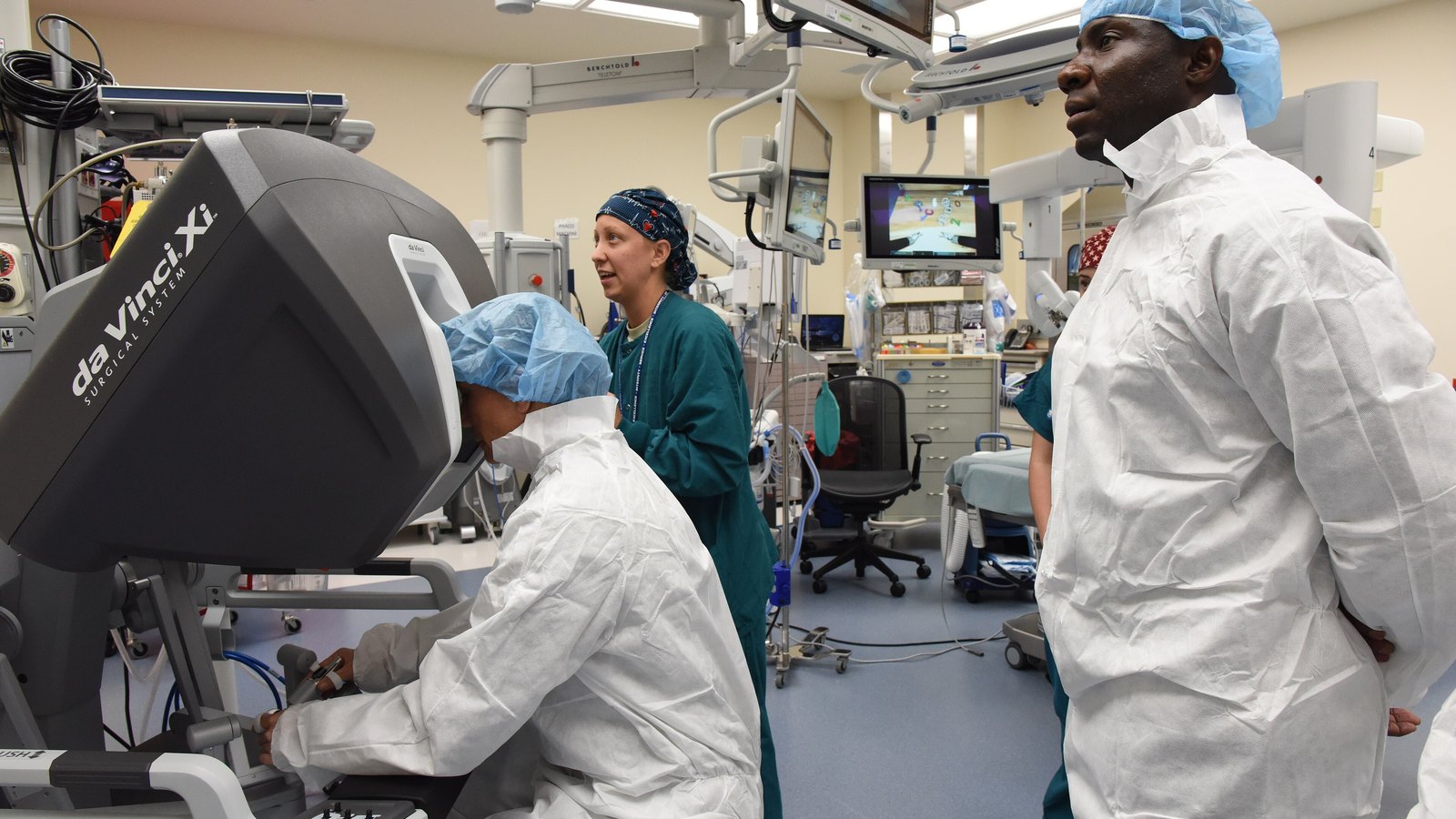
Memorial Hermann-Texas Medical Center in Houston installed the first commercial OTTAVA robotic surgical system in the United States on November 19, 2026, marking a pivotal transition from investigational trial to clinical practice that creates new multi-site trial opportunities and evaluation benchmarks for academic medical centers studying table-integrated surgical robotics.
This page describes products and general use; it is not medical advice.
First Commercial Installation of the Table-Integrated Robotic System
Johnson & Johnson MedTech announced on November 19, 2026, that Memorial Hermann-Texas Medical Center in Houston, Texas, became the inaugural hospital in the United States to install the OTTAVA robotic surgical system under the manufacturer’s early access commercial program. The commercial placement represents the culmination of translational engineering and clinical evaluation conducted in partnership with McGovern Medical School at UTHealth Houston. The installation establishes Memorial Hermann as the premier reference site for surgeon credentialing, operative workflow observation, and post-market surveillance on the first table-integrated soft-tissue robotic platform authorized in the United States.
The installation follows clearance under the FDA De Novo classification pathway for novel medical devices granted in July 2026. Prior to commercial availability, Memorial Hermann served as the primary clinical site evaluating the platform under an Investigational Device Exemption (IDE) protocol. Dr. Erik Wilson, Chief of Minimally Invasive and Elective General Surgery at UTHealth Houston and Medical Director of Bariatric Surgery at Memorial Hermann-TMC, performed the first clinical study procedures using the platform in early 2025. The transition from controlled clinical trials to routine operating room deployment provides surgical science departments with empirical operating room performance data outside protocol-restricted trial conditions.
Architecture, Engineering Specifications, and Authorized Upper-Abdominal Procedures
The OTTAVA system introduces a structural departure from traditional multi-quadrant robotic consoles by embedding its mechanical infrastructure directly into a standard-sized operating table. Unlike cart-based systems that require dedicated floor space and complex docking maneuvers alongside the patient, the platform integrates four robotic arms directly into the table architecture. When not in active use, all four arms stow completely beneath the surgical table surface. This zero-footprint storage configuration enables conventional open or laparoscopic surgery without removing equipment from the room, while facilitating unobstructed access for anesthesiology teams, circulating nurses, and surgical assistants.
The regulatory authorization granted by the U.S. Food and Drug Administration (FDA De Novo request DEN250068, classified under 21 CFR 878.4966 with product code SIR) authorizes the system for 10 distinct upper-abdominal general surgery procedures. These include Roux-en-Y gastric bypass, sleeve gastrectomy, cholecystectomy, gastrectomy, splenectomy, small bowel resection, appendectomy, lysis of adhesions, fundoplication, and hiatal hernia repair. The platform also interfaces with Johnson & Johnson’s Polyphonic open digital surgical ecosystem, enabling automated video capture, synchronized telemetry recording, and standardized surgical data curation for operative performance analytics.
Comparative Specifications of Clinical Robotic Surgical Platforms
The table below summarizes key structural, regulatory, and mechanical attributes of leading general surgery robotic platforms evaluated in academic medical centers as of late 2026:
| Platform Feature | Johnson & Johnson OTTAVA | Medtronic Hugo RAS | Intuitive da Vinci 5 |
|---|---|---|---|
| System Architecture | Table-integrated (robot-in-table) with stowable arms | Modular multi-cart configuration with independent arm carts | Single central patient cart with boom-mounted arms |
| Robotic Arm Count | 4 arms integrated into surgical table chassis | Up to 4 independent rolling arm carts | 4 boom-mounted articulated arms |
| FDA Pathway | De Novo Grant (DEN250068, 21 CFR 878.4966) | 510(k) Premarket Notification clearance | 510(k) Premarket Notification clearance |
| Initial OR Footprint | Zero additional cart footprint; integrated with OR table | Requires dedicated floor perimeter for up to four separate carts | Requires dedicated floor area for wheeled patient cart |
| Primary Trial Benchmark | FORTE Study (NCT06709261; 30-patient RYGB evaluation) | EXPAND Trial (multicenter urologic and gynecologic cohort) | Premarket clinical equivalence and usability registries |
| Authorized Scope | 10 upper-abdominal general surgical procedures | General surgery, urologic, and gynecologic indications | Broad multi-specialty thoracic, abdominal, and pelvic scope |
Translational Evidence: The FORTE IDE Clinical Study
Regulatory clearance and subsequent clinical adoption rest on data from the FORTE study (Safety and Performance of the OTTAVA Robotic System, registered as NCT06709261 on ClinicalTrials.gov), an Investigational Device Exemption clinical investigation sponsored by Auris Health. The prospective, multicenter, single-arm trial enrolled 30 adult patients undergoing primary Roux-en-Y gastric bypass to assess intraoperative device performance, technical docking parameters, adverse events, and 30-day post-procedure clinical outcomes.
Results presented at the 2026 American Society for Metabolic and Bariatric Surgery (ASMBS) Annual Meeting demonstrated that the trial met all primary safety and effectiveness endpoints. Investigators documented zero intraoperative conversions to conventional laparoscopy or open surgery, zero device-related serious adverse events, and consistent arm repositioning without physical collisions. The trial satisfied FDA criteria for establishing special controls, establishing empirical baselines for medical device clinical trial design and execution across academic surgical consortia.
Regulatory Precedent: De Novo Pathway and Class II Classification
The FDA’s regulatory disposition of the OTTAVA system establishes a notable precedent for clinical device researchers. Because no legally marketed predicate device combined an electromechanical surgical console directly with an articulated operating table, the system was ineligible for standard 510(k) notification. The sponsor utilized the De Novo classification pathway to establish a new generic device category under 21 CFR 878.4966, formally designated as an “integrated operating table-electromechanical surgical system.”
Examining the differences between 510(k) clearance and De Novo marketing authorization is vital for regulatory affairs officers and principal investigators at university hospitals. By defining special controls covering electrical safety, electromagnetic compatibility, software verification, mechanical table-load integrity, and sterile instrument reprocessing, the De Novo order creates a predicate device class. Future innovators developing table-integrated robotics can now seek 510(k) clearance by demonstrating substantial equivalence to the regulatory baseline established by DEN250068.
This development builds on recent regulatory activity in robotic surgery, following federal decisions where the FDA cleared the Medtronic Hugo system for US general surgery procedures. Together, these authorizations expand technological options for surgical suites that previously relied on single-vendor robotic architectures.
Institutional and Clinical Leadership Perspectives
Clinical leadership at Memorial Hermann and UTHealth Houston underscored that space optimization and workflow flexibility represent critical priorities in modern surgical suites. “Operating rooms in academic medical centers face substantial spatial demands due to monitoring systems, imaging equipment, and support carts,” noted Dr. Erik Wilson in an institutional clinical summary. “Integrating robotic arms directly into the table chassis reduces physical crowding, allows surgical teams to move freely around the patient, and supports rapid transitions between robotic and laparoscopic modalities.”
Johnson & Johnson MedTech leadership highlighted that the early access program is structured to evaluate operational reliability under high-volume clinical conditions. Company representatives indicated that initial commercial deployments at major research hospitals will yield critical feedback on surgical team training, perioperative turnover times, and digital telemetry curation to guide future manufacturing scale-up and software updates.
Implications for Academic Medical Centers and Surgical Innovation
The deployment of table-integrated robotics at Memorial Hermann offers practical operational and research implications for university hospitals, clinical research offices, and institutional review boards (IRBs):
- Operating Room Capital and Facility Planning: Academic health systems frequently undertake costly renovations to enlarge operating rooms for large robotic carts. Table-integrated platforms permit hospitals to modernize standard-sized suites without structural alterations or dedicated storage alcoves.
- Comparative Clinical Trial Protocols: With 10 authorized upper-abdominal procedures, surgical departments can design comparative effectiveness studies evaluating operative times, console ergonomics, docking latency, and patient recovery against conventional robotic and laparoscopic methods.
- Perioperative Data Science and AI Integration: The platform’s digital interfaces allow biomedical researchers to capture kinematic data, instrument pressure metrics, and synchronized video to train machine learning models for surgical workflow analysis and technique assessment.
- Surgical Residency and Fellowship Training: Surgical education leaders must broaden training curricula to prepare residents across multi-vendor robotic platforms, adapting credentialing standards for varied mechanical architectures.
Commercial Rollout and Multisite Clinical Registry Timelines
Following the Memorial Hermann installation, Johnson & Johnson MedTech plans a phased commercial rollout to select academic medical centers across the United States through late 2026 and 2027. Early access institutions will participate in a national post-market clinical registry tracking longitudinal patient outcomes, instrument longevity, and health economics data across general surgery services. The sponsor is also conducting ongoing clinical investigations to support future regulatory filings for expanded procedural indications, including colorectal and gynecologic procedures.
Sources
- Johnson & Johnson: Johnson & Johnson Announces First Commercial Installation of the OTTAVA Robotic Surgical System at Memorial Hermann Health System, checked 2026-11-20
- U.S. Food and Drug Administration: Device Classification Under Section 513(f)(2)(De Novo) — DEN250068, checked 2026-11-20
- ClinicalTrials.gov: Safety and Performance of the OTTAVA Robotic System (FORTE Study) — NCT06709261, checked 2026-11-20
- Surgical Robotics Technology: J&J Announces First Commercial Installation of OTTAVA Surgical Robot, checked 2026-11-20
- MassDevice: Johnson & Johnson installs first Ottava robotic surgical system in Texas, checked 2026-11-20


