
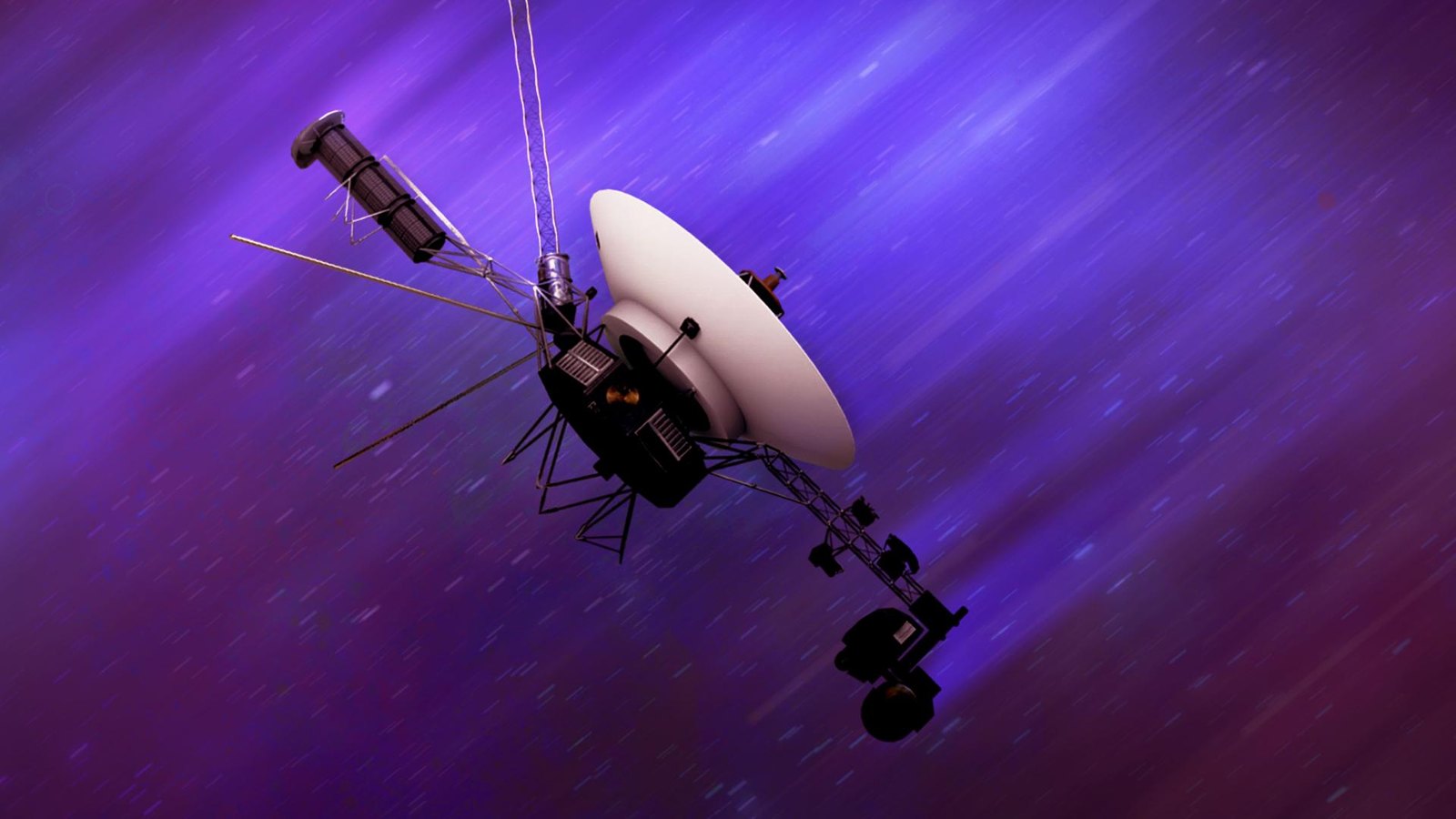
NASA announced that its Voyager 1 spacecraft has crossed the historic threshold of one light-day from Earth, according to an official NASA news release, requiring exactly 24 hours for radio signals to bridge the 16.1-billion-mile gulf and providing heliophysics researchers and university astrophysics consortia with direct in situ measurements of the local interstellar medium.
Voyager 1 Crosses Historic One Light-Day Threshold
On November 18, 2026, at 2:16 a.m. PST (10:16 UTC), NASA’s Voyager 1 spacecraft reached a distance of exactly one light-day from Earth. After traveling across interplanetary and interstellar space for more than 49 years following its September 1977 launch, the probe reached a physical displacement of approximately 16.1 billion miles (25.9 billion kilometers), or roughly 173.14 Astronomical Units (AU). At this distance, radio signals propagating at light speed require exactly 24 hours to travel one way between ground tracking stations and the probe.
Flight controllers at NASA’s Jet Propulsion Laboratory (JPL) in Pasadena, California, managed by Caltech, confirmed the passage using radio carrier tracking via the Deep Space Network. Because light travel time equals Earth’s 24-hour day, commands sent to the spacecraft require 48 hours for round-trip verification. The milestone cements Voyager 1’s status as the most distant human-made artifact, navigating the interstellar plasma beyond the heliopause.
“Traveling a light-day is a singular feat for a spacecraft, but Voyager is so much more than a distant traveler,” said Joe Westlake, Director of the Heliophysics Division at NASA Headquarters. “The Voyager mission would be remarkable just for what it contributed to planetary science with the Grand Tour of the outer planets. But it went on to become central to NASA’s fleet of heliophysics missions offering insights into the star that we all revolve around, the Sun.”
Telemetry Metrics, Physical Distances, and Deep Space Network Operations
Tracking Voyager 1 at one light-day requires continuous monitoring across NASA’s Deep Space Network (DSN), which uses 70-meter (230-foot) parabolic antennas located at Goldstone in California, near Madrid in Spain, and at Tidbinbilla near Canberra, Australia. The planetary distribution of these complexes ensures line-of-sight tracking toward the constellation Ophiuchus as the spacecraft drifts outward at 38,000 miles per hour (61,000 kilometers per hour).
In mid-November 2026, engineers encountered a communication anomaly when telemetry frame synchronization paused on November 14, while a strong 2.3 GHz S-band carrier signal persisted. As reported on site by Space.com, mission operators confirmed the milestone through Doppler tracking and trajectory modeling while analyzing the telemetry modulation framing.
| Spacecraft / Metric | Voyager 1 | Voyager 2 | New Horizons |
|---|---|---|---|
| Launch Date | September 5, 1977 | August 20, 1977 | January 19, 2006 |
| Distance from Earth (AU) | ~173.14 AU | ~144.20 AU | ~61.50 AU |
| Distance (Billion km / mi) | 25.9B km (16.1B mi) | 21.6B km (13.4B mi) | 9.2B km (5.7B mi) |
| One-Way Light Time | 24 hours 00 minutes | ~19 hours 58 minutes | ~8 hours 31 minutes |
| Round-Trip Delay | 48 hours 00 minutes | ~39 hours 56 minutes | ~17 hours 02 minutes |
| Operating Region | Interstellar Space | Interstellar Space | Outer Heliosphere |
| Active Science Payloads | CRS, MAG, PWS, LECP | CRS, MAG, PWS, LECP, PLS | SWAP, PEPSSI, LORRI, SDC |
As noted by EarthSky, sunlight passing Earth requires 1.3 seconds to reach the Moon, 4.1 hours to reach Neptune, and another 20 hours to reach Voyager 1.
Five Decades Across the Solar System: From Planetary Flybys to Interstellar Space
Voyager 1 and Voyager 2 were designed in the late 1960s to exploit a rare alignment of the outer planets occurring once every 175 years. This alignment allowed gravitational slingshots from Jupiter to Saturn, Uranus, and Neptune. Launched two weeks after Voyager 2 on a faster trajectory, Voyager 1 conducted flybys of Jupiter in 1979 and Saturn in 1980. Its close encounter with Titan revealed a dense atmosphere, deflecting its course out of the ecliptic plane into deep space.
NASA subsequently designated the extended journey the Voyager Interstellar Mission. On August 25, 2012, at 121.6 AU, Voyager 1 crossed the heliopause into interstellar space, followed by Voyager 2 in 2018. Trajectory archives maintained by Spaceflight Now record that Voyager 1 reached the one light-day mark after 49 years, 2 months, and 13 days of flight.
Mission Leadership and Scientific Community Perspectives
The achievement was commemorated by mission teams, academic researchers, and institutional leaders. At JPL in Pasadena, engineers and scientists gathered to mark the milestone across five decades of operations.
“Voyager 1 crossing the light-day threshold is yet another historic feat on an extraordinary voyage of discovery,” stated Dave Gallagher, Director of NASA’s Jet Propulsion Laboratory. “Above all, this milestone stands as a testament to the exceptional teams who built, programmed, and fly these spacecraft today, and who have overcome countless challenges to keep them connected to Earth across the vastness of space.”
Caltech President Ray Jayawardhana noted that the mission reflects the lifelong legacy of former JPL director Ed Stone and generations of university physicists. Voyager Project Manager Suzanne Dodd affirmed that the flight team communicates with both probes daily and continues systematic troubleshooting of the telemetry stream. Educational commentary from The Planetary Society highlighted Voyager’s role as an enduring cultural and scientific emissary carrying the Golden Record beyond the solar system.
Significance for Academic Heliophysicists, Research Facilities, and Data Archiving
For academic researchers and university space physics laboratories, Voyager 1 provides irreplaceable in situ data on interstellar plasma density, cosmic rays, and galactic magnetic fields. Without the Voyagers, astrophysical models would depend solely on remote spectroscopy.
The spacecraft’s distance and longevity present distinct research administration and data management priorities:
- Direct Interstellar Calibration: In situ observations from the Cosmic Ray Subsystem allow university physicists to calibrate terrestrial cosmic ray detectors against unmodulated galactic cosmic ray spectra.
- Long-Baseline Data Stewardship: Researchers accessing Voyager data rely on the NASA Space Physics Data Facility and the Planetary Data System. Managing 50-year telemetry streams requires institutions to support a sustained data repository capable of maintaining legacy observational formats.
- Public Access and Open Science: NASA disseminates calibrated Voyager telemetry under federal open data mandates, enabling academic consortia to study plasma boundary dynamics without proprietary restrictions.
- Research Integrity and Replicability: Decoding low-power interstellar signals demands careful distinctions between reproducibility vs replicability, ensuring independent algorithms verify magnetic and plasma field measurements.
- Persistent Provenance: Academic libraries index deep-space telemetry records with persistent identifiers to track instrument calibrations across decadal reanalysis projects.
Future Trajectory, Power Margins, and Extended Mission Milestones
Voyager 1 continues its journey outward at an inclination of 35 degrees north of the ecliptic plane. Onboard electrical power is supplied by three Plutonium-238 radioisotope thermoelectric generators (RTGs), which decay by roughly four watts per year. Engineers have managed declining power by sequentially shutting down heaters and non-essential systems to sustain fields and particles instruments.
NASA engineers project that Voyager 1 has sufficient power to operate at least one science instrument through the late 2020s, with carrier signal tracking potentially persisting past 2030. Voyager 2 is projected to reach its own one light-day distance milestone around 2035. In roughly 40,000 years, Voyager 1 will drift within 1.6 light-years of the red dwarf star Gliese 445 in the constellation Camelopardalis, silently carrying Earth’s message through the Milky Way.
Sources
- NASA: NASA’s Voyager 1 Makes History Reaching One Light-Day From Earth, checked 2026-11-21
- Space.com: Voyager 1 team, unbowed by communications glitch, celebrates epic 1-light-day distance milestone, checked 2026-11-21
- EarthSky: Voyager 1 reaches 1 light-day from Earth!, checked 2026-11-21
- Spaceflight Now: NASA’s Voyager 1 is one light-day from Earth, checked 2026-11-21
- The Planetary Society: Voyager 1 reaches one light-day from Earth, checked 2026-11-21


